
Gakken Inc.
Our company philosophy is to provide everyone the sensation, satisfaction and peace of mind for the day along with the dreams and hope for tomorrow.
View Rights Portal
Our company philosophy is to provide everyone the sensation, satisfaction and peace of mind for the day along with the dreams and hope for tomorrow.
View Rights Portal
An imprint of Schwartz Books, Black Inc. is a leading independent Australian book publisher of fiction, non-fiction and poetry. We are passionate about diversity, inclusivity, social justice, new ideas and writing which informs, entertains and inspires. We are fiercely independent, but also strongly commercial. We publish local and international commercial mass-market titles under our Nero imprint, and children’s books under Piccolo Nero. Our La Trobe University Press imprint brings leading scholars and exports to deliver books of high intellectual quality, substance and originality. Schwartz Books also publishes the issue-defining journals Quarterly Essay and Australian Foreign Affairs.
View Rights Portal Trusted Partner
Trusted Partner
Trusted Partner
Trusted Partner
Trusted Partner


Iraqi women in Denmark is an ethnographic study of ritual performance and place-making among Shi'a Muslim Iraqi women in Copenhagen. The book explores how Iraqi women construct a sense of belonging to Danish society through ritual performances, and investigates how this process is interrelated with their experiences of inclusion and exclusion in Denmark. The findings refute the all too simplistic assumptions of general debates on Islam and immigration in Europe that tend to frame religious practice as an obstacle to integration in the host society. In sharp contrast to the fact that the Iraqi women's religious activities in many ways contribute to categorising them as outsiders to Danish society, their participation in religious events also localises them in the city. Written in an accessible, narrative style, this book addresses both an academic audience and the general reader interested in Islam in Europe and immigration to Scandinavia. ;
Trusted Partner
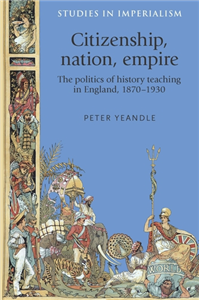
Citizenship, nation, empire investigates the extent to which popular imperialism influenced the teaching of history between 1870 and 1930. It is the first book-length study to trace the substantial impact of educational psychology on the teaching of history, probing its impact on textbooks, literacy primers and teacher-training manuals. Educationists identified 'enlightened patriotism' to be the core objective of historical education. This was neither tub-thumping jingoism, nor state-prescribed national-identity teaching, but rather a carefully crafted curriculum for all children which fused civic as well as imperial ambitions. The book will be of interest to those studying or researching aspects of English domestic imperial culture, especially those concerned with questions of childhood and schooling, citizenship, educational publishing and anglo-British relations. Given that vitriolic debates about the politics of history teaching have endured into the twenty-first century, Citizenship, nation, empire is a timely study of the formative influences that shaped the history curriculum in English schools
Trusted Partner

Why are constitutionalist ideals so prominent in science fiction? Does Independence Day depict self-defence as a legal concept with absolute limits? Is international law lost in space? This innovative interdisciplinary volume represents the first exploration of the relationship between international law and cinema. From Star Wars to Werner Herzog, The Godfather to The West Wing, this book uncovers a diverse range of representations of international law and its norms in film and television. Examining the wider links between international law, cinema, and ideology, the contributions not only examine visual representations of international law, but they offer an essential insight into the functions fulfilled by these cinematic representations. Providing an extraordinary introduction to a variety of perspectives on core international legal questions, Cinematic perspectives on international law extends a valuable methodology by which international lawyers can critique the depiction of international law in film.
Trusted Partner
 Trusted Partner
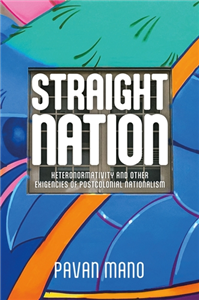
In Straight Nation, Pavan Mano reveals the logic of straightness that sits at the heart of postcolonial nationalism in Singapore. Mano rejects the romantic notion of the nation as a haven of belonging, showing it to be a relentless force that is allied with heteronormativity to create a host of minoritized and xenologized figures. Through meticulous exploration and close reading of a swathe of texts, Mano unveils the instrumental role of sexuality in structuring the national imaginary. The book adroitly demonstrates how queerness is rendered foreign in postcolonial Singapore and functions alongside technologies of "race", gender, and class. A provocative critique of narrow contemporary identity politics and its concomitant stymying of a more ambitious political critique, Straight Nation sets out an argument that moves beyond the negativity of traditional critique into a space of (re)thinking, (re)building and (re)imagining.
Trusted Partner

Child, nation, race and empire is an innovative, inter-disciplinary, cross cultural study that contributes to understandings of both contemporary child welfare practices and the complex dynamics of empire. It analyses the construction and transmission of nineteenth-century British child rescue ideology. Locating the origins of contemporary practice in the publications of the prominent English Child rescuers, Dr Barnardo, Thomas Bowman Stephenson, Benjamin Waugh, Edward de Montjoie Rudolf and their colonial disciples and literature written for children, it shows how the vulnerable body of the child at risk came to be reconstituted as central to the survival of nation, race and empire. Yet, as the shocking testimony before the many official enquiries into the past treatment of children in out-of-home 'care' held in Britain, Ireland, Australia and Canada make clear, there was no guarantee that the rescued child would be protected from further harm.
Trusted Partner

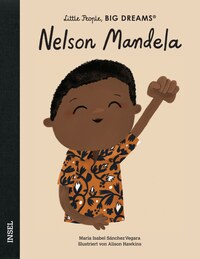
Seine Eltern nannten ihn Rolihlahla, in Xhosa, seiner Muttersprache, hieß das Unruhestifter. Als er in die Schule kam, gab ihm die Lehrerin den englischen Namen Nelson. Aber seine rebellische Natur konnte sie ihm nicht nehmen. Ein Leben lang kämpfte er gegen die weiße Vorherrschaft in Südafrika, weshalb er fast 30 Jahre im Gefängnis saß. Nach seiner Entlassung wurde er der erste schwarze Präsident seines Landes. Für sein beispielhaftes Engagement erhielt er den Friedensnobelpreis. Little People, Big Dreams erzählt von den beeindruckenden Lebensgeschichten großer Menschen: Jede dieser Persönlichkeiten, ob Philosophin, Forscherin oder Sportler, hat Unvorstellbares erreicht. Dabei begann alles, als sie noch klein waren: mit großen Träumen.
Trusted Partner
This volume offers new practical and theoretical perspectives on one of the most complex questions regarding the formation of international law, namely that actors other than states contribute to the making of customary international law. Notwithstanding the International Law Commission's valuable contribution, the making of customary international law remains riddled with acute practical and theoretical controversies that continue to be intensively debated. Making extensive reference to the case-law of international law courts and tribunals, as well as the most recent scholarly work on customary international law, this volume provides a comprehensive study of the contribution of international organisations and non-state actors to the formation of customary international law. With innovative tools and guidance for law students, legal scholars, and researchers in law, as well as legal practitioners, advisers, judges, arbitrators, and counsels, this collection is essential reading for those wishing to understand and address contemporary questions of international law-making.
Trusted Partner


The WHO’s International Classification of Functioning, Disability and Health (ICF) is the accepted common framework for understanding and documenting functioning and disability. The ICF Core Sets selected for this book have now been developed to facilitate the standardized use of the ICF in real-life clinical practice and thus improve quality of care. By using this collection of clear checklists, definitions, and forms, clinicians will quickly and easily be able to assess clients with a range of typical health conditions at different stages and in a variety of health care contexts. This manual describes how and why the ICF Core Sets have been developed and shows, step-by-step, how to apply the ICF Core Sets in clinical practice. Target Group: For practitioners working in various health care contexts but also for students and teachers.
Trusted Partner
Trusted Partner
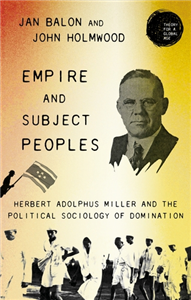
The book outlines the sociological arguments and political activities of the US pragmatist sociologist, Herbert Adolphus Miller (1875-1951). Miller was part of the milieu of Chicago sociology and involved in its studies of race and immigration. He took a distinctly more radical approach and developed a novel political sociology of domination in which he set out a critique of empires, the plight of subject minorities and the risks associated with the inevitable nationalist responses. Where others have identified with the 'internationalisation' of nationalism, Miller sought to make the nation 'international'. He was actively involved in movements for racial justice, Czechoslovakian independence, the formation of the Mid-European Union of subject peoples, as well as support for Korean and Indian independence. He was dismissed by Ohio State University for his activism in 1932.
Trusted Partner
On 25 January 1474, Charles the Bold, duke of Burgundy, appeared before his subjects in Dijon. Robed in silk, gold and precious jewels and wearing a headpiece that gave the illusion of a crown, he made a speech in which he cryptically expressed his desire to become a king. Three years later, Charles was killed at the battle of Nancy, an event that plunged the Great Principality of Burgundy into chaos. This book, innovative and essential, not only explores Burgundian history and historiography but offers a complete synthesis about the nature of politics in this region, considered both from the north and the south. Focusing on political ideologies, a number of important issues are raised relating to the medieval state, the signification of the nation under the 'Ancien Regime', the role of warfare in the creation of political power and the impact of political loyalties in the exercise of government. In doing so, the book challenges a number of existing ideas about the Burgundian state.
Trusted Partner

Auteurism - the idea that a director of a film is its source of meaning and should retain creative control over the finished product - has been one of film studies' most important paradigms ever since the French New Wave of the late 1950s and early 1960s, and the adoption of the term auteur by Andrew Sarris. Through the popular, controversial and critically acclaimed films of Olivier Assayas, Jacques Audiard, the Dardenne borthers, Michael Haneke and Francois Ozon, this book looks into how the meaning of 'auteur' has changed over this half-century, and assesses the current state of Francophone auteur cinema. It combines French philosophical and sociological approaches with methodologies from the Anglo-American fields of gender studies, queer theory and postmodernism. This volume will be of interest to researchers and students of film studies, European cinema and French and Francophone studies, as well as to film enthusiasts.
Trusted Partner

This topical and innovative study is the first book on Algerian cinema to be published in English since the 1970s. At a time when North African and Islamic cultures are of increasing political significance, Algerian National Cinema presents a dynamic, detailed and up to date analysis of how film has represented this often misunderstood nation. Algerian National Cinema explores key films from The Battle of Algiers (1966) to Mascarades (2007). Introductions to Algerian history and to the national film industry are followed by chapters on the essential genres and themes of filmmaking in Algeria, including films of anti-colonial struggle, representations of gender, Berber cinema, and filming the 'black decade' of the 1990s. This thoughtful and timely book will appeal to all interested in world cinemas, in North African and Islamic cultures, and in the role of cinema as a vehicle for the expression of contested identities. By the author of the critically-acclaimed Contemporary French Cinema.
Trusted Partner

This topical and innovative study is the first book on Algerian cinema to be published in English since the 1970s. At a time when North African and Islamic cultures are of increasing political significance, Algerian National Cinema presents a dynamic, detailed and up to date analysis of how film has represented this often misunderstood nation. Algerian National Cinema explores key films from The Battle of Algiers (1966) to Mascarades (2007). Introductions to Algerian history and to the national film industry are followed by chapters on the essential genres and themes of filmmaking in Algeria, including films of anti-colonial struggle, representations of gender, Berber cinema, and filming the 'black decade' of the 1990s. This thoughtful and timely book will appeal to all interested in world cinemas, in North African and Islamic cultures, and in the role of cinema as a vehicle for the expression of contested identities. By the author of the critically-acclaimed Contemporary French Cinema.
Trusted Partner



