Daniel Goleman - Foreign Audio
Please contact anaban@gmail.com for information
View Rights Portal

**Download our catalogue** https://app.box.com/s/wxf7sfuxp8uz5c5sj0cel08plfc9z1v3 ** Watch our short video pitches for your key books of the fair https://www.youtube.com/playlist?list=PLRuP9O31bj5-sKE3iByYmYu1PuzFvK8_4 ** We are proud to represent prizewinning and bestselling authors across all genres, from literary fiction (Kate Tempest) to Top5 thrillers (Cara Hunter), from pop science (Sue Black) to narrative nonfiction (Helen Russell) and narrative history (Sinclair McKay). Join our monthly newsletter: https://lb.benchmarkemail.com/listbuilder/signupnew?UDxLzrt9hi4UoU%252BY0hWxQf5pwVnAjsSIhoQhofH0GHztO5iNRn8gS049TyW7spdJ
View Rights Portal
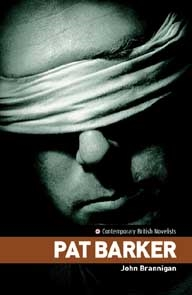
This book provides a comprehensive account and critical analysis of the literary career of Pat Barker. It offers readings of Barker's innovations in narrative form, her revisionist perspectives on history, class and gender, and her preoccupation with themes of trauma, haunting and terror. It also analyses the reasons for her success and significance as a novelist. The chapters draw on contemporary theories of critical realism, gender and social identities, memory and narrative, in order to outline the debates with which Barker's work has consistently engaged. Brannigan argues that Barker is one of the most important writers in modern English literary history. She is principally renowned and widely acclaimed for her 'Regeneration' trilogy, the last volume of which, 'The Ghost Road', won the Booker Prize in 1995. In recent novels, Barker has continued to deal with controversial and shocking themes, including child murderers and the meanings of 'terror' in the contemporary world. ;
 Trusted Partner

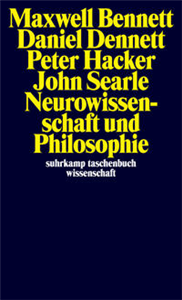
Als der Neurowissenschaftler Maxwell Bennett und der Philosoph Peter Hacker den Klassiker Philosophical Foundations of Neuroscience veröffentlichten, war dies die erste systematische Untersuchung der begrifflichen Grundlagen der Neurowissenschaften und der Startschuss für den bis heute intensiv geführten Kampf um die Deutungsmacht über den menschlichen Geist. Besonders kritisch fiel seinerzeit die Auseinandersetzung mit den einflussreichen Arbeiten von Daniel Dennett und John Searle aus – also mit jenen beiden Denkern, die von der neurowissenschaftlichen Seite gerne als philosophische Gewährsmänner herangezogen werden. In Neurowissenschaft und Philosophie diskutieren die vier kongenialen »Streithähne« miteinander.
Trusted Partner

Zu Beginn des dritten Jahrtausends ist die Situation der Demokratie paradox: Einerseits sind mehr Staaten denn jemals zuvor demokratisch verfaßt, andererseits nehmen die Krisensymptome in den Staaten, die einstmals so etwas wie eine demokratische Avantgarde bildeten, zu: Die Wahlbeteiligung sinkt, schillernde Persönlichkeiten wie Silvio Berlusconi oder Nicolas Sarkozy gewinnen an Bedeutung, Wahlkämpfe geraten zu schalen Marketingkampagnen. Colin Crouch hat all diese Trends in dem Band "Postdemokratie" präzise auf den Punkt gebracht. In diesem Band setzen sich nun acht herausragende politische Denkerinnen und Denker mit dem Zustand und den Perspektiven der am wenigsten schlechten aller Regierungsformen (Winston Churchill) auseinander, die tageszeitung sprach von einem »Who's who der internationalen linken Theorie«. Der Diskussionsband enthält Beiträge von Giorgio Agamben, Alain Badiou, Daniel Bensaïd, Wendy Brown, Jean-Luc Nancy, Jacques Rancière, Kristin Ross und Slavoj Žižek.
Trusted Partner
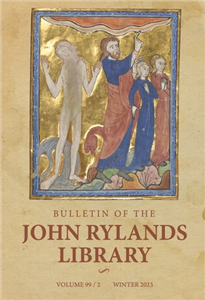
The John Rylands Library houses one of the finest collections of rare books, manuscripts and archives in the world. The collections span five millennia and cover a wide range of subjects, including art and archaeology; economic, social, political, religious and military history; literature, drama and music; science and medicine; theology and philosophy; travel and exploration. For over a century, the Bulletin of the John Rylands Library has published research that complements the Library's special collections. The editors invite the submission of articles in these fields and welcome discussion of in-progress projects.
Trusted Partner

The John Rylands Library houses one of the finest collections of rare books, manuscripts and archives in the world. The collections span five millennia, have a global reach and cover a wide range of subjects, including art and archaeology; economic, social, political, religious and military history; literature, drama and music; science and medicine; theology and philosophy; travel and exploration. For over a century, the Bulletin of the John Rylands Library has published research that complements the Library's special collections.
Trusted Partner
 Trusted Partner
The John Rylands Library houses one of the finest collections of rare books, manuscripts and archives in the world. The collections span five millennia, have a global reach and cover a wide range of subjects, including art and archaeology; economic, social, political, religious and military history; literature, drama and music; science and medicine; theology and philosophy; travel and exploration. For over a century, the Bulletin of the John Rylands Library has published research that complements the Library's special collections. An electronic edition of this issue is freely available under a Creative Commons (CC BY-NC-ND) licence.
Trusted Partner

Waiting for the revolution is a volume of essays examining the diverse currents of British left-wing politics from 1956 to the present day. The book is designed to complement the previous volume, Against the grain: The far left in Britain from 1956, bringing together young and established academics and writers to discuss the realignments and fissures that maintain leftist politics into the twenty-first century. The two books endeavour to historicise the British left, detailing but also seeking to understand the diverse currents that comprise 'the far left'. Their objective is less to intervene in ongoing issues relevant to the left and politics more generally, than to uncover and explore the traditions and issues that have preoccupied leftist groups, activists and struggles. To this end, the book will appeal to scholars and anyone interested in British politics.
Trusted Partner

This book offers an accessible critical introduction to the work of Graham Swift, one of Britain's most significant contemporary authors. Through detailed readings of his novels and short stories from 'The Sweet Shop Owner' (1980) to 'The Light of Day' (2003), Daniel Lea lucidly addresses the key themes of history, loss, masculinity and ethical redemption, to present a fresh approach to Swift. This study proposes that one of the side-effects of modernity has been the destruction of traditional pathways of self and collective belief, leading to a loss of understanding between individuals about their duties to each other and to society. Swift's writing returns repeatedly to the question of what we can believe in when all the established markers of identity - family, community, gender, profession, history - have become destabilised. Lea suggests that Swift increasingly moves towards a notion of redemption through a lived ethical practice as the only means of finding solace in a world lacking a central symbolic authority. ;
Trusted Partner

The John Rylands Library houses one of the finest collections of rare books, manuscripts and archives in the world. The collections span five millennia, have a global reach and cover a wide range of subjects, including art and archaeology; economic, social, political, religious and military history; literature, drama and music; science and medicine; theology and philosophy; travel and exploration. For over a century, the Bulletin of the John Rylands Library has published research that complements the Library's special collections. An electronic edition of this issue is freely available under a Creative Commons (CC BY-NC-ND) licence.
Trusted Partner
 Trusted Partner
Trusted Partner
Trusted Partner
Trusted Partner
Trusted Partner
Trusted Partner
Trusted Partner
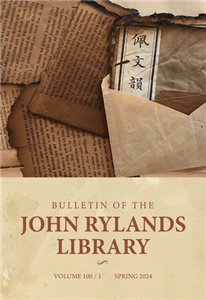
The John Rylands Library houses one of the finest collections of rare books, manuscripts and archives in the world. The collections span five millennia, have a global reach and cover a wide range of subjects, including art and archaeology; economic, social, political, religious and military history; literature, drama and music; science and medicine; theology and philosophy; travel and exploration. For over a century, the Bulletin of the John Rylands Library has published research that complements the Library's special collections.
Trusted Partner
 Trusted Partner

Daniel Calparsoro, a director who has made a crucial contribution to contemporary Spanish and Basque cinema, has provoked strong reactions from the critics. Reductively dismissed as a works of crude violence by those lamenting a 'lost golden age' of Spanish filmmaking, Calparsoro's films in fact reveal a more complex interaction with trends and traditions in both Spanish and Hollywood cinema. This book is the first full-length study of the director's work, from his early social-realist films set in the Basque Country to his later forays into the genres of the war and horror. It offers an in-depth film-by-film analysis while simultaneously exploring the director's position in the contemporary Spanish context, the tension between directors and critics and the question of national cinema in an area - the Basque Country - of heightened national and regional sensitivities.
Trusted Partner

Daniel Calparsoro, a director who has provided a crucial contribution to the contemporary scene in Spanish and Basque cinema, has provoked strong reactions from the critics. Reductively dismissed as a purveyor of crude violence by those critics lamenting a 'lost golden age' of Spanish filmmaking, Calparsoro's films reveal in fact a more complex interaction with trends and traditions in both Spanish and Hollywood cinema. This book is the first full-length study of the director's work, from his early social realist films set in the Basque Country to his later forays into the genres of the war and horror film. It offers an in-depth film-by-film analysis, while simultaneously exploring the function of the director in the contemporary Spanish context, the tension between directors and critics, and the question of national cinema in an area - the Basque Country - of heightened national and regional sensitivities. ;
Trusted Partner

Nach seinen sprachphilosophischen Arbeiten ('Sprechakte', stw 458; 'Ausdruck und Bedeutung', stw 349) hat John R. Searle mit 'Intentionalität' eine Untersuchung zu einem Kernstück der Philosophie des Geistes vorgelegt, die in einem engen thematischen Zusammenhang mit den früheren Arbeiten steht. Intentionalität ist nach Searles Auffassung die Basis sprachlicher Bedeutung. In seiner Theorie der Intentionalität geht es um die begrifflichen Eigenschaften intentionaler Zustände (auf die Frage nach ihrem ontologischen Status geht er ausführlicher ein in 'Geist, Hirn und Wissenschaft', stw 591). Zwei Aspekte stehen dabei im Vordergrund der Untersuchung: die Logik der Repräsentation und der Kausalität intentionaler Zustände. Doch Searle entwickelt in dieser Arbeit nicht nur eine Theorie der Intentionalität und des Zusammenhangs zwischen sprachlichem und geistigem Inhalt. In einem vornehmlich kritischen Teil setzt er sich ausführlich mit konkurrierenden Auffassungen aus dem Bereich der analytischen Philosophie auseinander, insbesondere mit derzeit sehr einflußreichen 'nicht-deskriptivistischen' Theorien des Bezugs, wie sie von S. Kripke, H. Putnam, K. Donnellan, T. Burge und D. Kaplan vertreten und angeregt wurden.