
Your Search Results


-
Promoted Content

 August 2012
Empty Mind
by John Cage, Marie Luise Knott, Walter Zimmermann
»In welchem Käfig man sich auch befindet, man muß ihn verlassen«, lautete das Credo von John Cage (1912 bis 1992), dem international bekanntesten experimentellen Komponisten des 20. Jahrhunderts. Weniger bekannt ist sein literarisches Werk, das gleichberechtigt neben dem musikalischen steht. Cage ließ sich von Erik Satie, Robert Rauschenberg, James Joyce, Merce Cunningham und Marcel Duchamp inspirieren − verwandten Geistern, mit denen er Zeit seines Lebens täglich umging. Indem er seine poetisch-philosphischen Versuche musikalischen Verfahren unterwarf, verwandelte er Vorträge über das Komponieren, über den Zufall oder die Kategorie der Unbestimmtheit in Ereignisse, schwebend, der Festlegung entzogen – nicht anders als die Musik der Absichtslosigkeit, von der er träumte. John Cage als Wortkünstler harrt hierzulande noch der Entdeckung. »Empty Mind« versammelt eine Auswahl poetischer Schlüsseltexte, an denen sich die unerschöpfliche Freude, neue Wege zu gehen, Grenzen zu überschreiten, ablesen läßt. Eine Freude, die ansteckend wirkt − auch auf all jene, die sich noch nie mit seinem Werk beschäftigt haben.
-
Promoted Content

 The ArtsJanuary 2019
Carol Reed
by Peter William Evans
Carol Reed is one of the truly outstanding directors of British cinema, and one whose work is long overdue for reconsideration. This major study ranges over Reed's entire career, combining observation of general trends and patterns with detailed analysis of twenty films, both acknowledged masterpieces and lesser-known works. Evans avoids a simplistic auteurist approach, placing the films in their autobiographical, socio-political and cultural contexts and relating these to the analysis of Reed's art. The critical approach combines psychoanalysis, gender theory, and the analysis of form. Archival research is also relied on to clarify Reed's relations with his creative team, financial backers and others. Films examined include Bank Holiday, A Girl Must Live, Odd Man Out, The Fallen Idol, The Third Man, Night Train to Munich, The Way Ahead, Outcast of the Islands, Trapeze and Oliver!.
-
 Trusted Partner
 Humanities & Social SciencesDecember 2024
Bulletin of the John Rylands Library 100/2
Higher Learning and Civic Cultures of Knowledge: Manchester 1824–2024
by Stuart Jones
The John Rylands Library houses one of the finest collections of rare books, manuscripts and archives in the world. The collections span five millennia, have a global reach and cover a wide range of subjects, including art and archaeology; economic, social, political, religious and military history; literature, drama and music; science and medicine; theology and philosophy; travel and exploration. For over a century, the Bulletin of the John Rylands Library has published research that complements the Library's special collections.
-
Trusted Partner
 Humanities & Social SciencesDecember 2025
Bulletin of the John Rylands Library 101/2
Imaging Heritage Science Initiatives at The John Rylands Research Institute and Library
by Stefan Hanß, James Robinson
The John Rylands Library houses one of the finest collections of rare books, manuscripts and archives in the world. The collections span five millennia, have a global reach and cover a wide range of subjects, including art and archaeology; economic, social, political, religious and military history; literature, drama and music; science and medicine; theology and philosophy; travel and exploration. For over a century, the Bulletin of the John Rylands Library has published research that complements the Library's special collections. An electronic edition of this issue is freely available under a Creative Commons (CC BY-NC-ND) licence.
-
Trusted Partner
 Humanities & Social SciencesJune 2025
Bulletin of the John Rylands Library 101/1
by Fred Schurink, Rachel Winchcombe, Huw Twiston Davies
The John Rylands Library houses one of the finest collections of rare books, manuscripts and archives in the world. The collections span five millennia, have a global reach and cover a wide range of subjects, including art and archaeology; economic, social, political, religious and military history; literature, drama and music; science and medicine; theology and philosophy; travel and exploration. For over a century, the Bulletin of the John Rylands Library has published research that complements the Library's special collections. An electronic edition of this issue is freely available under a Creative Commons (CC BY-NC-ND) licence.
-
Trusted Partner
 Literature & Literary StudiesDecember 2023
Bulletin of the John Rylands Library 99/2
by Stephen Mossman, Cordelia Warr
The John Rylands Library houses one of the finest collections of rare books, manuscripts and archives in the world. The collections span five millennia and cover a wide range of subjects, including art and archaeology; economic, social, political, religious and military history; literature, drama and music; science and medicine; theology and philosophy; travel and exploration. For over a century, the Bulletin of the John Rylands Library has published research that complements the Library's special collections. The editors invite the submission of articles in these fields and welcome discussion of in-progress projects.
-
Trusted Partner
 Literature & Literary StudiesApril 2021
John Derricke's The Image of Irelande: with a Discoverie of Woodkarne
by Thomas Herron, Denna Iammarino, Maryclaire Moroney, Joshua Samuel Reid
-
Trusted Partner
-
Trusted Partner
 Literature & Literary StudiesMay 2022
The correspondence of John Dryden
by Stephen Bernard, John McTague
-
Trusted Partner
 November 1977
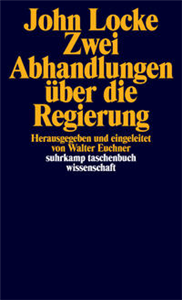
Zwei Abhandlungen über die Regierung
by John Locke, Walter Euchner, Hans Jörn Hoffmann, Walter Euchner
"»Locke hatte in der historischen Epoche, als in England das Bürgertum sein soziales und politisches Selbstverständnis gegenüber einer feudal-absolutistischen Krone zu entwickeln begann, als einer der ersten die Postulate der bürgerlichen Freiheitsbewegung formuliert; das Recht auf Selbstentfaltung der Persönlichkeit, das er auf die Formel des legitimen Strebens nach Glück brachte; das auf Arbeit beruhende Recht auf Privateigentum, das als materielle Grundlage bürgerlicher Existenz (…) zu verstehen ist; Verhinderung der Zusammenballung aller politischen Macht in der Hand einer einzigen Institution, etwa des Monarchen, deshalb Aufteilung der Gewalten auf Legislative und Exekutive - Gewaltenteilung also; Recht auf Toleranz in Glaubensdingen; Widerstandsrecht des Volkes gegen eine absolutistische Macht, die sich an den Rechten der Bürger auf Leben, Freiheit und Eigentum vergreifen will.« (Walter Büchner)"
-
Trusted Partner
 The ArtsJune 2005
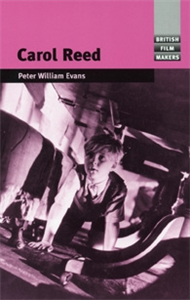
Carol Reed
by Peter William Evans, Brian McFarlane, Neil Sinyard
Carol Reed is one of the truly outstanding directors of British cinema, and one whose work is long overdue for reconsideration. This major study ranges over Reed's entire career, combining observation of general trends and patterns with detailed analysis of twenty films, both acknowledged masterpieces and lesser-known works. Evans avoids a simplistic auteurist approach, placing the films in their autobiographical, socio-political and cultural contexts and relating these to the analysis of Reed's art. The critical approach combines psychoanalysis, gender theory, and the analysis of form. Archival research is also relied on to clarify Reed's relations with his creative team, financial backers and others. Films examined include Bank Holiday, A Girl Must Live, Odd Man Out, The Fallen Idol, The Third Man, Night Train to Munich, The Way Ahead, Outcast of the Islands, Trapeze and Oliver!. ;
-
Trusted Partner
 Biography & True StoriesMay 2026
Punk rock ruined my life
And other stories
by John Robb
The irresistible story of a one-man cultural phenomenon. Minister for the Counterculture, Mancunian mainstay and alternative national treasure John Robb has lived a life in music. In this book he charts his adventures on the cultural frontline, chronicling the making of a DIY icon. Robb's quest began in his hometown of Blackpool - where punk was a battle against the odds - and went international when he toured the world with his band. The first person to interview Nirvana, he also discovered The Stone Roses for weekly newspaper Sounds and did early interviews with The Jesus and Mary Chain and The Manics, before moving on to legends such as Mark E. Smith, Nick Cave and Patti Smith. Along the way, he became an on-screen commentator and author of bestselling books. Robb's memoir tells of deep friendships with figures from Poly Styrene to Chris Packham. Packed with riotous stories, it provides an alternative account of British musical and cultural history and a triumphant blueprint for a punk rock life.
-
Trusted Partner
 May 1991
Intentionalität
Eine Abhandlung zur Philosophie des Geistes
by Harvey P. Gavagai, John R. Searle
Nach seinen sprachphilosophischen Arbeiten ('Sprechakte', stw 458; 'Ausdruck und Bedeutung', stw 349) hat John R. Searle mit 'Intentionalität' eine Untersuchung zu einem Kernstück der Philosophie des Geistes vorgelegt, die in einem engen thematischen Zusammenhang mit den früheren Arbeiten steht. Intentionalität ist nach Searles Auffassung die Basis sprachlicher Bedeutung. In seiner Theorie der Intentionalität geht es um die begrifflichen Eigenschaften intentionaler Zustände (auf die Frage nach ihrem ontologischen Status geht er ausführlicher ein in 'Geist, Hirn und Wissenschaft', stw 591). Zwei Aspekte stehen dabei im Vordergrund der Untersuchung: die Logik der Repräsentation und der Kausalität intentionaler Zustände. Doch Searle entwickelt in dieser Arbeit nicht nur eine Theorie der Intentionalität und des Zusammenhangs zwischen sprachlichem und geistigem Inhalt. In einem vornehmlich kritischen Teil setzt er sich ausführlich mit konkurrierenden Auffassungen aus dem Bereich der analytischen Philosophie auseinander, insbesondere mit derzeit sehr einflußreichen 'nicht-deskriptivistischen' Theorien des Bezugs, wie sie von S. Kripke, H. Putnam, K. Donnellan, T. Burge und D. Kaplan vertreten und angeregt wurden.
-
Trusted Partner
 July 1979
Naturrecht und Politik bei John Locke
by Walter Euchner
John Locke ist der repräsentative Philosoph des europäischen Bürgertums im 17. Und 18. Jahrhundert. Auf ihn geht das Prinzip der Gewaltenteilung zurück; nach seiner Ansicht stand dem Parlament die führende Rolle in der Politik zu; die Staatsgewalt war vor allem dazu da, das Eigentum der Bürger zu schützen; das Volk hat das Recht, auf Übergriffe des Staates auf seine wohlerworbenen Rechte mit Revolution zu antworten. Walter Euchner sichtet die Kontroverse, die in der modernen Literatur um die Tragweite der politischen Prinzipien Lockes entstanden ist und analysiert die komplizierte Position Lockes zwischen dem Naturrecht der Tradition und der modernen Naturrechtsauffassung wie bei Thomas Hobbes. In Lockes Naturrechtslehre und seiner Konstruktion der politischen Institutionen manifestiert sich seine widersprüchliche Stellung zwischen altem und modernem politischen Denken bzw. die Widersprüchlichkeit in der Interessenlage des aufstrebenden Bürgertums.
-
Trusted Partner
 November 2026
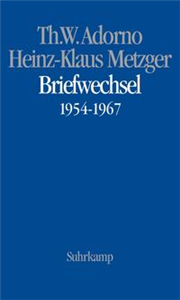
Theodor W. Adorno, Heinz-Klaus Metzger, Briefwechsel 1926-1969
Musikalische Briefwechsel III
by Theodor W. Adorno, Heinz-Klaus Metzger, Clemens Nachtmann, Florian Neuner
Im Jahr 1950 nahm Theodor W. Adorno, gerade aus der Emigration zurückgekehrt, erstmals an den legendären Internationalen Ferienkursen für Neue Musik in Darmstadt teil. Unter seinen Hörern war der damals achtzehnjährige Heinz-Klaus Metzger. Diese Begegnung war der Beginn einer Freundschaft, die erst mit dem Tod Adornos endete und anfangs ganz im Zeichen von Adornos Philosophie der neuen Musik stand – dem Paukenschlag in der Musikwissenschaft Nachkriegsdeutschlands. Der Briefwechsel selbst kam jedoch erst in Gang, als Metzger in Paris bei dem Schönberg-Schüler Max Deutsch Komposition studierte – und entzündete sich vollends an Adornos Essay Das Altern der neuen Musik, der als heftige Attacke auf die Nachkriegsavantgarde aufgenommen und alsbald ebenso heftig von Metzger öffentlich kritisiert wurde. Weitere Themen sind u.a. der Aufstieg und Niedergang der seriellen Musik und der »Komet« John Cage, dessen Kompositionen die internationale Musikszene polarisierten. Die Korrespondenz, die bis ins Jahr 1967 reicht, belegt nicht nur Adornos vitale Anteilnahme an den musikalischen Entwicklungen der 50er und 60er Jahre, sondern läßt auch ein Stück Musikgeschichte lebendig werden, das zu den spannendsten des vergangenen Jahrhunderts gehört.
-
Trusted Partner
 March 1976
Beschreibung eines Dorfes
Nachwort von Walter Helmut Fritz
by Marie Luise Kaschnitz, Walter Helmut Fritz
Die »Beschreibung eines Dorfes« berichtet von einer Ortschaft im Südwesten Deutschlands und von ihren Einwohnern. Aufgedeckt wird die Wirklichkeit, die sich gesammelt hat in den Lebensläufen der Leute und den Gegenständen des täglichen Gebrauchs; die sich niederschlug in den Konventionen und den menschlichen Beziehungen. »Gemeinsam sind der Prosa und der Lyrik von Marie Luise Kaschnitz der künstlerische Ernst, die Spiritualität, die durch diese bewirkte Transparenz. Zwei Sprechweisen, die nicht nur Mitteilung und Ausdruck sind, sondern eine Lebensform bilden. Ausgeprägt ist – bei aller Radikalisierung der den Menschen betreffenden Fragen – die Beherrschtheit dieser Kunst. Ein Beispiel solcher aus Spannung lebender Beherrschtheit ist die teilweise fast helle Topographie dieses Buches, in der gesehene Landschaft und Landschaft der Reflexion eine Einheit bilden.« Walter Helmut Fritz
-
Trusted Partner
Literature & Literary StudiesJanuary 2026
David, Donne, and Thirsty Deer
Selected Essays of Anne Lake Prescott
by Anne Lake Prescott, Roger Kuin, William A. Oram
For nearly half a century Anne Lake Prescott has been a force and an inspiration in Renaissance studies. A force, because of her unique blend of learning and wit and an inspiration through her tireless encouragement of younger scholars and students. Her passion has always been the invisible bridge across the Channel: the complex of relations, literary and political, between Britain and France. The essays in this long-awaited collection range from Edmund Spenser to John Donne, from Clément Marot to Pierre de Ronsard. Prescott has a particular fondness for King David, who appears several times; and the reader will encounter chessmen, bishops, male lesbian voices and Roman whores. Always Prescott's immense erudition is accompanied by a sly and gentle wit that invites readers to share her amusement. Reading her is a joyful education.
-
Trusted Partner
 Literature & Literary StudiesMay 2024
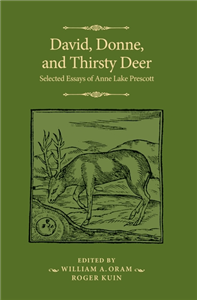
David, Donne and Thirsty Deer
Selected Essays of Anne Lake Prescott
by Anne Lake Prescott, Roger Kuin, William A. Oram
For nearly half a century Anne Lake Prescott has been a force and an inspiration in Renaissance studies. A force, because of her unique blend of learning and wit and an inspiration through her tireless encouragement of younger scholars and students. Her passion has always been the invisible bridge across the Channel: the complex of relations, literary and political, between Britain and France. The essays in this long-awaited collection range from Edmund Spenser to John Donne, from Clément Marot to Pierre de Ronsard. Prescott has a particular fondness for King David, who appears several times; and the reader will encounter chessmen, bishops, male lesbian voices and Roman whores. Always Prescott's immense erudition is accompanied by a sly and gentle wit that invites readers to share her amusement. Reading her is a joyful education.
-
Trusted Partner
Humanities & Social SciencesMarch 2017
The Arctic in the British imagination 1818–1914
by Andrew Thompson, John M. MacKenzie, Rob David
The Arctic region has been the subject of much popular writing. This book considers nineteenth-century representations of the Arctic, and draws upon an extensive range of evidence that will allow the 'widest connections' to emerge from a 'cross-disciplinary analysis' using different methodologies and subject matter. It positions the Arctic alongside more thoroughly investigated theatres of Victorian enterprise. In the nineteenth century, most images were in the form of paintings, travel narratives, lectures given by the explorers themselves and photographs. The book explores key themes in Arctic images which impacted on subsequent representations through text, painting and photography. For much of the nineteenth century, national and regional geographical societies promoted exploration, and rewarded heroic endeavor. The book discusses images of the Arctic which originated in the activities of the geographical societies. The Times provided very low-key reporting of Arctic expeditions, as evidenced by its coverage of the missions of Sir John Franklin and James Clark Ross. However, the illustrated weekly became one of the main sources of popular representations of the Arctic. The book looks at the exhibitions of Arctic peoples, Arctic exploration and Arctic fauna in Britain. Late nineteenth-century exhibitions which featured the Arctic were essentially nostalgic in tone. The Golliwogg's Polar Adventures, published in 1900, drew on adult representations of the Arctic and will have confirmed and reinforced children's perceptions of the region. Text books, board games and novels helped to keep the subject alive among the young.
-
Trusted Partner
June 1981
Vogel Rock
Unheimliche Geschichten
by Marie Luise Kaschnitz
Marie Luise Kaschnitz wurde am 31. Januar 1901 in Karlsruhe geboren und wuchs in Potsdam und Berlin auf. Nach einer Ausbildung zur Buchhändlerin arbeitete sie beim O.C. Recht Verlag in München und in einem Antiquariat in Rom. Nachdem sie den Archäologen Guido Kaschnitz von Weinberg geheiratet hatte, begleitete sie ihn auf mehrere seiner Forschungsreisen und wohnte u.a. in Rom, Marburg und Königsberg, nach 1941 vor allem in Frankfurt am Main. Nach der Geburt ihrer Tochter 1928 begann sie zu schreiben – Romane, Erzählungen, Essays und Gedichte. Ihr erster Roman Liebe beginnt erschien 1933. Ab 1950 widmete sie sich zudem zunehmend dem Hörspiel. Sie wurde mit zahlreichen Preisen ausgezeichnet und war Mitglied u.a. des P.E.N.-Zentrums der Bundesrepublik Deutschland, der Deutschen Akademie für Sprache und Dichtung und der Bayerischen Akademie der Schönen Künste. Sie starb am 10. Oktober 1974 in Rom.

