
Your Search Results
-

-

Johnson & Alcock Ltd.
**Download our catalogue** https://app.box.com/s/wxf7sfuxp8uz5c5sj0cel08plfc9z1v3 ** Watch our short video pitches for your key books of the fair https://www.youtube.com/playlist?list=PLRuP9O31bj5-sKE3iByYmYu1PuzFvK8_4 ** We are proud to represent prizewinning and bestselling authors across all genres, from literary fiction (Kate Tempest) to Top5 thrillers (Cara Hunter), from pop science (Sue Black) to narrative nonfiction (Helen Russell) and narrative history (Sinclair McKay). Join our monthly newsletter: https://lb.benchmarkemail.com/listbuilder/signupnew?UDxLzrt9hi4UoU%252BY0hWxQf5pwVnAjsSIhoQhofH0GHztO5iNRn8gS049TyW7spdJ
View Rights Portal
-
Promoted Content

 Political partiesSeptember 2008
The Labour governments 1964–1970 volume 2
International policy
by John W. Young
This book is the second in the three volume set The Labour governments 1964-1970 and concentrates on Britain's international policy under the Labour governments in the 1960s and is available for the first time in paperback. The coverage ranges from defence policy and the government machine to European integration, NATO and the Vietnam war. Harold Wilson and his ministers have often been accused of betraying the sense of promise that greeted their victory in 1964. Using recently released archival evidence, John Young argues that a more balanced view of the government will recognise the real difficulties that surrounded decision-making, not only on Vietnam, but also on Aden, the Nigerian civil war and Rhodesia. Economic weakness, waning military strength, Cold War tensions and the need to placate allies all placed limits on what a once-great but now clearly declining power could achieve. Furthermore the government proved of pivotal importance in the history of Britain's international role, in that it presided over a major shift from positions East of Suez to a focus on European concerns, a focus that has remained until the present day. The book will be of vital importance to students of British history and international relations during this exciting period. Together with the other books in the series, on domestic policy and economic policy, it provides a complete picture of the development of Britain under the premiership of Harold Wilson.
-
Promoted Content
 Humanities & Social SciencesDecember 2025
Bulletin of the John Rylands Library 101/2
Imaging Heritage Science Initiatives at The John Rylands Research Institute and Library
by Stefan Hanß, James Robinson
The John Rylands Library houses one of the finest collections of rare books, manuscripts and archives in the world. The collections span five millennia, have a global reach and cover a wide range of subjects, including art and archaeology; economic, social, political, religious and military history; literature, drama and music; science and medicine; theology and philosophy; travel and exploration. For over a century, the Bulletin of the John Rylands Library has published research that complements the Library's special collections. An electronic edition of this issue is freely available under a Creative Commons (CC BY-NC-ND) licence.
-

 Biography & True StoriesMarch 1905
Alaska Days with John Muir
by Samuel Hall Young
Samuel Hall Young, a Presbyterian clergyman, met John Muir when the great naturalist's steamboat docked at Fort Wrangell, in southeastern Alaska, where Young was a missionary to the Stickeen Indians. In "Alaska Days With John Muir" he describes this 1879 meeting: "A hearty grip of the hand and we seemed to coalesce in a friendship which, to me at least, has been one of the very best things in a life full of blessings." This book, first published in 1915, describes two journeys of discovery taken in company with Muir in 1879 and 1880. Despite the pleas of his missionary colleagues that he not risk life and limb with "that wild Muir," Young accompanied Muir in the exploration of Glacier Bay. Upon Muir's return to Alaska in 1880, they traveled together and mapped the inside route to Sitka. Young describes Muir's ability to "slide" up glaciers, the broad Scotch he used when he was enjoying himself, and his natural affinity for Indian wisdom and theistic religion. From the gripping account of their near-disastrous ascent of Glenora Peak to Young's perspective on Muir's famous dog story "Stickeen," Alaska Days is an engaging record of a friendship grounded in the shared wonders of Alaska's wild landscapes.
-
 Trusted Partner
 Humanities & Social SciencesDecember 2024
Bulletin of the John Rylands Library 100/2
Higher Learning and Civic Cultures of Knowledge: Manchester 1824–2024
by Stuart Jones
The John Rylands Library houses one of the finest collections of rare books, manuscripts and archives in the world. The collections span five millennia, have a global reach and cover a wide range of subjects, including art and archaeology; economic, social, political, religious and military history; literature, drama and music; science and medicine; theology and philosophy; travel and exploration. For over a century, the Bulletin of the John Rylands Library has published research that complements the Library's special collections.
-
Trusted Partner
 Literature & Literary StudiesApril 2021
John Derricke's The Image of Irelande: with a Discoverie of Woodkarne
by Thomas Herron, Denna Iammarino, Maryclaire Moroney, Joshua Samuel Reid
-
Trusted Partner
 Humanities & Social SciencesJune 2025
Bulletin of the John Rylands Library 101/1
by Fred Schurink, Rachel Winchcombe, Huw Twiston Davies
The John Rylands Library houses one of the finest collections of rare books, manuscripts and archives in the world. The collections span five millennia, have a global reach and cover a wide range of subjects, including art and archaeology; economic, social, political, religious and military history; literature, drama and music; science and medicine; theology and philosophy; travel and exploration. For over a century, the Bulletin of the John Rylands Library has published research that complements the Library's special collections. An electronic edition of this issue is freely available under a Creative Commons (CC BY-NC-ND) licence.
-
Trusted Partner

 November 2026
Theodor W. Adorno, Heinz-Klaus Metzger, Briefwechsel 1926-1969
Musikalische Briefwechsel III
by Theodor W. Adorno, Heinz-Klaus Metzger, Clemens Nachtmann, Florian Neuner
Im Jahr 1950 nahm Theodor W. Adorno, gerade aus der Emigration zurückgekehrt, erstmals an den legendären Internationalen Ferienkursen für Neue Musik in Darmstadt teil. Unter seinen Hörern war der damals achtzehnjährige Heinz-Klaus Metzger. Diese Begegnung war der Beginn einer Freundschaft, die erst mit dem Tod Adornos endete und anfangs ganz im Zeichen von Adornos Philosophie der neuen Musik stand – dem Paukenschlag in der Musikwissenschaft Nachkriegsdeutschlands. Der Briefwechsel selbst kam jedoch erst in Gang, als Metzger in Paris bei dem Schönberg-Schüler Max Deutsch Komposition studierte – und entzündete sich vollends an Adornos Essay Das Altern der neuen Musik, der als heftige Attacke auf die Nachkriegsavantgarde aufgenommen und alsbald ebenso heftig von Metzger öffentlich kritisiert wurde. Weitere Themen sind u.a. der Aufstieg und Niedergang der seriellen Musik und der »Komet« John Cage, dessen Kompositionen die internationale Musikszene polarisierten. Die Korrespondenz, die bis ins Jahr 1967 reicht, belegt nicht nur Adornos vitale Anteilnahme an den musikalischen Entwicklungen der 50er und 60er Jahre, sondern läßt auch ein Stück Musikgeschichte lebendig werden, das zu den spannendsten des vergangenen Jahrhunderts gehört.
-
Trusted Partner
 Literature & Literary StudiesDecember 2023
Bulletin of the John Rylands Library 99/2
by Stephen Mossman, Cordelia Warr
The John Rylands Library houses one of the finest collections of rare books, manuscripts and archives in the world. The collections span five millennia and cover a wide range of subjects, including art and archaeology; economic, social, political, religious and military history; literature, drama and music; science and medicine; theology and philosophy; travel and exploration. For over a century, the Bulletin of the John Rylands Library has published research that complements the Library's special collections. The editors invite the submission of articles in these fields and welcome discussion of in-progress projects.
-
Trusted Partner
-
Trusted Partner
Humanities & Social SciencesMarch 2017
The Arctic in the British imagination 1818–1914
by Andrew Thompson, John M. MacKenzie, Rob David
The Arctic region has been the subject of much popular writing. This book considers nineteenth-century representations of the Arctic, and draws upon an extensive range of evidence that will allow the 'widest connections' to emerge from a 'cross-disciplinary analysis' using different methodologies and subject matter. It positions the Arctic alongside more thoroughly investigated theatres of Victorian enterprise. In the nineteenth century, most images were in the form of paintings, travel narratives, lectures given by the explorers themselves and photographs. The book explores key themes in Arctic images which impacted on subsequent representations through text, painting and photography. For much of the nineteenth century, national and regional geographical societies promoted exploration, and rewarded heroic endeavor. The book discusses images of the Arctic which originated in the activities of the geographical societies. The Times provided very low-key reporting of Arctic expeditions, as evidenced by its coverage of the missions of Sir John Franklin and James Clark Ross. However, the illustrated weekly became one of the main sources of popular representations of the Arctic. The book looks at the exhibitions of Arctic peoples, Arctic exploration and Arctic fauna in Britain. Late nineteenth-century exhibitions which featured the Arctic were essentially nostalgic in tone. The Golliwogg's Polar Adventures, published in 1900, drew on adult representations of the Arctic and will have confirmed and reinforced children's perceptions of the region. Text books, board games and novels helped to keep the subject alive among the young.
-
Trusted Partner
 May 1991
Intentionalität
Eine Abhandlung zur Philosophie des Geistes
by Harvey P. Gavagai, John R. Searle
Nach seinen sprachphilosophischen Arbeiten ('Sprechakte', stw 458; 'Ausdruck und Bedeutung', stw 349) hat John R. Searle mit 'Intentionalität' eine Untersuchung zu einem Kernstück der Philosophie des Geistes vorgelegt, die in einem engen thematischen Zusammenhang mit den früheren Arbeiten steht. Intentionalität ist nach Searles Auffassung die Basis sprachlicher Bedeutung. In seiner Theorie der Intentionalität geht es um die begrifflichen Eigenschaften intentionaler Zustände (auf die Frage nach ihrem ontologischen Status geht er ausführlicher ein in 'Geist, Hirn und Wissenschaft', stw 591). Zwei Aspekte stehen dabei im Vordergrund der Untersuchung: die Logik der Repräsentation und der Kausalität intentionaler Zustände. Doch Searle entwickelt in dieser Arbeit nicht nur eine Theorie der Intentionalität und des Zusammenhangs zwischen sprachlichem und geistigem Inhalt. In einem vornehmlich kritischen Teil setzt er sich ausführlich mit konkurrierenden Auffassungen aus dem Bereich der analytischen Philosophie auseinander, insbesondere mit derzeit sehr einflußreichen 'nicht-deskriptivistischen' Theorien des Bezugs, wie sie von S. Kripke, H. Putnam, K. Donnellan, T. Burge und D. Kaplan vertreten und angeregt wurden.
-
Trusted Partner
 Literature & Literary StudiesMay 2022
The correspondence of John Dryden
by Stephen Bernard, John McTague
-
Trusted Partner
 Literature & Literary StudiesJune 2022
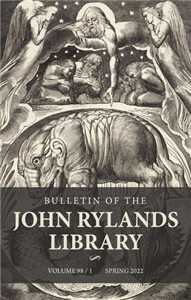
Bulletin of the John Rylands Library 98/1
The Artist of the Future Age: William Blake, Neo-Romanticism, Counterculture and Now
by Douglas Field
This special issue of the Bulletin of the John Rylands Library is devoted to William Blake. It explores the British and European reception of Blake's work from the late nineteenth century to the present day, with a particular focus on the counterculture. Opening with two articles by the late Michael Horovitz, an important figure in the 'Blake Renaissance' of the 1960s, the issue goes on to investigate the ideological struggle over Blake in the early part of the twentieth century, with particular reference to W. B. Yeats. This is followed by articles on the artistic avant-garde and underground of the 1960s and on Blake's significance for science fiction authors of the 1970s. The issue closes with an article on the contemporary Belgian art collective maelstrÖm reEvolution.
-
Trusted Partner
 Biography & True StoriesMay 2026
Punk rock ruined my life
And other stories
by John Robb
The irresistible story of a one-man cultural phenomenon. Minister for the Counterculture, Mancunian mainstay and alternative national treasure John Robb has lived a life in music. In this book he charts his adventures on the cultural frontline, chronicling the making of a DIY icon. Robb's quest began in his hometown of Blackpool - where punk was a battle against the odds - and went international when he toured the world with his band. The first person to interview Nirvana, he also discovered The Stone Roses for weekly newspaper Sounds and did early interviews with The Jesus and Mary Chain and The Manics, before moving on to legends such as Mark E. Smith, Nick Cave and Patti Smith. Along the way, he became an on-screen commentator and author of bestselling books. Robb's memoir tells of deep friendships with figures from Poly Styrene to Chris Packham. Packed with riotous stories, it provides an alternative account of British musical and cultural history and a triumphant blueprint for a punk rock life.
-
Trusted Partner
September 2026
Red Star Down
Thriller
by D. B. John, Thomas Wörtche, Lutz-W. Wolff
Februar 2017. Ein Nordkoreaner wird am helllichten Tag am Flughafen von Kuala Lumpur Weise vergiftet. Ein hochrangiger russischer Geheimdienstoffizier stirbt unter mysteriösen Umständen in einem Hotel in Washington. Und ein Reality-TV-Star zieht ins Weiße Haus ein. Zufall? Oder Auftakt zu etwas Größerem? Während sich die Machtzentren der Welt gefährlich neu sortieren und bizarre Gipfeltreffen die Schlagzeilen beherrschen, geraten drei Menschen ins Fadenkreuz: Jenna, eine CIA-Agentin, gejagt vom russischen Geheimdienst und vom nordkoreanischen Regime. Ljoscha, ein Moskauer Student, der es wagt, Putin live im Fernsehen herauszufordern, und nun seine Rache fürchten muss. Und Eric, ein nordkoreanischer Spion im Herzen des Weißen Hauses, der fasziniert ist von dem Mann, den er zu untergraben versucht ... In einer Welt aus brüchigen Allianzen, Verrat und verdeckten Kriegen ist Red Star Down ein packender globaler Thriller über Macht, Manipulation und den Moment, in dem die Welt aus den Fugen zu geraten droht.
-
Trusted Partner
 Humanities & Social SciencesOctober 2024
Bulletin of the John Rylands Library 100/1
by Fred Schurink, Rachel Winchcombe
The John Rylands Library houses one of the finest collections of rare books, manuscripts and archives in the world. The collections span five millennia, have a global reach and cover a wide range of subjects, including art and archaeology; economic, social, political, religious and military history; literature, drama and music; science and medicine; theology and philosophy; travel and exploration. For over a century, the Bulletin of the John Rylands Library has published research that complements the Library's special collections.
-
Trusted Partner
 The ArtsJanuary 2019
Carol Reed
by Peter William Evans
Carol Reed is one of the truly outstanding directors of British cinema, and one whose work is long overdue for reconsideration. This major study ranges over Reed's entire career, combining observation of general trends and patterns with detailed analysis of twenty films, both acknowledged masterpieces and lesser-known works. Evans avoids a simplistic auteurist approach, placing the films in their autobiographical, socio-political and cultural contexts and relating these to the analysis of Reed's art. The critical approach combines psychoanalysis, gender theory, and the analysis of form. Archival research is also relied on to clarify Reed's relations with his creative team, financial backers and others. Films examined include Bank Holiday, A Girl Must Live, Odd Man Out, The Fallen Idol, The Third Man, Night Train to Munich, The Way Ahead, Outcast of the Islands, Trapeze and Oliver!.
-
Trusted Partner
 The ArtsJune 2025
Toronto New Wave cinema and the anarchist-apocalypse
by David Christopher
The Toronto New Wave (TNW) comprises a group of avant-garde filmmakers working in Canada from the 1980s and into the new millennium whose innovative film works share significant affinities with anarchist themes and aesthetics. Several of the TNW filmmakers openly identify as anarchists and/or acknowledge a debt to anarchism in their production of highly apocalyptic narratives as part of their cinematic political projects. However, recognition of anarchism's progressive apocalyptic theoretical relevance has yet to be substantially taken up by scholarship in cinema analysis. This analysis introduces an anarchist-inflected analytical methodology to understand the apocalyptic-revelatory political work these films attempt to accomplish in the perceptual space between the filmic texts and both their auteurs and potential viewers, and to re-locate the TNW within cinema history as an ongoing phenomenon with new significance in an apocalyptic era of digital distribution.
-
Trusted Partner
-
Trusted Partner
Literature & Literary StudiesJanuary 2026
David, Donne, and Thirsty Deer
Selected Essays of Anne Lake Prescott
by Anne Lake Prescott, Roger Kuin, William A. Oram
For nearly half a century Anne Lake Prescott has been a force and an inspiration in Renaissance studies. A force, because of her unique blend of learning and wit and an inspiration through her tireless encouragement of younger scholars and students. Her passion has always been the invisible bridge across the Channel: the complex of relations, literary and political, between Britain and France. The essays in this long-awaited collection range from Edmund Spenser to John Donne, from Clément Marot to Pierre de Ronsard. Prescott has a particular fondness for King David, who appears several times; and the reader will encounter chessmen, bishops, male lesbian voices and Roman whores. Always Prescott's immense erudition is accompanied by a sly and gentle wit that invites readers to share her amusement. Reading her is a joyful education.


