
Silva Literary Agency
Silva Literary Agency is proud to represent a rich collection of children’s book authors. From picture books to graphic novels, middle grade to YA, our titles cross borders.
View Rights Portal
Silva Literary Agency is proud to represent a rich collection of children’s book authors. From picture books to graphic novels, middle grade to YA, our titles cross borders.
View Rights Portal
Silkworm Books is a general publisher based in Chiang Mai, Thailand. We specialize in select markets and quality English-language books, primarily on topics related to mainland Southeast Asia. Founded in 1989, we are the foremost publisher of serious books on Thailand in English. To date, we have published more than 300 English titles. We have licensed English-language rights, purchased translation rights, and less frequently commissioned writers. Our books are distributed in North America, and U.K., through the University of Washington Press, and in Asia by local distributors.
View Rights Portal Trusted Partner

 Trusted Partner
Trusted Partner
Trusted Partner
Trusted Partner
Trusted Partner
Trusted Partner
Trusted Partner
Trusted Partner
Trusted Partner
Trusted Partner
Trusted Partner

 Trusted Partner
Trusted Partner
Trusted Partner
Trusted Partner
Trusted Partner
Trusted Partner
Trusted Partner

Julius H. Schoeps, geboren 1942 in Djursholm/Schweden, ist ein namhafter Historiker. Nach einer Verlagstätigkeit war er von 1974 bis 1992 Professor an der Universität Duisburg und gründete dort das Salomon-Ludwig-Steinheim-Institut für deutsch-jüdische Geschichte. Von 1992 an war er Professor an der Universität Potsdam und seit 1992 Direktor des Moses Mendelssohn Zentrums für europäisch-jüdische Studien, 1993 Gründungsdirektor des Jüdischen Museums in Wien. Er hat zahlreiche Bücher und Aufsätze veröffentlicht, zuletzt eine Biographie der Familie Mendelssohn (2009) und seine Autobiographie Mein Weg als deutscher Jude (2003).
Trusted Partner

Der Briefwechsel zwischen dem Schriftsteller Schalom Ben-Chorin und dem Religionshistoriker Hans-Joachim Schoeps, der sich über vier Jahrzehnte (1934-1979) hinzieht, kreist im wesentlichen um ein Thema: Jüdische Theologie. In politischen Fragen Antipoden - empfand Schoeps seine preußische Herkunft als Schicksal, das seine Existenz unwandelbar formte, bekannte sich Schalom Ben-Chorin frühzeitig zum Zionismus und zog daraus seine Konsequenzen -, verband beide die Erkenntnis der Notwendigkeit jüdischer Theologie in unserer Zeit. Schoeps, Franz Rosenzweig folgend, ging von der Bejahung der Galuth (Diaspora) aus, während Ben-Chorin die Verwirklichung des Judentums primär in Israel sah und noch heute sieht. Beiden ging es um die Aufzeigung der Demarkationslinien des jüdischen Glaubens, von dem sie meinten, daß er aus der Bewußtseinslage des heutigen Menschen, in Konfrontation mit dem Komplex der Überlieferung, gewonnen werden sollte.
Trusted Partner

 Trusted Partner

The career of Wisconsin-born Joseph Losey spanned over four decades and several countries. A self-proclaimed Marxist and veteran of the 1930s Soviet agit-prop theater, he collaborated with Bertholt Brecht before directing noir B-pictures in Hollywood. A victim of McCarthyism, he later crossed the Atlantic to direct a series of seminal British films such as "Time Without Pity," "Eve," "The Servant," and "The Go-Between," which mark him as one of the cinema's greatest baroque stylists. His British films reflect on exile and the outsider's view of a class-bound society in crisis through a style rooted in the European art house tradition of Resnais and Godard. Gardner employs recent methodologies from cultural studies and poststructural theory, exploring and clarifying the films' uneasy tension between class and gender, and their explorations of fractured temporality.
Trusted Partner
Trusted Partner
Trusted Partner
Trusted Partner
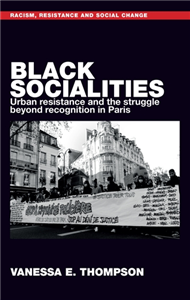
From author: This is a cutting-edge exploration of black urban politics in Parisian racialized working class and working poor districts, the formation of abolition geography, and the possibilities of new forms of political blackness. In Black Socialities. Urban resistance and the struggle beyond recognition in Paris, Vanessa E. Thompson argues that black urban politics in the French banlieues are multi-racial and spatially grounded towards abolition. Based on a close engagement with urban black activist practices against racial imagery in the city, policing and state racism, and housing insecurity, she shows how radical anti-racism goes beyond struggles for recognition and unfolds alongside new formations of political blackness that is based on urban conviviality. This form of black politics has much to teach us in this current conjuncture of liberal anti-racism and state recognition politics.



