
machiavelli edition
Der Verlag machiavelli edition wurde 2012 in Köln gegründet. Er publiziert Texte zur europäischen Literatur, Poesie, Kunst, Wissenschaft, Geschichte und Politik.
View Rights Portal
Der Verlag machiavelli edition wurde 2012 in Köln gegründet. Er publiziert Texte zur europäischen Literatur, Poesie, Kunst, Wissenschaft, Geschichte und Politik.
View Rights Portal
International literary agency with a distinguished list of fiction, non-fiction and children's authors, specializing in foreign rights.
View Rights Portal


The Arctic region has been the subject of much popular writing. This book considers nineteenth-century representations of the Arctic, and draws upon an extensive range of evidence that will allow the 'widest connections' to emerge from a 'cross-disciplinary analysis' using different methodologies and subject matter. It positions the Arctic alongside more thoroughly investigated theatres of Victorian enterprise. In the nineteenth century, most images were in the form of paintings, travel narratives, lectures given by the explorers themselves and photographs. The book explores key themes in Arctic images which impacted on subsequent representations through text, painting and photography. For much of the nineteenth century, national and regional geographical societies promoted exploration, and rewarded heroic endeavor. The book discusses images of the Arctic which originated in the activities of the geographical societies. The Times provided very low-key reporting of Arctic expeditions, as evidenced by its coverage of the missions of Sir John Franklin and James Clark Ross. However, the illustrated weekly became one of the main sources of popular representations of the Arctic. The book looks at the exhibitions of Arctic peoples, Arctic exploration and Arctic fauna in Britain. Late nineteenth-century exhibitions which featured the Arctic were essentially nostalgic in tone. The Golliwogg's Polar Adventures, published in 1900, drew on adult representations of the Arctic and will have confirmed and reinforced children's perceptions of the region. Text books, board games and novels helped to keep the subject alive among the young.
 Trusted Partner
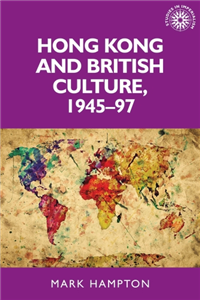
This book examines the British cultural engagement with Hong Kong in the second half of the twentieth century. It shows how the territory fit unusually within Britain's decolonisation narratives and served as an occasional foil for examining Britain's own culture during a period of perceived stagnation and decline. Drawing on a wide range of archival and published primary sources, Hong Kong and British culture, 1945-97 investigates such themes as Hong Kong as a site of unrestrained capitalism, modernisation, and good government, as well as an arena of male social and sexual opportunity. It also examines the ways in which Hong Kong Chinese embraced British culture, and the competing predictions that British observers made concerning the colony's return to Chinese sovereignty. An epilogue considers the enduring legacy of British colonialism.
Trusted Partner
The John Rylands Library houses one of the finest collections of rare books, manuscripts and archives in the world. The collections span five millennia, have a global reach and cover a wide range of subjects, including art and archaeology; economic, social, political, religious and military history; literature, drama and music; science and medicine; theology and philosophy; travel and exploration. For over a century, the Bulletin of the John Rylands Library has published research that complements the Library's special collections. An electronic edition of this issue is freely available under a Creative Commons (CC BY-NC-ND) licence.
Trusted Partner
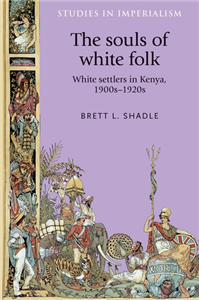
Kenya's white settlers have been alternately celebrated and condemned, painted as romantic pioneers or hedonistic bed-hoppers or crude racists. The souls of white folk examines settlers not as caricatures, but as people inhabiting a unique historical moment. It takes seriously - though not uncritically - what settlers said, how they viewed themselves and their world. It argues that the settler soul was composed of a series of interlaced ideas: settlers equated civilisation with a (hard to define) whiteness; they were emotionally enriched through claims to paternalism and trusteeship over Africans; they felt themselves constantly threatened by Africans, by the state, and by the moral failures of other settlers; and they daily enacted their claims to supremacy through rituals of prestige, deference, humiliation and violence. The souls of white folk will appeal to those interested in the histories of Africa, colonialism, and race, and can be appreciated by scholars and students alike.
Trusted Partner
The John Rylands Library houses one of the finest collections of rare books, manuscripts and archives in the world. The collections span five millennia, have a global reach and cover a wide range of subjects, including art and archaeology; economic, social, political, religious and military history; literature, drama and music; science and medicine; theology and philosophy; travel and exploration. For over a century, the Bulletin of the John Rylands Library has published research that complements the Library's special collections. An electronic edition of this issue is freely available under a Creative Commons (CC BY-NC-ND) licence.
Trusted Partner
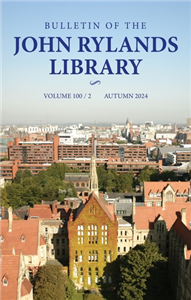
The John Rylands Library houses one of the finest collections of rare books, manuscripts and archives in the world. The collections span five millennia, have a global reach and cover a wide range of subjects, including art and archaeology; economic, social, political, religious and military history; literature, drama and music; science and medicine; theology and philosophy; travel and exploration. For over a century, the Bulletin of the John Rylands Library has published research that complements the Library's special collections.
Trusted Partner

This study of the British colonial administrator James Tod (1782-1835), who spent five years in north-western India (1818-22) collecting every conceivable type of material of historical or cultural interest on the Rajputs and the Gujaratis, gives special attention to his role as a mediator of knowledge about this little-known region of the British Empire in the early nineteenth century to British and European audiences. The book aims to illustrate that British officers did not spend all their time oppressing and inferiorising the indigenous peoples under their colonial authority, but also contributed to propagating cultural and scientific information about them, and that they did not react only negatively to the various types of human difference they encountered in the field.
Trusted Partner
 Trusted Partner
 Trusted Partner
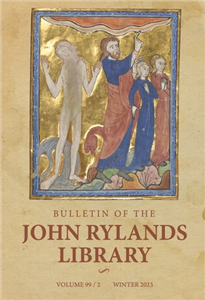
The John Rylands Library houses one of the finest collections of rare books, manuscripts and archives in the world. The collections span five millennia and cover a wide range of subjects, including art and archaeology; economic, social, political, religious and military history; literature, drama and music; science and medicine; theology and philosophy; travel and exploration. For over a century, the Bulletin of the John Rylands Library has published research that complements the Library's special collections. The editors invite the submission of articles in these fields and welcome discussion of in-progress projects.
Trusted Partner
 Trusted Partner
This book seeks to capture the complex experience of the white woman in colonial India through an exploration of gendered interactions over the nineteenth and early twentieth centuries. It examines missionary and memsahibs' colonial writings, both literary and non-literary, probing their construction of Indian women of different classes and regions, such as zenana women, peasants, ayahs and wet-nurses. Also examined are delineations of European female health issues in male authored colonial medical handbooks, which underline the misogyny undergirding this discourse. Giving voice to the Indian woman, this book also scrutinises the fiction of the first generation of western-educated Indian women who wrote in English, exploring their construction of white women and their negotiations with colonial modernities. This fascinating book will be of interest to the general reader and to experts and students of gender studies, colonial history, literary and cultural studies as well as the social history of health and medicine.
Trusted Partner
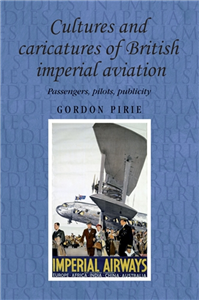
The new activity of trans-continental civil flying in the 1930s is a useful vantage point for viewing the extension of British imperial attitudes and practices. Cultures and caricatures of British imperial aviation examines the experiences of those (mostly men) who flew solo or with a companion (racing or for leisure), who were airline passengers (doing colonial administration, business or research), or who flew as civilian air and ground crews. For airborne elites, flying was a modern and often enviable way of managing, using and experiencing empire. On the ground, aviation was a device for asserting old empire: adventure and modernity were accompanied by supremacism. At the time, however, British civil imperial flying was presented romantically in books, magazines and exhibitions. Eighty years on, imperial flying is still remembered, reproduced and re-enacted in caricature. ;
Trusted Partner
 Trusted Partner
This book contributes to the growing literature on the role of the British non-settler empire in the Great War by exploring the service of the Cypriot Mule Corps on the Salonica Front, and after the war in Constantinople. Varnava encompasses all aspects of the story of the Mule Corps, from the role of the animals to the experiences of the men driving them both during and after the war, as well as how and why this significant story in the history of Cyprus and the British Empire has been forgotten. The book will be of great value to anyone interested in the impact of the Great War upon the British Empire in the Mediterranean, and vice- versa.
Trusted Partner
Trusted Partner
Trusted Partner

This book outlines the ways sport helps to create transnational social fields that interconnect migrants dispersed across a region known as the Black Atlantic: England, North America and the Caribbean. Many Caribbean men's stories about their experiences migrating to Canada, settling in Toronto, finding jobs and travelling involved some contact with a cricket and social club. This book offers a unique contribution to black diaspora studies through showing sport as a means of allaying the pain of ageing in the diaspora, creating transnational social networks and marking ethnic boundaries on a local scale. The book also brings black diaspora analysis to sport research, and through a close look at what goes on before, during and after cricket matches provides insights into the dis-unities, contradictions and complexities of Afro-diasporic identity in multicultural Canada. It will be of interest to students and scholars in sociology, sport studies and black diaspora studies.
Trusted Partner



