
Andrew Nurnberg Associates Ltd.
International literary agency with a distinguished list of fiction, non-fiction and children's authors, specializing in foreign rights.
View Rights Portal
International literary agency with a distinguished list of fiction, non-fiction and children's authors, specializing in foreign rights.
View Rights Portal
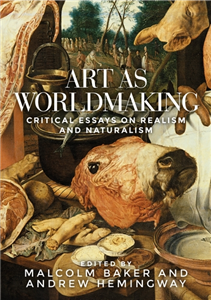
Introduction : Realism and its others in the 21st century: Why Realism won't go away - Andrew Hemingway Part I: Theory 1. The figure as double agent: realism and abstraction in European post-war art - Briony Fer 2. Realism's Credibility Problem - Joshua Shannon 3. If only; only if ... - Adrian Rifkin Part II: Sculpture 4. Confronting the Veristic Sculptural Portrait - Malcolm Baker 5. Sculpture, Realism and the Neo-classical Ideal - Martina Droth 6. Elasticity and Victorian Sculptural Form - Caroline Arscott 7. Image of the People: Charles Ray's Recent Work - Anne M. Wagner Part III: Garden Design 8. Of Gardens and Persons: the English Engagement with China's Garden Design - Martin Powers 9. Traditional Views. Conservative Anti-Naturalism and Landscape Aesthetics in France around 1900 - Neil McWilliam Part IV: Painting and Photography 10. Willem Kalf on Reflexykonst and the Aesthetics of Transformation in Still Life - Celeste Brusati 11. Democratic light: phenomenology and the worldliness of painting - Brendan Prendeville 12. The Visibility of Labor - T.J. Clark 13. Body and Soul in the work of Thomas Eakins and F. Holland Day - Rebecca Zurier Part V: Photography and Conema 14. Photography as counter forensics - Steve Edwards 15. Woman, War and Social Documentary Photography in South Africa - Tamar Garb 16. Antonioni's Blow-Up (1966): photography and film - Lisa Tickner Part VI: Post-Media / Contemporary Practice 17. Peter Dreher's Everyday Realism - Alistair Rider 18. From grey and rainy Vermont - Thomas Crow 19. 'Every day, something happens to us': Realism at the crossroads - Gail Day Index
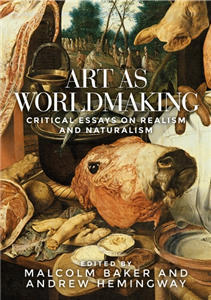
Art as worldmaking is a response to Alex Potts's provocative 2013 book Experiments in modern realism. Twenty essays by leading scholars test Potts's recasting of realism through examinations of art produced in different media and periods, ranging from eighth-century Chinese garden aesthetics to video work by the contemporary Russian collective Radek Community. While the book does not neglect avatars of pictorial realism such as Menzel and Eakins, or the question of nineteenth-century realism's historical antecedents, it is contemporary in orientation in that many contributors are particularly concerned with the questions that sculpture, photography and non-traditional media pose for realism as an aesthetic norm. It will be essential reading for students of art history concerned with art's truth value or more broadly with conceptual problems of representation and the intersections of art and politics.
 Trusted Partner
One of Britain's foremost TV practitioners, Andrew Davies is the creator of programmes such as 'A Very Peculiar Practice', 'To Serve Them All My Days', 'Pride and Prejudice', 'Othello' and 'The Way We Live Now'. Although best known for his adaptations of the work of writers such as Jane Austen and George Eliot, he has written numerous original drama series, single plays, films, stage plays and books. This volume offers a critical appraisal of Davies's work, and assesses his contribution to British television. Cardwell also explores the conventional notions of authorship and auteurism which are challenged by Davies's work. Can we identify Davies as the author of the varied texts attributed to him? If so, does an awareness of his authorial role aid our interpretation and evaluation of those texts? How does the phenomenon of adaptation affect the issue of authorship? How important is 'the author' to television? This book will appeal to both an academic readership, and to the many people who have taken pleasure in Davies's work. ;
Trusted Partner
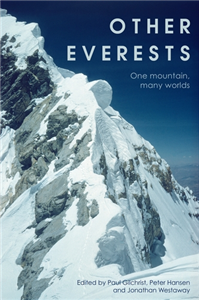
A hundred years after the tragic 1924 British Everest expedition, this collection explores the wider social and cultural history of the mountain. Mount Everest looms large in the popular imagination. Since the deaths of mountaineers George Mallory and Andrew Irvine in 1924, histories of the mountain have overwhelmingly focused on the mythologies of western male adventure and conquest. But there are many more stories waiting to be told. Other Everests brings together new voices and perspectives on the historical and cultural significance of Everest in the modern world. The book shines a light on the overlooked role of local people and high-altitude workers, while also revealing the significant contributions women have made to climbing the mountain and writing its history. It explores the depiction of Everest in a range of media and investigates how the forces of nationalism and commercialism have shaped many different 'Everests'. After years of exploitation, Indigenous people are now reclaiming Mount Everest in the twenty-first century. Other Everests re-examines the past and present of the world's highest peak, presenting an exciting vision of what Everest might become in the future.
Trusted Partner
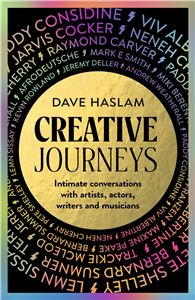
Dave Haslam presents conversations with creative trailblazers. Over forty years, DJ, writer and broadcaster Dave Haslam has interviewed some of the most fascinating figures in music, literature, film and art. Creative journeys gathers revelatory conversations with creative characters including Neneh Cherry, Maxine Peake, Lemn Sissay, Andrew Weatherall, Raymond Carver and Jeremy Deller. From politics and performance to art, fame and addiction, Haslam's interviewees speak with honesty about their creative journeys. Viv Albertine discusses 'Typical Girls' and Paddy Considine recalls Dead Man's Shoes. Jarvis Cocker goes deep into 'This is Hardcore'. Terry Hall and Miki Berenyi speak about childhood trauma. Bernard Sumner recalls the loss of Ian Curtis. Jonathan Franzen talks about torturing his characters. There's darkness but much humour too. The interviews provide fascinating stories of unorthodox, creative artists navigating negativity and personal setbacks to become celebrated cultural icons.
Trusted Partner


Testamentarisch hat Uwe Johnson die Peter Suhrkamp-Stiftung und seinen Verleger Siegfried Unseld zum Nachlaßverwalter eingesetzt. Siegfried Unseld beschreibt, wie es dazu kam, beschreibt aus seiner Sicht noch einmal die Begleitumstände, die das große Werk »Jahrestage« zu vollenden ermöglichten. »Für wenn ich tot bin«: es war Uwe Johnsons Wunsch, daß sein Nachlaß gesammelt und nach Frankfurt gebracht wurde. Siegfried Unseld konnte in Verbindung mit der Johann Wolfgang Goethe-Universität ein Uwe Johnson-Archiv einrichten, das dem Gedenken des großen Schriftstellers dient. Eberhard Fahlke, Leiter des Uwe Johnson-Archivs und ausgewiesener Johnson-Forscher, beschreibt in seinem Beitrag die Einrichtung und Anlage des Archivs, welches in seiner Art einzigartig ist.
Trusted Partner
Trusted Partner
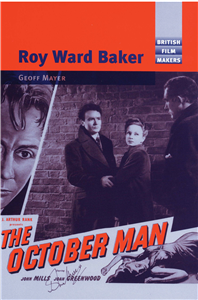
This book traces the career of Roy Ward Baker, one of the great survivors of the British film and television industry. He directed the landmark British film Morning Departure (1949), worked at Twentieth Century Fox in Hollywood in the early 1950s where he directed Marilyn Monroe's 'breakthrough' film (Don't Bother to Knock), and followed this with a succession of fine films for Rank, culminating in the best version of the Titanic disaster, A Night to Remember in 1958. Yet within three years he was unable to secure a job in the British film industry and he moved to television series such as The Avengers, The Saint and Minder. Later Baker re-emerged as a major director of science-fiction (Quatermass and the Pit) and horror films (Asylum). Geoff Mayer provides an industrial and aesthetic context in which to understand the interrelationship between a skilled classical director and the transformation of the British film industry in the 1950s. ;
Trusted Partner
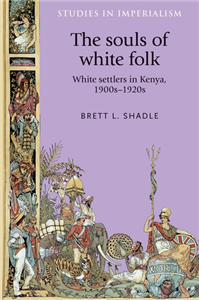
Kenya's white settlers have been alternately celebrated and condemned, painted as romantic pioneers or hedonistic bed-hoppers or crude racists. The souls of white folk examines settlers not as caricatures, but as people inhabiting a unique historical moment. It takes seriously - though not uncritically - what settlers said, how they viewed themselves and their world. It argues that the settler soul was composed of a series of interlaced ideas: settlers equated civilisation with a (hard to define) whiteness; they were emotionally enriched through claims to paternalism and trusteeship over Africans; they felt themselves constantly threatened by Africans, by the state, and by the moral failures of other settlers; and they daily enacted their claims to supremacy through rituals of prestige, deference, humiliation and violence. The souls of white folk will appeal to those interested in the histories of Africa, colonialism, and race, and can be appreciated by scholars and students alike.
Trusted Partner

New D.H. Lawrence uses current and emergent approaches in literary studies to explore one of Britain's major modernist writers. The collection features new work by the present generation of Lawrence scholars, who are brought together here for the first time. Chapters include: Andrew Harrison on the marketing of Sons and Lovers; Howard J. Booth on The Rainbow, Marxist criticism and colonialism; Holly A. Laird on ethics and suicide in Women in Love; Hugh Stevens on psychoanalysis and war in Women in Love; Jeff Wallace on Lawrence, Deleuze and abstraction; Stefania Michelucci on myth and war in 'The Ladybird'; Bethan Jones on gender and comedy in the late short fiction; Fiona Becket on green cultural critique, Apocalypse and Birds, Beasts and Flowers; and Sean Matthews on class, Leavis and the trial of Lady Chatterley. New D.H. Lawrence will be of interest to all concerned with contemporary writing on Lawrence, modernism and English radical cultures. ;
Trusted Partner


This book, the world's first biography of Paul Watzlawick, written by his great-niece, describes the life of this philosopher, therapist, and best-selling author. Paul Watzlawick had a talent for languages and he led an adventurous life, from his childhood in Villach to studying in Venice after the war, to analyst training under C. G. Jung in Zurich, an attempt at establishing himself in India and then in El Salvador as a therapist, and finally to the Mental Research Institute (MRI) in the United States, headed by Don D. Jackson, a venerable scientist. This marked the beginning of the second half of his life, his amazing career as a communication researcher, a pioneer of systemic therapy, a radical constructivist, and a great thinker regarding the divisions between East and West. With many letters, lectures, interviews, and statements from contemporary witnesses and family members, this book makes Paul Watzlawick accessible as a human being and as a spiritually inspired, leading 20th century thinker. It includes a variety of unpublished material from Watzlawick, and introduces a comprehensive and exciting picture of the scientist and cosmopolitan person, Paul Watzlawick. Target Group: For people interest in Paul Watzlawick, communication sciences, systemic therapy, and constructivism.
Trusted Partner

Uwe Johnson ist im Februar 1984 in Sheerness-on-Sea in der englischen Grafschaft Kent gestorben. Siegfried Unseld, »Freund, Leser, Verleger« nach Johnsons Worten, beschreibt Leben und Werk und die Begleitumstäne, unter denen das große Werk »Jahrestage« vollendet wurde.
Trusted Partner

 Trusted Partner
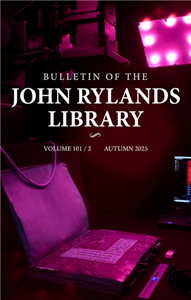
The John Rylands Library houses one of the finest collections of rare books, manuscripts and archives in the world. The collections span five millennia, have a global reach and cover a wide range of subjects, including art and archaeology; economic, social, political, religious and military history; literature, drama and music; science and medicine; theology and philosophy; travel and exploration. For over a century, the Bulletin of the John Rylands Library has published research that complements the Library's special collections. An electronic edition of this issue is freely available under a Creative Commons (CC BY-NC-ND) licence.
Trusted Partner
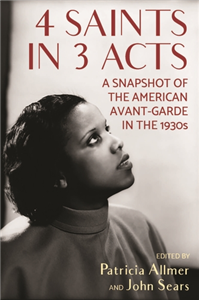
Four Saints in Three Acts by Gertrude Stein and Virgil Thomson was a major avant-garde phenomenon of the 1930s, an experimental opera that nonetheless achieved remarkable popular success. Photography was a key element of that success, but its complex roles in the construction, representation and dissemination of the opera have hitherto received little critical attention. The photographic recording of the all-African American cast in particular affords a unique insight into the complexities of Four Saints in relation to the Harlem Renaissance and the New York avant-gardes of the time. This book, published in collaboration with The Photographers' Gallery, London, presents a wide selection of photographs of the cast, performances, and other material - many images reproduced for the first time - alongside essays by an international range of scholars exploring different aspects of the opera, including dance, fashion, music, and avant-garde writing, as well as photography.
Trusted Partner
Trusted Partner
Trusted Partner

This study of the British colonial administrator James Tod (1782-1835), who spent five years in north-western India (1818-22) collecting every conceivable type of material of historical or cultural interest on the Rajputs and the Gujaratis, gives special attention to his role as a mediator of knowledge about this little-known region of the British Empire in the early nineteenth century to British and European audiences. The book aims to illustrate that British officers did not spend all their time oppressing and inferiorising the indigenous peoples under their colonial authority, but also contributed to propagating cultural and scientific information about them, and that they did not react only negatively to the various types of human difference they encountered in the field.
Trusted Partner
Trusted Partner




