Spatterlight
We manage rights for science-fiction and fantasy legend Jack Vane (1916 - 2013) and selected titles by Tanith Lee, Michael Shea, Matthew Hughes, and others.
View Rights Portal
We manage rights for science-fiction and fantasy legend Jack Vane (1916 - 2013) and selected titles by Tanith Lee, Michael Shea, Matthew Hughes, and others.
View Rights Portal
Sparsile Books is an independent publisher, based in Glasgow, specialising in high quality fiction and non-fiction. We see publishing as an art in itself, and work closely with our authors to ensure that the books we publish give readers a unique vision of the world. Since our beginning in 2018, we have been fortunate to discover some truly exceptional writers, and look forward to developing many more.
View Rights Portal

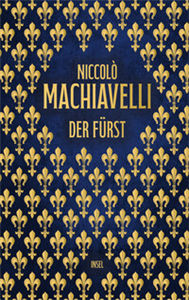
Wer heute in der freien Wirtschaft, in Industrie und Politik Verantwortung übernimmt und Entscheidungen fallen muß, dem bleibt es nicht erspart, sich die ausgeklügelten Machtspiel-Gesetze anzueignen.


This book offers a fresh look at some of the most challenging dilemmas of European integration and proposes innovative solutions to them by building on perspectives and insights from twelve classical authors in the history of political thought. The book simultaneously offers an original introduction to critical debates in EU studies and makes key political thinkers more accessible to contemporary readers by presenting present-day policy applications of their doctrines. While each chapter discusses a specific challenge for the EU, five key themes appear recurrently throughout the book: (i) the prospects for peace in Europe; (ii) the conditions for an inclusive EU democracy; (iii) socioeconomic inequalities in the EU; (iv) strategies to promote political change in Europe; and (v) the requisites for a fully-fledged EU citizenship. The authors discussed are Plato, Aristotle, Augustine, Machiavelli, Hobbes, Rousseau, Kant, Wollstonecraft, Marx, Arendt, Rawls and hooks.
 Trusted Partner

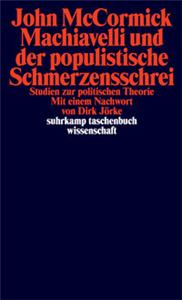
Seit zwei Jahrzehnten tritt der Politwissenschaftler John McCormick für eine »demokratische Wende« in der Forschung zu Machiavelli ein, indem er die plebejischen, antioligarchischen und sogar »populistischen« Züge von dessen politischem Denken betont. Wie die bahnbrechenden Aufsätze in diesem Band zeigen, ist Machiavelli überraschend relevant für die Analyse der gegenwärtigen Krise der Demokratie, die durch Populismus und Plutokratie gekennzeichnet ist. Mit seiner Hilfe, so McCormick, lassen sich unsere demokratischen Verfassungen neu gestalten, so dass die Bürgerinnen und Bürger die Korruption von Oligarchen vereiteln und sich direkter sowie umfassender am politischen Geschehen beteiligen können.
Trusted Partner
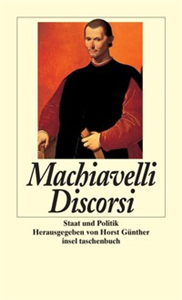
Die Discorsi sind das grundlegende Werk Machiavellis (1469-1527). Hier entdeckt er, ähnlich wie Kolumbus, einen neuen Kontinent: die Wissenschaft der Politik.Und er schreibt eine bestechend klare italienische Prosa.
Trusted Partner

 Trusted Partner
Trusted Partner
Trusted Partner
Trusted Partner
Trusted Partner
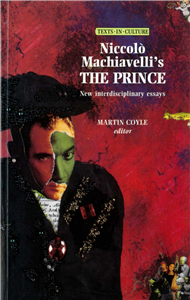
No text has attracted more controversy over the centuries than Machiavelli's The Prince. Placed on the Index of Prohibited Books by the Catholic Church in 1599, The Prince nevertheless proved to be the means by which Machiavelli came to be known throughout Europe, establishing his name as a byword for the cunning and unscrupulous politician. Written as the medieval world was giving way to the new dynamic of renaissance capitalism, The Prince embodies a whole series of vital issues that affect our understanding of modern politics, including power and morality, history and human nature, language and meaning, gender and government. It is these issues which the essays in this volume debate and explore from a variety of perspectives, from the original responses to The Prince through to feminist and deconstructive approaches. The result is a volume packed with ideas and insights. With contributions by international scholars and critics, a chronological table and select bibliography, this is an essential guide for anyone studying Machiavelli. ;
Trusted Partner
Trusted Partner
Trusted Partner
Trusted Partner

Der Principe ist bis in neueste Zeit immer wieder aufgelegt worden, er wurde in alle Kultursprachen übersetzt, immer wieder kommentiert, angefochten und leidenschaftlich verteidigt.
Trusted Partner
Trusted Partner
Trusted Partner
Trusted Partner
Trusted Partner
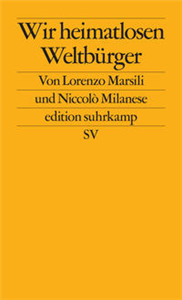
»Milanese und Marsili haben ihren Finger am Puls Europas. Pflichtlektüre für alle, die von einem anderen, demokratischen und sozialen Europa träumen.« Ulrike Guérot Europa gleicht einem Kontinent, der sich selbst zerreißt. Nach zehn Jahren der Krise durchziehen vielfältige Brüche und Konflikte die EU: Norden gegen Süden, Osten gegen Westen, Bürger gegen Institutionen. Zugleich hat diese Dekade jedoch gezeigt, was Europäerinnen und soziale Bewegungen erreichen können, wenn sie über Grenzen hinweg zusammenarbeiten. Lorenzo Marsili und Niccolò Milanese stellen Aktivistinnen und Aktivisten vor, in deren Handeln Alternativen zum Status quo aufscheinen. Sie analysieren, wie Neoliberalismus und Globalisierung die Menschen zu ohnmächtigen Bürgern machen, in denen das Gefühl wächst, nirgendwo mehr zuhause zu sein, und die sich daher verstärkt nationalistischen Positionen zuwenden. Nur eine transnationale Partei, so die Autoren in ihrem Manifest, kann diese Zwickmühle auflösen und das utopische Potenzial Europas einlösen.
Trusted Partner

Elena Esposito lehrt Soziologie an der Universität Modena e Reggio Emilia. Elena Esposito lehrt Soziologie an der Universität Modena e Reggio Emilia.
Trusted Partner

 Trusted Partner
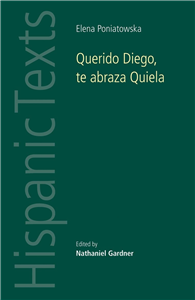
One of the threads that runs through Elena Poniatowska's oeuvre is that of foreigners who have fallen in love with Mexico and its people. This is certainly the case of Querido Diego, te abraza Quiela - a brief novel (so short it was originally published in its entirety in Octavio Paz's literary magazine Vuelta). The Russian exile and painter Angelina Beloff writes from the cold and impoverished post-war Paris to Diego Rivera, her spouse of over ten years. Beloff sends these letters to which there is no response during a time when the emancipation of women has broken many of the standard models and the protagonist struggles to fashion her own. Elena Poniatowska has (re)created these letters and within them one finds the unforgettable testimony of an artist and her lover during the valuable crossroads of a new time when Diego Rivera was forging a new life in his native country. In this edition, Nathanial Gardner comments on the truth and fiction Poniatowska has woven together to form this compact, yet rich, modern classic. Using archives in London, Paris and Mexico City (including Angelina's correspondence held in Frida Kahlo's own home) as well as interviews from the final remaining characters who knew the real Angelina, Gardner offers a mediation of the text and its historical groundings as well as critical commentary. This edition will appeal to both students and scholars of Latin American Studies as well as lovers of Mexican Literature and Art in general.