
Andrew Nurnberg Associates Ltd.
International literary agency with a distinguished list of fiction, non-fiction and children's authors, specializing in foreign rights.
View Rights Portal
International literary agency with a distinguished list of fiction, non-fiction and children's authors, specializing in foreign rights.
View Rights Portal
Gelobtes Land, die dystopische Climate Fiction Trilogie: Mit CO2 verbindet man den Klimawandel, schmelzende Gletscher und Überflutungen. Mittlerweile ist der Klimawandel auch in der Literatur angekommen. „Climate Fiction“ oder „Cli-fi“ lautet das Stichwort, das zuletzt verstärkt in den Feuilletons auftauchte. Die deutsche Autorin Christine Heimannsberg präsentiert mit ihrer Debüt-Trilogie „Gelobtes Land“ eine ungewöhnliche, spannende Dystopie, die ökologische wie humanistische Themen geschickt im neuen Genre zusammenführt.
View Rights Portal

This electronic version has been made available under a Creative Commons () open access license. Beyond text? Critical practices and sensory anthropology is about the relationship between anthropological understandings of the world, sensory perception and aesthetic practices. It suggests that if different sensory experiences embody and facilitate different kinds of knowledge, then we need to develop new methods and more creative forms of representation that are not based solely around text or on correspondence theories of truth. The volume brings together leading figures in anthropology, visual and sound studies to explore how knowledge, sensation and embodied experiences can be researched and represented by combining different visual, aural and textual forms which it demonstrates through an accompanying DVD. The book and DVD make an argument for a necessary, critical development in anthropological ways of knowing that take place not merely at the level of theory and representation but also through innovative fieldwork methods and media practices.
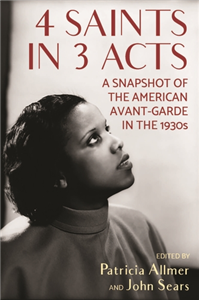
Four Saints in Three Acts by Gertrude Stein and Virgil Thomson was a major avant-garde phenomenon of the 1930s, an experimental opera that nonetheless achieved remarkable popular success. Photography was a key element of that success, but its complex roles in the construction, representation and dissemination of the opera have hitherto received little critical attention. The photographic recording of the all-African American cast in particular affords a unique insight into the complexities of Four Saints in relation to the Harlem Renaissance and the New York avant-gardes of the time. This book, published in collaboration with The Photographers' Gallery, London, presents a wide selection of photographs of the cast, performances, and other material - many images reproduced for the first time - alongside essays by an international range of scholars exploring different aspects of the opera, including dance, fashion, music, and avant-garde writing, as well as photography.
 Trusted Partner
The John Rylands Library houses one of the finest collections of rare books, manuscripts and archives in the world. The collections span five millennia, have a global reach and cover a wide range of subjects, including art and archaeology; economic, social, political, religious and military history; literature, drama and music; science and medicine; theology and philosophy; travel and exploration. For over a century, the Bulletin of the John Rylands Library has published research that complements the Library's special collections. An electronic edition of this issue is freely available under a Creative Commons (CC BY-NC-ND) licence.
Trusted Partner
The John Rylands Library houses one of the finest collections of rare books, manuscripts and archives in the world. The collections span five millennia, have a global reach and cover a wide range of subjects, including art and archaeology; economic, social, political, religious and military history; literature, drama and music; science and medicine; theology and philosophy; travel and exploration. For over a century, the Bulletin of the John Rylands Library has published research that complements the Library's special collections. An electronic edition of this issue is freely available under a Creative Commons (CC BY-NC-ND) licence.
Trusted Partner
The Arctic region has been the subject of much popular writing. This book considers nineteenth-century representations of the Arctic, and draws upon an extensive range of evidence that will allow the 'widest connections' to emerge from a 'cross-disciplinary analysis' using different methodologies and subject matter. It positions the Arctic alongside more thoroughly investigated theatres of Victorian enterprise. In the nineteenth century, most images were in the form of paintings, travel narratives, lectures given by the explorers themselves and photographs. The book explores key themes in Arctic images which impacted on subsequent representations through text, painting and photography. For much of the nineteenth century, national and regional geographical societies promoted exploration, and rewarded heroic endeavor. The book discusses images of the Arctic which originated in the activities of the geographical societies. The Times provided very low-key reporting of Arctic expeditions, as evidenced by its coverage of the missions of Sir John Franklin and James Clark Ross. However, the illustrated weekly became one of the main sources of popular representations of the Arctic. The book looks at the exhibitions of Arctic peoples, Arctic exploration and Arctic fauna in Britain. Late nineteenth-century exhibitions which featured the Arctic were essentially nostalgic in tone. The Golliwogg's Polar Adventures, published in 1900, drew on adult representations of the Arctic and will have confirmed and reinforced children's perceptions of the region. Text books, board games and novels helped to keep the subject alive among the young.
Trusted Partner
The John Rylands Library houses one of the finest collections of rare books, manuscripts and archives in the world. The collections span five millennia, have a global reach and cover a wide range of subjects, including art and archaeology; economic, social, political, religious and military history; literature, drama and music; science and medicine; theology and philosophy; travel and exploration. For over a century, the Bulletin of the John Rylands Library has published research that complements the Library's special collections.
Trusted Partner

The Toronto New Wave (TNW) comprises a group of avant-garde filmmakers working in Canada from the 1980s and into the new millennium whose innovative film works share significant affinities with anarchist themes and aesthetics. Several of the TNW filmmakers openly identify as anarchists and/or acknowledge a debt to anarchism in their production of highly apocalyptic narratives as part of their cinematic political projects. However, recognition of anarchism's progressive apocalyptic theoretical relevance has yet to be substantially taken up by scholarship in cinema analysis. This analysis introduces an anarchist-inflected analytical methodology to understand the apocalyptic-revelatory political work these films attempt to accomplish in the perceptual space between the filmic texts and both their auteurs and potential viewers, and to re-locate the TNW within cinema history as an ongoing phenomenon with new significance in an apocalyptic era of digital distribution.
Trusted Partner

A Vision of Battlements is the first novel by the writer and composer Anthony Burgess, who was born in Manchester in 1917. Set in Gibraltar during the Second World War, the book follows the fortunes of Richard Ennis, an army sergeant and incipient composer who dreams of composing great music and building a new cultural world after the end of the war. Following the example of his literary hero, James Joyce, Burgess takes the structure of his book from Virgil's Aeneid. The result is, like Joyce's Ulysses, a comic rewriting of a classical epic, whose critique of the Army and the postwar settlement is sharp and assured. The Irwell Edition is the first publication of Burgess's forgotten masterpiece since 1965. This new edition includes an introduction and notes by Andrew Biswell, author of a prize-winning biography of Anthony Burgess.
Trusted Partner
The John Rylands Library houses one of the finest collections of rare books, manuscripts and archives in the world. The collections span five millennia and cover a wide range of subjects, including art and archaeology; economic, social, political, religious and military history; literature, drama and music; science and medicine; theology and philosophy; travel and exploration. For over a century, the Bulletin of the John Rylands Library has published research that complements the Library's special collections. The editors invite the submission of articles in these fields and welcome discussion of in-progress projects.
Trusted Partner
One of Britain's foremost TV practitioners, Andrew Davies is the creator of programmes such as 'A Very Peculiar Practice', 'To Serve Them All My Days', 'Pride and Prejudice', 'Othello' and 'The Way We Live Now'. Although best known for his adaptations of the work of writers such as Jane Austen and George Eliot, he has written numerous original drama series, single plays, films, stage plays and books. This volume offers a critical appraisal of Davies's work, and assesses his contribution to British television. Cardwell also explores the conventional notions of authorship and auteurism which are challenged by Davies's work. Can we identify Davies as the author of the varied texts attributed to him? If so, does an awareness of his authorial role aid our interpretation and evaluation of those texts? How does the phenomenon of adaptation affect the issue of authorship? How important is 'the author' to television? This book will appeal to both an academic readership, and to the many people who have taken pleasure in Davies's work. ;
Trusted Partner


There he stands, the man the whole of Spain cheered, before whom the most catholic regents Isabella and Ferdinand rose to their feet, his eyes on his ship Capitana, devoured by shipworm, stranded off Jamaica. Some of the crew mutiny, the locals can no longer be fobbed off with glass beads, the Spanish on the nearby island of Hispaniola do not help, the world doesn‘t want anything to do with him, the demanding whinger. He, Christopher Columbus, is a John Lackland, a king without land, a conqueror without conquest. Between fiction and historical truth, Wolfgang Wissler recounts the legendary sailor‘s last expedition in an entirely new way – and what a story it is!
Trusted Partner
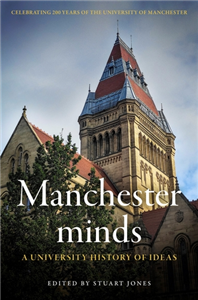
A bicentennial celebration of brilliant thinkers from The University of Manchester's history. The year 2024 marks two centuries since the establishment of The University of Manchester in its earliest form. The first of England's civic universities, Manchester has been home and host to a huge number of influential thinkers and generated world-changing ideas. This book presents a rich account of the remarkable contribution that people associated with The University of Manchester have made to human knowledge. A who's who of Manchester greats, it presents fascinating snapshots of pioneering artists, scholars and scientists, from the poet and activist Eva Gore-Booth to the economist Arthur Lewis, the computer scientist Alan Turing and the physicist Brian Cox.
Trusted Partner
 Trusted Partner
Forker's critical edition fills the need for a fully annotated, historically contextualised and modernised text of the most important Elizabethan chronicle play apart from Shakespeare and Marlowe's Edward II. Now attributed definitely to George Peele, this drama helped to establish a major theatrical genre, raising contemporary political and religious issues through the dramatisation of medieval history in a compelling and popular fashion. A major source for Shakespeare, it throws new light on the bard's adaptation of earlier drama and helps to illustrate his working methods. With the full introduction and generous notes this Revels Plays edition will be the first port of call for students and enthusiasts of Elizabethan and early modern drama. ;
Trusted Partner
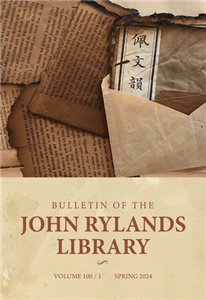
The John Rylands Library houses one of the finest collections of rare books, manuscripts and archives in the world. The collections span five millennia, have a global reach and cover a wide range of subjects, including art and archaeology; economic, social, political, religious and military history; literature, drama and music; science and medicine; theology and philosophy; travel and exploration. For over a century, the Bulletin of the John Rylands Library has published research that complements the Library's special collections.
Trusted Partner
Trusted Partner

Dave Haslam presents conversations with creative trailblazers. Over forty years, DJ, writer and broadcaster Dave Haslam has interviewed some of the most fascinating figures in music, literature, film and art. Creative journeys gathers revelatory conversations with creative characters including Neneh Cherry, Maxine Peake, Lemn Sissay, Andrew Weatherall, Raymond Carver and Jeremy Deller. From politics and performance to art, fame and addiction, Haslam's interviewees speak with honesty about their creative journeys. Viv Albertine discusses 'Typical Girls' and Paddy Considine recalls Dead Man's Shoes. Jarvis Cocker goes deep into 'This is Hardcore'. Terry Hall and Miki Berenyi speak about childhood trauma. Bernard Sumner recalls the loss of Ian Curtis. Jonathan Franzen talks about torturing his characters. There's darkness but much humour too. The interviews provide fascinating stories of unorthodox, creative artists navigating negativity and personal setbacks to become celebrated cultural icons.
Trusted Partner
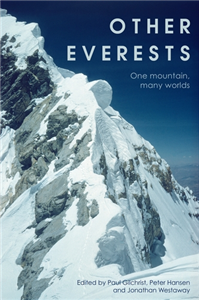
A hundred years after the tragic 1924 British Everest expedition, this collection explores the wider social and cultural history of the mountain. Mount Everest looms large in the popular imagination. Since the deaths of mountaineers George Mallory and Andrew Irvine in 1924, histories of the mountain have overwhelmingly focused on the mythologies of western male adventure and conquest. But there are many more stories waiting to be told. Other Everests brings together new voices and perspectives on the historical and cultural significance of Everest in the modern world. The book shines a light on the overlooked role of local people and high-altitude workers, while also revealing the significant contributions women have made to climbing the mountain and writing its history. It explores the depiction of Everest in a range of media and investigates how the forces of nationalism and commercialism have shaped many different 'Everests'. After years of exploitation, Indigenous people are now reclaiming Mount Everest in the twenty-first century. Other Everests re-examines the past and present of the world's highest peak, presenting an exciting vision of what Everest might become in the future.
Trusted Partner
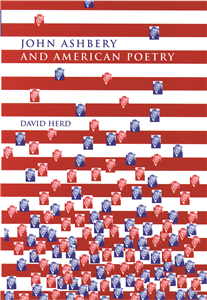
starting point. David Herd sets out to provide readers with a new critical language through which they can appreciate the beauty and complexity of Ashbery's writing. Presenting the poet in all his forms -avant-garde, nostalgic, sublime and camp - the book argues that the perpetual inventiveness of Ashbery's work has always been underpinned by the poets desire to write the poem fit to cope with its occasion. Tracing Ashbery's development in the light of this idea, and from its origins in the dazzling artistic environment of 1950's New York, the book evaluates his poetry against the aesthetic, literary and historical backgrounds that have informed it. The story of a brilliant career, and a history of the period in which that career has taken shape, John Ashbery and American Poetry provides a compelling account of Ashbery's importance to Twentieth Century Literature. ;
Trusted Partner


This book, the world's first biography of Paul Watzlawick, written by his great-niece, describes the life of this philosopher, therapist, and best-selling author. Paul Watzlawick had a talent for languages and he led an adventurous life, from his childhood in Villach to studying in Venice after the war, to analyst training under C. G. Jung in Zurich, an attempt at establishing himself in India and then in El Salvador as a therapist, and finally to the Mental Research Institute (MRI) in the United States, headed by Don D. Jackson, a venerable scientist. This marked the beginning of the second half of his life, his amazing career as a communication researcher, a pioneer of systemic therapy, a radical constructivist, and a great thinker regarding the divisions between East and West. With many letters, lectures, interviews, and statements from contemporary witnesses and family members, this book makes Paul Watzlawick accessible as a human being and as a spiritually inspired, leading 20th century thinker. It includes a variety of unpublished material from Watzlawick, and introduces a comprehensive and exciting picture of the scientist and cosmopolitan person, Paul Watzlawick. Target Group: For people interest in Paul Watzlawick, communication sciences, systemic therapy, and constructivism.

