
Your Search Results


-
Promoted Content

 The ArtsJanuary 1905
The Elements of Drawing
by John Ruskin
Can drawing — sound, honest representation of the world as the eye sees it, not tricks with the pencil or a few "effects" — be learned from a book? One of the most gifted draftsmen, who is also one of the greatest art critics and theorists of all time, answers that question with a decided "Yes." He is John Ruskin, the author of this book, a classic in art education as well as a highly effective text for the student and amateur today. The work is in three parts, cast in the form of letters to a student, successively covering "First Practice," "Sketching from Nature," and "Colour and Composition." Starting with the bare fundamentals (what kind of drawing pen to buy; shading a square evenly), and using the extremely practical method of exercises which the student performs from the very first, Ruskin instructs, advises, guides, counsels, and anticipates problems with sensitivity. The exercises become more difficult, developing greater and greater skills until Ruskin feels his reader is ready for watercolors and finally composition, which he treats in detail as to the laws of principality, repetition, continuity, curvature, radiation, contrast, interchange, consistency, and harmony. All along the way, Ruskin explains, in plain, clear language, the artistic and craftsmanlike reasons behind his practical advice — underlying which, of course, is Ruskin's brilliant philosophy of honest, naturally observed art which has so much affected our aesthetic. Three full-page plates and 48 woodcuts and diagrams (the latter from drawings by the author) show the student what the text describes. An appendix devotes many pages to the art works which may be studied with profit.
-
Promoted Content

 Literature & Literary StudiesJune 2024
The poems of Elizabeth Siddal in context
by Anne Woolley
A ground breaking new book that considers all Siddal poems with reference to female and primarily male counterparts, adding substantially to knowledge of her work as a writer, and their shared contemporary concerns. Dante Rossetti, Swinburne, Tennyson, Ruskin and Keats were either known to her or a source of influence on the Pre-Raphaelite Brotherhood with which she was associated, and certain of their texts are compared with hers to discuss interplay between erotic and spiritual love, the ballad tradition, nineteenth-century feminism, and the Romantic concept of the conjoined physical and spectral body. Siddal's artwork is used to introduce each chapter, while other Pre-Raphaelite paintings illuminate the texts and further the inter-disciplinary philosophy of the Brotherhood. This important and stimulating book focuses on the intrinsic merit of Siddal's poetics whilst advocating a research method that could have multiple applications elsewhere.
-
 Trusted Partner
-
Trusted Partner

 September 1972
Lear
by Edward Bond, Christian Enzensberger, Jörg Wehmeier, Edward Bond
Hilde Spiel in der Weltwoche: »Mit seinem ›Lear‹ ist Bond an die Seite Becketts getreten: sagt dieser uns letzte Wahrheiten über die kosmische Situation des Menschen, so rührt Bond an die sozialen Wurzeln unserer Existenz.«
-
Trusted Partner
 January 2003
Das Verbrechen des einundzwanzigsten Jahrhunderts. Die Kinder
Stücke und Materialien
by Edward Bond, Brigitte Landes
Edward Bond wurde 1934 in der Londoner Vorstadt Holloway geboren. 1956 schrieb er erste Gedichte und Stückentwürfe und trat 1960 einer Dramatikergruppe um John Osborne, Arnold Wesker und John Arden bei. 1962 wurde Bonds erstes Stück, The Pope's Wedding (Die Hochzeit des Papstes), in London uraufgeführt. Sein zweites Theaterstück, Saved (Gerettet), provozierte einen der größten Skandale der britischen Theatergeschichte: Das Stück wurde kurz nach seiner Premiere im November 1965 im Royal Court Theatre aufgrund von expliziter Gewaltdarstellung von der Zensur verboten. Die sich anschließende Diskussion um Freiheit der Kunst bewirkte 1968 das Ende der britischen Theaterzensur. Große Erfolge wurden Anfang der 1970er Jahre seine Lear-Bearbeitung und das Stück The Sea (Die See). In den kommenden Jahrzehnten zahlreiche Stücke, Opernlibretti für Hans Werner Henze, Arbeit an Theatern, für den Film (u.a. Mitarbeit am Drehbuch zu Antonionis Film Blow up) und das Fernsehen. Edward Bond lebt in der Nähe von Cambridge. Brigitte Landes, geboren 1946 in Frankfurt/Main. Sie arbeitet freiberuflich als Dramaturgin, Regisseurin und Autorin.
-
Trusted Partner
October 1973
Die See
Eine Komödie
by Edward Bond, Harald Mueller
Edward Bond wurde 1934 in der Londoner Vorstadt Holloway geboren. 1956 schrieb er erste Gedichte und Stückentwürfe und trat 1960 einer Dramatikergruppe um John Osborne, Arnold Wesker und John Arden bei. 1962 wurde Bonds erstes Stück, The Pope's Wedding (Die Hochzeit des Papstes), in London uraufgeführt. Sein zweites Theaterstück, Saved (Gerettet), provozierte einen der größten Skandale der britischen Theatergeschichte: Das Stück wurde kurz nach seiner Premiere im November 1965 im Royal Court Theatre aufgrund von expliziter Gewaltdarstellung von der Zensur verboten. Die sich anschließende Diskussion um Freiheit der Kunst bewirkte 1968 das Ende der britischen Theaterzensur. Große Erfolge wurden Anfang der 1970er Jahre seine Lear-Bearbeitung und das Stück The Sea (Die See). In den kommenden Jahrzehnten zahlreiche Stücke, Opernlibretti für Hans Werner Henze, Arbeit an Theatern, für den Film (u.a. Mitarbeit am Drehbuch zu Antonionis Film Blow up) und das Fernsehen. Edward Bond lebt in der Nähe von Cambridge. Harald Mueller, geb. am 18. Mai 1934 in Memel, war u. a. Theaterautor und Dramaturg. Für den Suhrkamp Verlag übersetzte er Werke von Bernard Shaw ins Deutsche. Er starb am 27. Dezember 2021.
-
Trusted Partner
 The ArtsSeptember 2009
The James Bond Phenomenon
A critical reader (second edition)
by Derek Cullen
Sean Connery's tuxedo, Ursula Andress' bikini, Oddjob's bowler hat, and Q's gadgets are just a few defining features of the 007 world examined in The James Bond phenomenon. Drawn from the fields of literary, film, music, and cultural studies, the essays in this collection range from revitalised readings of Ian Fleming's original spy novels to the analysis of Pussy Galore's lesbianism, Miss Moneypenny's filmic feminism, and Pierce Brosnan's techno-fetishism. Together, the essays not only consider the James Bond novels and films in relation to their historical, political, and social contexts from the Cold War period onwards, but also examine the classic Bond canon from an array of theoretical perspectives. This updated and expanded edition features new essays on a range of hot topics, including Daniel Craig's debut as Bond, Playboy magazine's obsession with the 007 lifestyle, Bond's erotic Orientalism, and the rise of 007 video gaming. ;
-
Trusted Partner
June 1994
Die See, Gerettet und andere Stücke
by Edward Bond, Harald Mueller, Klaus Reichert, Christian Enzensberger
Edward Bond wurde 1934 in der Londoner Vorstadt Holloway geboren. 1956 schrieb er erste Gedichte und Stückentwürfe und trat 1960 einer Dramatikergruppe um John Osborne, Arnold Wesker und John Arden bei. 1962 wurde Bonds erstes Stück, The Pope's Wedding (Die Hochzeit des Papstes), in London uraufgeführt. Sein zweites Theaterstück, Saved (Gerettet), provozierte einen der größten Skandale der britischen Theatergeschichte: Das Stück wurde kurz nach seiner Premiere im November 1965 im Royal Court Theatre aufgrund von expliziter Gewaltdarstellung von der Zensur verboten. Die sich anschließende Diskussion um Freiheit der Kunst bewirkte 1968 das Ende der britischen Theaterzensur. Große Erfolge wurden Anfang der 1970er Jahre seine Lear-Bearbeitung und das Stück The Sea (Die See). In den kommenden Jahrzehnten zahlreiche Stücke, Opernlibretti für Hans Werner Henze, Arbeit an Theatern, für den Film (u.a. Mitarbeit am Drehbuch zu Antonionis Film Blow up) und das Fernsehen. Edward Bond lebt in der Nähe von Cambridge. Harald Mueller, geb. am 18. Mai 1934 in Memel, war u. a. Theaterautor und Dramaturg. Für den Suhrkamp Verlag übersetzte er Werke von Bernard Shaw ins Deutsche. Er starb am 27. Dezember 2021. Klaus Reichert, geboren 1938, emeritierter Professor für Anglistik an der Johann Wolfgang Goethe-Universität Frankfurt am Main, 1964-1968 Lektor in den Verlagen Suhrkamp und Insel, 2002-2011 Präsident der Deutschen Akademie für Sprache und Dichtung in Darmstadt. Autor, Übersetzer und Herausgeber (u. a. der Joyce-Ausgabe des Suhrkamp Verlages). Christian Enzensberger, geboren 1931 in Nürnberg und verstorben 2009 in München, war Professor für Englische Literaturgeschichte an der Universität München. Er übersetzte zahlreiche Werke aus dem Englischen ins Deutsche.
-
Trusted Partner
 Literature & Literary StudiesMarch 2021
The poems of Elizabeth Siddal in context
by Anne Woolley, Andrew Smith
-
Trusted Partner
 October 1983
Spectaculum 37
Sechs moderne Theaterstücke
by Samuel Beckett, Sean O’Casey, Edward Bond, Thomas Brasch, Cecil P. Taylor, Martin Walser, Elmar Tophoven
Samuel Beckett zeigt in Katastrophe, wie ein Gefangener in Szene gesetzt wird. Ihm gelingt zweierlei: die Katastrophe des Gefangenen zu zeigen und zugleich die ›Katastrophe‹ dessen, der dieses Elend darzustellen versucht. Edward Bond nennt sein neues Stück »Sommer« im Untertitel ein ›europäisches‹ Stück und sagt, er schreibe nicht über einen Deutschen (der in dem Stück von den Greueln der Vergangenheit berichtet, als beschreibe er einen Sonntagsausflug), sondern er schreibe über das Böse als etwas ganz Banales. C.P. Taylor versteht sein Stück »so gut, so schlecht« über den Nazi-Professor Halder als Frage nach seiner eigenen (unserer) Rolle hinsichtlich der ›Friedensverbrechen‹ der westlichen Welt gegenüber der Dritten Welt. Martin Walser untersucht, ob Abhängigkeit und Selbstverwirklichung notwendig ein Widerspruch sind. Zeitlich näher ist uns Rotter, den Thomas Brasch in seinem gleichnamigen Stück beschreibt. Wie soll man einen neuen Staat aufbauen, wenn die Menschen dieselben geblieben sind? Das Irland O'Caseys, wie weit ist das? Viel näher, als man denken könnte. Das, was in der Routine des Alltags zur Selbstverständlichkeit geworden ist, bricht unvermutet heftig aus: der bigotte Katholizismus des Stadtrats Reiligan und der ihn unterstützenden Geistlichkeit, der primitive Antikommunismus.
-
Trusted Partner
-
Trusted Partner
-
Trusted Partner
 Humanities & Social SciencesDecember 2025
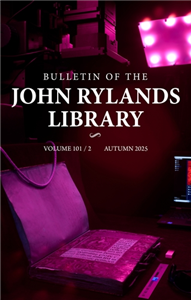
Bulletin of the John Rylands Library 101/2
Imaging Heritage Science Initiatives at The John Rylands Research Institute and Library
by Stefan Hanß, James Robinson
The John Rylands Library houses one of the finest collections of rare books, manuscripts and archives in the world. The collections span five millennia, have a global reach and cover a wide range of subjects, including art and archaeology; economic, social, political, religious and military history; literature, drama and music; science and medicine; theology and philosophy; travel and exploration. For over a century, the Bulletin of the John Rylands Library has published research that complements the Library's special collections. An electronic edition of this issue is freely available under a Creative Commons (CC BY-NC-ND) licence.
-
Trusted Partner
-
Trusted Partner
-
Trusted Partner
-
Trusted Partner
 Humanities & Social SciencesDecember 2024
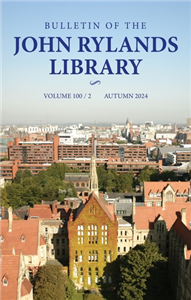
Bulletin of the John Rylands Library 100/2
Higher Learning and Civic Cultures of Knowledge: Manchester 1824–2024
by Stuart Jones
The John Rylands Library houses one of the finest collections of rare books, manuscripts and archives in the world. The collections span five millennia, have a global reach and cover a wide range of subjects, including art and archaeology; economic, social, political, religious and military history; literature, drama and music; science and medicine; theology and philosophy; travel and exploration. For over a century, the Bulletin of the John Rylands Library has published research that complements the Library's special collections.
-
Trusted Partner
-
Trusted Partner
-
Trusted Partner



