
Your Search Results
-

-

Sarigaga Books
Sarıgaga Books is an independent small publishing house founded on May 2011. Sarıgaga is specialized in children books and mainly picture books. Our aim is to contribute to the intellectual and emotional growth of children with beautifully illustrated books with good stories.
View Rights Portal
-
Promoted Content
-
Promoted Content
-
 Trusted Partner
-
Trusted Partner
-
Trusted Partner

 Literature & Literary StudiesApril 2020
Interweaving myths in Shakespeare and his contemporaries
by Janice Valls-Russell, Agnès Lafont, Charlotte Coffin
This volume proposes new insights into the uses of classical mythology by Shakespeare and his contemporaries, focusing on interweaving processes in early modern appropriations of myth. Its 11 essays show how early modern writing intertwines diverse myths and plays with variant versions of individual myths that derive from multiple classical sources, as well as medieval, Tudor and early modern retellings and translations. Works discussed include poems and plays by William Shakespeare, Christopher Marlowe and others. Essays concentrate on specific plays including The Merchant of Venice and Dido Queen of Carthage, tracing interactions between myths, chronicles, the Bible and contemporary genres. Mythological figures are considered to demonstrate how the weaving together of sources deconstructs gendered representations. New meanings emerge from these readings, which open up methodological perspectives on multi-textuality, artistic appropriation and cultural hybridity.
-
Trusted Partner

 January 1988
Ein anderer Tag, ein anderer Traum
Erzählungen aus den Jahren 1939-1954
by Saroyan, William / Englisch Wolff, Lutz W
-
Trusted Partner
 Literature & Literary StudiesDecember 2005
Graham Swift
by Daniel Lea, Susan Williams
This book offers an accessible critical introduction to the work of Graham Swift, one of Britain's most significant contemporary authors. Through detailed readings of his novels and short stories from 'The Sweet Shop Owner' (1980) to 'The Light of Day' (2003), Daniel Lea lucidly addresses the key themes of history, loss, masculinity and ethical redemption, to present a fresh approach to Swift. This study proposes that one of the side-effects of modernity has been the destruction of traditional pathways of self and collective belief, leading to a loss of understanding between individuals about their duties to each other and to society. Swift's writing returns repeatedly to the question of what we can believe in when all the established markers of identity - family, community, gender, profession, history - have become destabilised. Lea suggests that Swift increasingly moves towards a notion of redemption through a lived ethical practice as the only means of finding solace in a world lacking a central symbolic authority. ;
-
Trusted Partner
 The ArtsAugust 2026
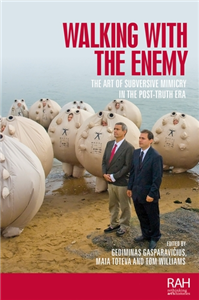
Walking with the enemy
The art of subversive mimicry in the post-truth era
by Gediminas Gasparavicius, Maia Toteva, Tom Williams
This book is about artists and activists who have embraced mimicry as a subversive tactic. Bringing together the contributions of seventeen writers, it addresses the ways in which artists have responded to power and ideology by imitating its outward forms. These contributors address in particular the current age of fantasy and political deception, and they consider the work of artists who have reacted by using dissimulation and make-believe themselves. Chapters include discussions of mimicry in reference to a number developments and debates: the post-truth era, the neoliberal consensus, the politics of race and gender, online subcultures, and the rise of the new right.
-
Trusted Partner
-
Trusted Partner
 Literature & Literary StudiesDecember 1999
Ngugi Wa Thiong'o
by Patrick Williams, John Thieme
Ngugi is one of the most important novelists on the contemporary world stage, and someone whose name has for many become synonymous with cultural controversy and political struggle. Patrick William's lucid analysis offers the most up-to-date study of Ngugi's writing, including his most rcent collection of essays. Focusing on important aspects of Ngugi's work which critics have hitherto ignored, and drawing on a wide range of relevant theoretical perspectives, this study examines the growing complexity of Ngugi's accounts of the history of colonised and post-colonial Kenya. The cultural and anti-imperial politics on Ngugi's experimentation with language and form in both novel and drama is discussed, including the important role of culture as a source of historical memory and strategies of resistance for oppressed groups. All the novels and the major plays are studies in detail, and in addition a substantial chapter examines Ngugi's contribution in the area of non-fiction. ;
-
Trusted Partner
 The ArtsAugust 2014
David Lean
by Melanie Williams, Brian McFarlane, Neil Sinyard
'A rule of mine is this', said William Goldman in 1983, 'there are always three hot directors and one of them is always David Lean.' One of the best known and most admired of British film makers, David Lean had a directorial career that spanned five decades and encompassed everything from the intimate black-and-white romance of Brief Encounter (1945) to the spectacular Technicolor epic of Lawrence of Arabia (1962). This book offers comprehensive coverage of every feature film directed by Lean, yielding new insights on the established classics of his career as well as its lesser-known treasures. Its analysis prioritises questions of gender and emphasises the often-overlooked but highly significant recurrence of female-centred narratives throughout Lean's career. Drawing extensively on archival historical materials while also presenting nuanced close readings of individual films, David Lean offers a fascinating and original account of the work of a remarkable British film maker. ;
-
Trusted Partner
 Humanities & Social SciencesOctober 2022
Bankruptcy, bubbles and bailouts
by Aeron Davis, Karel Williams
-
Trusted Partner
 The ArtsMarch 2013
Space and being in contemporary French cinema
by James S. Williams
This book brings together for the first time five French directors who have established themselves as among the most exciting and significant working today: Bruno Dumont, Robert Guédiguian, Laurent Cantet, Abdellatif Kechiche, and Claire Denis. Whatever their chosen habitats or shifting terrains, each of these highly distinctive auteurs has developed unique strategies of representation and framing that reflect a profound investment in the geophysical world. The book proposes that we think about cinematographic space in its many different forms simultaneously (screenspace, landscape, narrative space, soundscape, spectatorial space). Through a series of close and original readings of selected films, it posits a new 'space of the cinematic subject'. Accessible and wide-ranging, this volume opens up new areas of critical enquiry in the expanding interdisciplinary field of space studies. It will be of immediate interest to students and researchers working not only in film studies and film philosophy, but also in French/Francophone studies, postcolonial studies, gender and cultural studies. Listen to James S. Williams speaking about his book http://bit.ly/13xCGZN. (Copy and paste the link into your browser) ;
-
Trusted Partner
-
Trusted Partner
 The ArtsJanuary 2019
Postcolonial African cinema
Ten directors
by David Murphy, Patrick Williams
This is the first introduction of its kind to an important cross-section of postcolonial African filmmakers from the 1950s to the present. Building on previous critical work in the field, this volume will bring together ideas from a range of disciplines - film studies, African cultural studies, and, in particular, postcolonial studies - in order to combine the in-depth analysis of individual films and bodies of work by individual directors with a sustained interrogation of these films in relation to important theoretical concepts. Structurally, the book is straightforward, though the aim is to incorporate diversity and complexity of approach within the overall simplicity of format. Chapters provide both an overview of the director's output to date, and the necessary background - personal or national, cultural or political - to enable readers to achieve a better understanding of the director's choice of subject matter, aesthetic or formal strategies, or ideological stance. They also offer a particular reading of one or more films, in which the authors aim to situate African cinema in relation to important critical and theoretical debates. This book thus constitutes a new departure in African film studies, recognising the maturity of the field, and the need for complex yet accessible approaches to it, which move beyond the purely descriptive while refusing to get bogged down in theoretical jargon. Consequently, the volume should be of interest not only to specialists but also to the general reader.
-
Trusted Partner

 March 2026
Racing Legends (Band 1) - Lewis Hamilton
101 Fakten über die Formel 1
by Maurice Hamilton, Cat Sims, Kanut Kirches
Komm mit in die Welt der schnellen Champions! Sieben Weltmeistertitel und über 100 Grand Prix‘ Siege – kein anderer Fahrer hat so viele Rekorde gebrochen wie er: Lewis Hamilton! Schon als Junge wollte er ganz nach vorn und mit Talent, Mut und harter Arbeit hat er es bis an die Spitze der Formel 1 geschafft.In dieser Reihe tauchen Kinder ab 8 Jahren in die aufregende Welt des Motorsports ein. Jeder Band erzählt den Werdegang einer berühmten Rennsportlegende – von den ersten Schritten im Kart bis zum großen Durchbruch in der Formel 1. Fundiert erzählt von Rennsportexperte Maurice Hamilton und damit ein Muss für alle kleinen Fans des Motorsports! Lewis Hamilton hautnah: Mehr als Rekorde und Siege – das Buch erzählt von den Träumen, Herausforderungen und der persönlichen Geschichte des Formel-1-Stars. Spannende Rennsport-Fakten: Zusätzlich wird spannendes Wissen über den Rennsport vermittelt: Technik, Boxenstopps, berühmte Strecken, die Arbeit der Teams und vieles mehr – ein perfekter Einstieg in die faszinierende Welt der Formel 1. Aktueller Trend: Formel 1 erlebt weltweit einen großen Boom – und Racing Legends richtet sich direkt an die jüngsten Motorsport-Fans. Coole Illustrationen: Die Geschichte wird durch viele Schwarz-Weiß-Illustrationen im Comic-Stil aufgelockert. Perfekt für Leseanfänger*innen: Kurze Kapitel, einfache Sätze und viele Illustrationen – ideal für den Lesestart! Experten-Wissen: Der Formel 1-Experte und Journalist Maurice Hamilton hat in seiner Karriere über 500 Grand-Prix-Rennen besucht – und gibt sein Wissen in Racing Legends weiter. Leseförderung mit Antolin: Der Titel ist bei Antolin gelistet und fördert spielerisch die Lesekompetenz.
-
Trusted Partner
 Literature & Literary StudiesSeptember 2016
Love, history and emotion in Chaucer and Shakespeare
by Andrew Johnston, Anke Bernau, Russell West-Pavlov, Elisabeth Kempf
-
Trusted Partner
 Literature & Literary StudiesOctober 2017
Interweaving myths in Shakespeare and his contemporaries
by Charlotte Coffin, Agnès Lafont, Janice Valls-Russell
-
Trusted Partner
 The ArtsMarch 2018
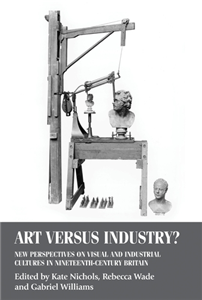
Art versus industry?
New perspectives on visual and industrial cultures in nineteenth-century Britain
by Christopher Breward, Kate Nichols, Bill Sherman, Rebecca Wade, Gabriel Williams
This book is about encounters between art and industry in nineteenth-century Britain. It looks beyond the oppositions established by later interpretations of the work of John Ruskin, William Morris and the Arts and Crafts movement to reveal surprising examples of collaboration - between artists, craftspeople, designers, inventors, curators, engineers and educators - during a crucial period in the formation of the cultural and commercial identity of Britain and its colonies. Across thirteen chapters by fourteen contributors, Art versus industry? explores such diverse subjects as the production of lace, the mechanical translation of sculpture, the display of stained glass, the use of the kaleidoscope in painting and pattern design, the emergence of domestic electric lighting and the development of art and design education and international exhibitions in India.
-
Trusted Partner



