
ZNN Network Literary and Illustrator Agency
- International Copyright, Licensing, and Literary Agency - International Illustrator Agency and Management Services - Creative Content Development Services
View Rights Portal
- International Copyright, Licensing, and Literary Agency - International Illustrator Agency and Management Services - Creative Content Development Services
View Rights Portal

 Trusted Partner
 Trusted Partner


This volume proposes new insights into the uses of classical mythology by Shakespeare and his contemporaries, focusing on interweaving processes in early modern appropriations of myth. Its 11 essays show how early modern writing intertwines diverse myths and plays with variant versions of individual myths that derive from multiple classical sources, as well as medieval, Tudor and early modern retellings and translations. Works discussed include poems and plays by William Shakespeare, Christopher Marlowe and others. Essays concentrate on specific plays including The Merchant of Venice and Dido Queen of Carthage, tracing interactions between myths, chronicles, the Bible and contemporary genres. Mythological figures are considered to demonstrate how the weaving together of sources deconstructs gendered representations. New meanings emerge from these readings, which open up methodological perspectives on multi-textuality, artistic appropriation and cultural hybridity.
Trusted Partner

The John Rylands Library houses one of the finest collections of rare books, manuscripts and archives in the world. The collections span five millennia, have a global reach and cover a wide range of subjects, including art and archaeology; economic, social, political, religious and military history; literature, drama and music; science and medicine; theology and philosophy; travel and exploration. For over a century, the Bulletin of the John Rylands Library has published research that complements the Library's special collections. An electronic edition of this issue is freely available under a Creative Commons (CC BY-NC-ND) licence.
Trusted Partner
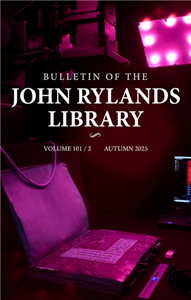
The John Rylands Library houses one of the finest collections of rare books, manuscripts and archives in the world. The collections span five millennia, have a global reach and cover a wide range of subjects, including art and archaeology; economic, social, political, religious and military history; literature, drama and music; science and medicine; theology and philosophy; travel and exploration. For over a century, the Bulletin of the John Rylands Library has published research that complements the Library's special collections. An electronic edition of this issue is freely available under a Creative Commons (CC BY-NC-ND) licence.
Trusted Partner

Charles Dickens called his sister-in-law Georgina Hogarth his 'best and truest friend'. Georgina saw Dickens as much more than a friend. They lived together for twenty-eight years, during which time their relationship constantly changed. The sister of his wife Catherine, the sharp and witty Georgina moved into the Dickens home aged fifteen. What began as a father-daughter relationship blossomed into a genuine rapport, but their easy relations were fractured when Dickens had a mid-life crisis and determined to rid himself of Catherine. Georgina's refusal to leave Dickens and his desire for her to remain in his household led to rumours of an affair and even illegitimate children. He left her the equivalent of almost £1 million and all his personal papers in his will. Georgina's commitment to Dickens was unwavering but it is far from clear what he did to deserve such loyalty. There were several occasions when he misused her in order to protect his public reputation. Why did Georgina betray her once much-loved sister? Why did she fall out with her family and risk her reputation in order to stay with Dickens? And why did the Dickenses' daughter Katey say it was 'the greatest mistake ever' to invite a sister-in-law to live with a family?
Trusted Partner
 Trusted Partner
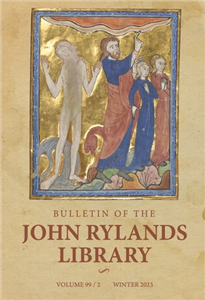
The John Rylands Library houses one of the finest collections of rare books, manuscripts and archives in the world. The collections span five millennia and cover a wide range of subjects, including art and archaeology; economic, social, political, religious and military history; literature, drama and music; science and medicine; theology and philosophy; travel and exploration. For over a century, the Bulletin of the John Rylands Library has published research that complements the Library's special collections. The editors invite the submission of articles in these fields and welcome discussion of in-progress projects.
Trusted Partner
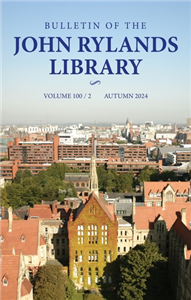
The John Rylands Library houses one of the finest collections of rare books, manuscripts and archives in the world. The collections span five millennia, have a global reach and cover a wide range of subjects, including art and archaeology; economic, social, political, religious and military history; literature, drama and music; science and medicine; theology and philosophy; travel and exploration. For over a century, the Bulletin of the John Rylands Library has published research that complements the Library's special collections.
Trusted Partner


Nach seinen sprachphilosophischen Arbeiten ('Sprechakte', stw 458; 'Ausdruck und Bedeutung', stw 349) hat John R. Searle mit 'Intentionalität' eine Untersuchung zu einem Kernstück der Philosophie des Geistes vorgelegt, die in einem engen thematischen Zusammenhang mit den früheren Arbeiten steht. Intentionalität ist nach Searles Auffassung die Basis sprachlicher Bedeutung. In seiner Theorie der Intentionalität geht es um die begrifflichen Eigenschaften intentionaler Zustände (auf die Frage nach ihrem ontologischen Status geht er ausführlicher ein in 'Geist, Hirn und Wissenschaft', stw 591). Zwei Aspekte stehen dabei im Vordergrund der Untersuchung: die Logik der Repräsentation und der Kausalität intentionaler Zustände. Doch Searle entwickelt in dieser Arbeit nicht nur eine Theorie der Intentionalität und des Zusammenhangs zwischen sprachlichem und geistigem Inhalt. In einem vornehmlich kritischen Teil setzt er sich ausführlich mit konkurrierenden Auffassungen aus dem Bereich der analytischen Philosophie auseinander, insbesondere mit derzeit sehr einflußreichen 'nicht-deskriptivistischen' Theorien des Bezugs, wie sie von S. Kripke, H. Putnam, K. Donnellan, T. Burge und D. Kaplan vertreten und angeregt wurden.
Trusted Partner
Trusted Partner
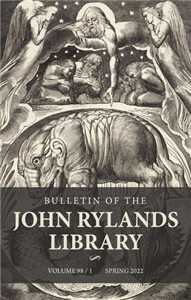
This special issue of the Bulletin of the John Rylands Library is devoted to William Blake. It explores the British and European reception of Blake's work from the late nineteenth century to the present day, with a particular focus on the counterculture. Opening with two articles by the late Michael Horovitz, an important figure in the 'Blake Renaissance' of the 1960s, the issue goes on to investigate the ideological struggle over Blake in the early part of the twentieth century, with particular reference to W. B. Yeats. This is followed by articles on the artistic avant-garde and underground of the 1960s and on Blake's significance for science fiction authors of the 1970s. The issue closes with an article on the contemporary Belgian art collective maelstrÖm reEvolution.
Trusted Partner
 Trusted Partner
A history of Shakespeare's play in performance, from John Dryden's Restoration adaptation to the rediscovery of the play in the twentieth century. What made this play so relevant to audiences who had lived through the horrors of two world wars and the rise of fascism? Why did it speak so directly to the 'angry young men' of the post-war generation and to the countercultural movements of the 1960s? This book investigates the many ways in which modern directors and actors have found their own world reflected in the play, from anti-war protests and the sexual revolution to feminism and postcolonialism. In doing so, it explores the play's own complexity and its refusal to give easy answers.
Trusted Partner


Komm mit in die Welt der schnellen Champions! Sieben Weltmeistertitel und über 100 Grand Prix‘ Siege – kein anderer Fahrer hat so viele Rekorde gebrochen wie er: Lewis Hamilton! Schon als Junge wollte er ganz nach vorn und mit Talent, Mut und harter Arbeit hat er es bis an die Spitze der Formel 1 geschafft.In dieser Reihe tauchen Kinder ab 8 Jahren in die aufregende Welt des Motorsports ein. Jeder Band erzählt den Werdegang einer berühmten Rennsportlegende – von den ersten Schritten im Kart bis zum großen Durchbruch in der Formel 1. Fundiert erzählt von Rennsportexperte Maurice Hamilton und damit ein Muss für alle kleinen Fans des Motorsports! Lewis Hamilton hautnah: Mehr als Rekorde und Siege – das Buch erzählt von den Träumen, Herausforderungen und der persönlichen Geschichte des Formel-1-Stars. Spannende Rennsport-Fakten: Zusätzlich wird spannendes Wissen über den Rennsport vermittelt: Technik, Boxenstopps, berühmte Strecken, die Arbeit der Teams und vieles mehr – ein perfekter Einstieg in die faszinierende Welt der Formel 1. Aktueller Trend: Formel 1 erlebt weltweit einen großen Boom – und Racing Legends richtet sich direkt an die jüngsten Motorsport-Fans. Coole Illustrationen: Die Geschichte wird durch viele Schwarz-Weiß-Illustrationen im Comic-Stil aufgelockert. Perfekt für Leseanfänger*innen: Kurze Kapitel, einfache Sätze und viele Illustrationen – ideal für den Lesestart! Experten-Wissen: Der Formel 1-Experte und Journalist Maurice Hamilton hat in seiner Karriere über 500 Grand-Prix-Rennen besucht – und gibt sein Wissen in Racing Legends weiter. Leseförderung mit Antolin: Der Titel ist bei Antolin gelistet und fördert spielerisch die Lesekompetenz.
Trusted Partner
Trusted Partner
Trusted Partner
This volume on Norman Italy (southern Italy and Sicily, c. 1000-1200) honours and reflects the pioneering scholarship of Graham A. Loud. An international group of scholars reassesses and recasts the paradigm by which Norman Italy has been conventionally understood, addressing varied subjects across four key themes: historiographies, identities and communities, religion and Church, and conquest. The chapters revise and refine our understanding of Norman Italy in the eleventh and twelfth centuries, demonstrating that it was not just a parochial Norman or Mediterranean entity but also an integral player in the medieval mainstream.
Trusted Partner

Carol Reed is one of the truly outstanding directors of British cinema, and one whose work is long overdue for reconsideration. This major study ranges over Reed's entire career, combining observation of general trends and patterns with detailed analysis of twenty films, both acknowledged masterpieces and lesser-known works. Evans avoids a simplistic auteurist approach, placing the films in their autobiographical, socio-political and cultural contexts and relating these to the analysis of Reed's art. The critical approach combines psychoanalysis, gender theory, and the analysis of form. Archival research is also relied on to clarify Reed's relations with his creative team, financial backers and others. Films examined include Bank Holiday, A Girl Must Live, Odd Man Out, The Fallen Idol, The Third Man, Night Train to Munich, The Way Ahead, Outcast of the Islands, Trapeze and Oliver!.



