
Your Search Results
-

-

Hanska Literary&Film Agency S.L.
Hanska Literary & Film Agency represents internationally Spanish writers and scriptwriters. Specializing in Spanish commercial and up-market commercial adult fiction: women's fiction, historical novel, crime, thriller, noir, romance, family saga.
View Rights Portal
-
Promoted Content

 June 2025
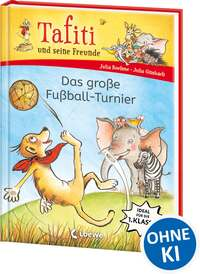
Tafiti und seine Freunde (Band 1) - Das große Fußball-Turnier
Tafiti jetzt für die 1. Klasse! - Wer wird das spannende Spiel gewinnen? - Mit Comic-Elementen und Leselernschrift ABeZeh für Kinder ab 6 Jahren
by Julia Boehme, Julia Ginsbach
Fußballfieber in der Savanne Das Leben in der Savanne kann wirklich gefährlich sein! Das merkt auch Pango, der kleine Pangolin. Um sich vor King Kofis Krallen zu retten, rollt er sich zu einem Ball zusammen und wirbelt durch die Luft. Das macht ihm großen Spaß und bringt Tafiti und Pinsel auf eine Idee: Sie könnten doch Fußball spielen und Pango ist der Fußball. Alle drei sind Feuer und Flamme. Doch da taucht ausgerechnet King Kofi auf und möchte mitspielen. Um des lieben Friedens willen werden zwei Mannschaften aufgestellt: Tafitis Team mit Tafiti, Pinsel, Pix und Pax und Kukukifuku, und das von King Kofi, das ausschließlich aus Raubtieren besteht. Daher gibt es eine Bedingung: Wenn King Kofis Team verliert, dürfen alle Mitspieler drei Tage lang nicht jagen.
-
Promoted Content
 March 2023
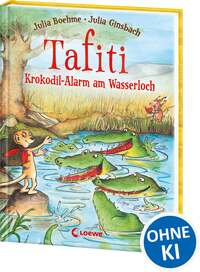
Tafiti (Band 19) - Krokodil-Alarm am Wasserloch
Komm mit nach Afrika und lerne die Welt des beliebten Erdmännchens kennen - Erstlesebuch zum Vorlesen und ersten Selberlesen ab 6 Jahren
by Julia Boehme, Julia Ginsbach
Endlich findet wieder das Wettsingen in der Savanne statt! Pinsel möchte auch teilnehmen – und treibt seine Freunde mit seinem schiefen Gesang in den Wahnsinn. Aber nichts kann ein Pinselohrschwein von seinem Vorhaben abhalten. Noch dazu hat sich eine Gruppe von Krokodilen am Wasserloch niedergelassen und keiner traut sich mehr dorthin. Was nun? Die Wasservorräte werden knapp und die Tiere müssen etwas unternehmen! Zum Glück hat Tafiti eine Idee: Mit einer List überzeugt er die Krokodile davon, auch an dem Gesangswettbewerb teilzunehmen, und stellt sich ihnen als Dirigent zur Verfügung. Der Plan dahinter: Während die Krokodile abgelenkt sind, schleichen die anderen Tiere ans Wasserloch und füllen ihre Vorräte wieder auf. Ob Tafitis Plan aufgeht und die Tiere auch auf lange Sicht wieder ungehinderten Zugang zu ihrer Wasserstelle haben werden? Und von wem mag das Ei sein, das Pinsel gefunden hat und nun unter seiner Mütze ausbrütet?
-
 Trusted Partner
 April 2026
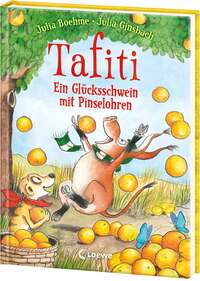
Tafiti (Band 24) - Ein Glücksschwein mit Pinselohren
Komm mit nach Afrika und lerne die Welt des beliebten Erdmännchens kennen - Erstlesebuch zum Vorlesen und ersten Selberlesen ab 6 Jahren
by Julia Boehme, Julia Ginsbach
Tafiti und Pinsel gehen zusammen durch dick und dünn! Zeit für Kuchen! Dafür braucht Omama Affenorangen. Tafiti und Pinsel ziehen los, um welche zu holen. Doch leider hängen die Früchte viel zu hoch. Aber dank Pinsel kommen sie trotzdem an die Orangen. „Du bist ein echtes Glücksschwein“, jubelt Tafiti. Jetzt will Pinsel auch allen anderen Tieren Glück bringen. Aber er selbst hat großes Pech: King Kofi nimmt ihn als sein königliches Glücksschwein gefangen. Ob Tafiti Pinsel befreien kann? Ein neues spannendes Abenteuer mit Tafiti und Pinsel! Band 24 der beliebten Reihe von Julia Boehme und Julia Ginsbach Ein spannender und witziger Lesespaß für Leseanfänger*innen Warmherzige und kindgerechte Abenteuergeschichte mit viel Humor Behandelt das wichtige Thema Freundschaft in jedem Band Wichtige Botschaft: „Gemeinsam sind wir stark!“ Vermittelt spielerisch Wissen über Afrika Zum ersten Lesen für Kinder ab 6 Jahren Auch zum Vorlesen geeignet ab 5 Jahren Mit großer , leicht lesbarer Schrift Bunte und liebevolle Illustrationen auf jeder Seite Mit Quizfragen auf Antolin
-
Trusted Partner

 The ArtsJanuary 2019
European Film Noir
by Andrew Spicer
European Film Noir is the first book to bring together specialist discussions of film noir in specific European national cinemas. Written by leading scholars, this groundbreaking study provides an authoritative understanding of an important aspect of European cinema and of film noir itself, for too long considered as a solely American form. The Introduction reviews the problems of defining film noir, its key characteristics and discusses its significance to the development of European film, the relationship of specific national films noirs to each other, to American noir and to historical and social change. Eight chapters then discuss film noir in France, Germany, Britain and Spain, analysing both earlier developments and the evolution of neo-noir through to the present. A further chapter explores film noir in Italian cinema where its presence is not so well defined. Each piece provides a critical overview of the most significant films in relation to their industrial and social contexts. European Film Noir is an important contribution to the study of European cinema that will have a broad appeal to undergraduates, cinéastes, film teachers and researchers.
-
Trusted Partner
 The ArtsJune 2021
Medieval film
by Anke Bernau, Bettina Bildhauer
Medieval film explores theoretical questions about the ideological, artistic, emotional and financial investments inhering in cinematic renditions of the medieval period. What does it mean to create and watch a 'medieval film'? What is a medieval film and why are they successful? This is the first work that attempts to answer these questions, drawing, for instance, on film theory, postcolonial theory, cultural studies and the growing body of work on medievalism. Contributors investigate British, German, Italian, Australian, French, Swedish and American film, exploring topics such translation, temporality, film noir, framing and period film - and find the medieval lurking in inexpected corners. In addition it provides in-depth studies of individual films from different countries including The Birth of a Nation to Nosferatu, and Robin Hood: Prince of Thieves. Medieval Film will be of interest to medievalists working in disciplines including literature, history, to scholars working on film and in cultural studies. It will also be of interest to undergraduates, postgraduates and to an informed enthusiast in film or/and medieval culture.
-
Trusted Partner
-
Trusted Partner
 July 2025
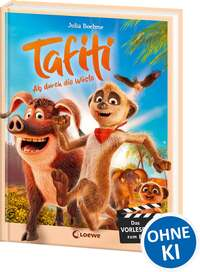
Tafiti - Ab durch die Wüste
Das Vorlesebuch zum Kinofilm ab 5 Jahren - Mit zahlreichen animierenden Filmfotos und exklusiven Illustrationen - Ausgezeichnet mit dem CineKindl Audience Award
by Julia Boehme, Julia Ginsbach
Wahre Freundschaft kann (Wüsten)-Berge versetzen! Tafiti und Pinsel erobern die große Leinwand In der Savanne Afrikas lauern viele Gefahren. Darum sind Omama und Opapa stets darauf bedacht, dass die Erdmännchenfamilie nur unter sich bleibt. Trotzdem schleppt Tafiti eines Tages Pinsel, das Pinselohrschwein, an, um ihm zu helfen. Es ist ein tragisches Missgeschick – doch ohne Pinsel wäre es nicht passiert: Eine Giftschlange beißt Opapa. Die einzige Hoffnung auf Rettung ist die sagenumwobene blaue Blume, die jenseits der Wüste blüht und alles heilen kann. Tafiti beschließt, die Sicherheit der Familie nochmal zu verlassen. Er und Pinsel machen sich auf den langen und gefährlichen Weg, um die Blume zu suchen. Dabei müssen sie nicht nur die unendliche Wüste durchqueren, oh nein! Ihnen begegnen hungrige Schakale, sie müssen einem Sandsturm trotzen und ein fieser Adler hat es auch auf sie abgesehen. Werden Tafiti und Pinsel rechtzeitig die blaue Blume finden und Opapa das Leben retten können?
-
Trusted Partner
 The ArtsJanuary 2019
Realist film theory and cinema
The nineteenth-century Lukácsian and intuitionist realist traditions
by Ian Aitken
'Realist film theory and cinema' embraces studies of cinematic realism and 19th century tradition, the realist film theories of Lukács, Grierson, Bazin and Kracauer, and the relationship of realist film theory to the general field of film theory and philosophy. This is the first book to attempt a rigorous and systematic application of realist film theory to the analysis of particular films. The book suggests new ways forward for a new series of studies in cinematic realism, and for a new form of film theory based on realism. It stresses the importance of the question of realism both in film studies and in contemporary life. Aitken's work will be of interest to scholars and advanced students of film studies, literary studies, media studies, cultural studies and philosophy.
-
Trusted Partner
 The ArtsJanuary 2019
Medieval film
by Anke Bernau, Bettina Bildhauer
Medieval film explores theoretical questions about the ideological, artistic, emotional and financial investments inhering in cinematic renditions of the medieval period. What does it mean to create and watch a 'medieval film'? What is a medieval film and why are they successful? This is the first work that attempts to answer these questions, drawing, for instance, on film theory, postcolonial theory, cultural studies and the growing body of work on medievalism. Contributors investigate British, German, Italian, Australian, French, Swedish and American film, exploring topics such translation, temporality, film noir, framing and period film - and find the medieval lurking in unexpected corners. In addition it provides in-depth studies of individual films from different countries including The Birth of a Nation to Nosferatu, and Robin Hood: Prince of Thieves. Medieval film will be of interest to medievalists working in disciplines including literature, history, art history, to scholars working on film and in cultural studies. It will also be of interest to undergraduates, postgraduates and to an informed enthusiast in film or/and medieval culture.
-
Trusted Partner
 The ArtsJune 2021
Lukácsian film theory and cinema
A study of Georg Lukács' writing on film 1913–1971
by Ian Aitken
Lukácsian film theory and cinema explores Georg Lukács' writings on film. The Hungarian Marxist critic Georg Lukács is primarily known as a literary theorist, but he also wrote extensively on the cinema. These writings have remained little known in the English-speaking world because the great majority of them have never actually been translated into English - until now. Aitken has gathered together the most important essays and the translations appear here, often for the first time. This book thus makes a decisive contribution to understandings of Lukács within the field of film studies, and, in doing so, also challenges many existing preconceptions concerning his theoretical position. For example, whilst Lukács' literary theory is well known for its repudiation of naturalism, in his writings on film Lukács appears to advance a theory and practice of film that can best be described as naturalist. Lukácsian film theory and cinema is divided into two parts. In part one, Lukács' writings on film are explored, and placed within relevant historical and intellectual contexts, whilst part two consists of the essays themselves. This book will be of considerable interest to scholars and students working within the fields of film studies, literary studies, intellectual history, media and cultural studies. It is also intended to be the final volume in a trilogy of works on cinematic realism, which includes the author's earlier European film theory and cinema (2001), and Realist film theory and cinema (2006).
-
Trusted Partner
-
Trusted Partner
 March 2023
Einfach erklärt - Künstliche Intelligenz - Fake News - Unsere digitale Zukunft
Leicht verständliches Sachbuch über Algorithmen und Probleme digitaler Kommunikation - Für Kinder ab 10 Jahren
by Manfred Theisen, Mo Büdinger
Die Reihe Einfach erklärt hält, was sie verspricht: Hier werden komplexe Themen leicht verständlich aufbereitet und anschaulich illustriert. Kurze Kapitel, eine klare Struktur und der coole Mix aus Fotos und modernen Infografiken helfen Leser*innen ab zehn Jahren, schnell und unkompliziert neues Wissen zu erlangen. So klappt es mit dem Durchblick – garantiert! Was ist ein Algorithmus? Können Maschinen denken? Welche technischen Entwicklungen wird es in der Zukunft geben? Wie entstehen Fake News? Und wie können Staaten und Regierungen all das nutzen, um ihre Bevölkerung zu beeinflussen? Der Autor spannt den Bogen von Algorithmen über den Einsatz von künstlicher Intelligenz in verschiedenen Bereichen bis hin zum hochaktuellen Thema Propaganda. Durch leicht verständliche Erklärungen und zahlreiche detaillierte Infografiken wird so das Interesse an unserer technischen Zukunft geweckt.
-
Trusted Partner
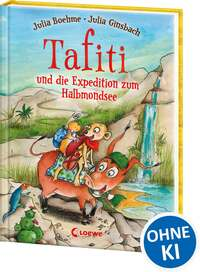 March 2022
Tafiti und die Expedition zum Halbmondsee
by Julia Boehme / Julia Ginsbach
Tafiti and the Expedition to Half Moon Lake
-
Trusted Partner

 September 2002
Film als Kunst
by Rudolf Arnheim, Karl Prümm, Rudolf Arnheim
Rudolf Arnheims Film als Kunst ist ein Klassiker der Film- und Medientheorie. Seine durch die Gestaltpsychologie beeinflußte Theorie des Films liefert sowohl eine konzise Darstellung der maßgeblichen filmischen Mittel wie auch eine Theorie der Wahrnehmung, die am Beispiel des Films entwickelt wird. 1932 erstmalig erschienen, wurden seine theoretische wie auch seine theoriegeschichtliche Bedeutung im Zuge der Renaissance der Wahrnehmungstheorie der letzten Jahre wiederentdeckt. Der Band enthält neben dem integralen Text ein Nachwort, das die Entstehungs- und Rezeptionsgeschichte sowie die aktuelle Bedeutung dieses berühmten Buches aufzeigt, und zeitgenössische Rezensionen.
-
Trusted Partner
-
Trusted Partner
 The ArtsJanuary 2019
The cultural politics of contemporary Hollywood film
by Chris Beasley, Heather Brook
-
Trusted Partner
 The ArtsFebruary 2007
European Film Noir
by Andrew Spicer
European Film Noir is the first book to bring together specialist discussions of film noir in specific European national cinemas. Written by leading scholars, this groundbreaking study provides an authoritative understanding of an important aspect of European cinema and of film noir itself, for too long considered as a solely American form. The Introduction reviews the problems of defining film noir, its key characteristics and discusses its significance to the development of European film, the relationship of specific national films noirs to each other, to American noir and to historical and social change. Eight chapters then discuss film noir in France, Germany, Britain and Spain, analysing both earlier developments and the evolution of neo-noir through to the present. A further chapter explores film noir in Italian cinema where its presence is not so well defined. Each piece provides a critical overview of the most significant films in relation to their industrial and social contexts. European Film Noir is an important contribution to the study of European cinema that will have a broad appeal to undergraduates, cinéastes, film teachers and researchers. ;
-
Trusted Partner
 April 2006
Komposition für den Film
by Theodor W. Adorno, Hanns Eisler, Johannes C. Gall, Johannes C. Gall
Adornos und Eislers Buch, das erstmals 1947 in englischer Sprache erschien, gehört zu den Klassikern der Musik-, aber auch der Filmtheorie. Es entstand als Gemeinschaftsarbeit im amerikanischen Exil, in der Folge zweier von der Rockefeller Foundation geförderter Forschungsprojekte: Im Rahmen des von Paul Lazarsfeld geleiteten »Radio Research Project« betrieb Adorno Studien zur Musik im Rundfunk, die in das zu Lebzeiten Fragment gebliebene Buch Current of Music eingegangen sind; Eisler lotete im »Film Music Project« die Funktionen, Möglichkeiten und Grenzen der Filmmusik aus. Dabei galt Eislers Arbeit zunächst weniger abstrakten Analysen und Erwägungen als der Komposition exemplarischer Filmpartituren und der anschließenden Produktion und Evaluation von Demonstrationsfilmen. Zu den künstlerischen Ergebnissen des Projekts zählen das berühmte Quintett Vierzehn Arten den Regen zu beschreiben als neue und neuartige Filmmusik zu Joris Ivens' »cinépoème« Regen ebenso wie die Tonspuren zu White Flood und zu A Child Went Forth, einem frühen Film von Joseph Losey. Auch komponierte Eisler zu einem Ausschnitt aus dem Klassiker The Grapes of Wrath von John Ford zwei experimentelle Filmpartituren als Alternative zu Alfred Newmans Musik in der Verleihfassung. Die DVD, die dem Band beiliegt, dokumentiert diese Filme und Filmmusikexperimente teils in originaler und restaurierter, teils in rekonstruierter Form. Cineasten und Philosophen, Musik- und Kulturwissenschaftler werden gleichermaßen begeistert sein. Erstmals liegt das großangelegte »Film Music Project« in der Form vor, die ihm gebührt.Mit in ihrem originalen deutschen Wortlaut erstmals publizierten Textpassagen, einem Entwurf zum Filmmusikbuch von Theodor W. Adorno und einer zweisprachig (deutsch/englisch) angelegten DVD: »Hanns Eislers Rockefeller-Filmmusik-Projekt 1940–1942«
-
Trusted Partner
 The ArtsJanuary 2019
Contemporary French cinema
An introduction (revised edition)
by Guy Austin
Contemporary French cinema is an essential introduction to popular French film of the last 35 years. It charts recent developments in all genres of French cinema with analyses of over 120 movies, from Les Valseuses to Caché. Reflecting the diversity of French film production since the New Wave, this clear and perceptive study includes chapters on the heritage film, the thriller and the war movie, alongside the 'cinéma du look', representations of sexuality, comedies, the work of women film makers and le jeune cinéma. Each chapter introduces the public reception and critical debates surrounding a given genre, interwoven with detailed accounts of relevant films. Confirmed as a major contribution to both Film Studies and French Studies, this book is a fascinating volume for students and fans of French film alike.
-
Trusted Partner
 The ArtsJune 2021
Contemporary French cinema
An introduction (revised edition)
by Guy Austin
Contemporary French cinema is an essential introduction to popular French film of the last 35 years. It charts recent developments in all genres of French cinema with analyses of over 120 movies, from Les Valseuses to Caché. Reflecting the diversity of French film production since the New Wave, this clear and perceptive study includes chapters on the heritage film, the thriller and the war movie, alongside the 'cinéma du look', representations of sexuality, comedies, the work of women film makers and le jeune cinéma. Each chapter introduces the public reception and critical debates surrounding a given genre, interwoven with detailed accounts of relevant films. Confirmed as a major contribution to both Film Studies and French Studies, this book is a fascinating volume for students and fans of French film alike.




