
All Things Women
Find your focus and strengths in times of crisis.
View Rights Portal



Any reader who has ever visited Asia knows that the great bulk of Western-language fiction about Asian cultures turns on stereotypes. This book, a collection of essays, explores the problem of entering Asian societies through Western fiction, since this is the major port of entry for most school children, university students and most adults. In the thirteenth century, serious attempts were made to understand Asian literature for its own sake. Hau Kioou Choaan, a typical Chinese novel, was quite different from the wild and magical pseudo-Oriental tales. European perceptions of the Muslim world are centuries old, originating in medieval Christendom's encounter with Islam in the age of the Crusades. There is explicit and sustained criticism of medieval mores and values in Scott's novels set in the Middle Ages, and this is to be true of much English-language historical fiction of the nineteenth and early twentieth centuries. Even mediocre novels take on momentary importance because of the pervasive power of India. The awesome, remote and inaccessible Himalayas inevitably became for Western writers an idealised setting for novels of magic, romance and high adventure, and for travellers' tales that read like fiction. Chinese fictions flourish in many guises. Most contemporary Hong Kong fiction reinforced corrupt mandarins, barbaric punishments and heathens. Of the novels about Japan published after 1945, two may serve to frame a discussion of Japanese behaviour as it could be observed (or imagined) by prisoners of war: Black Fountains and Three Bamboos.


Little Women "has been read as a romance or as a quest, or both. It has been read as a family drama that validates virtue over wealth", but also "as a means of escaping that life by women who knew its gender constraints only too well".[6]:34 According to Sarah Elbert, Alcott created a new form of literature, one that took elements from Romantic children's fiction and combined it with others from sentimental novels, resulting in a totally new format. Elbert argued that within Little Women can be found the first vision of the "All-American girl" and that her multiple aspects are embodied in the differing March sisters.
 Trusted Partner
Penny politics offers a new way to read early Victorian popular fiction such as Jack Sheppard, Sweeney Todd, and The Mysteries of London. It locates forms of radical discourse in the popular literature that emerged simultaneously with Brittan's longest and most significant people's movement. It listens for echoes of Chartist fiction in popular fiction. The book rethinks the relationship between the popular and political, understanding that radical politics had popular appeal and that the lines separating a genuine radicalism from commercial success are complicated and never absolute. With archival work into Newgate calendars and Chartist periodicals, as well as media history and culture, it brings together histories of the popular and political so as to rewrite the radical canon.
Trusted Partner

At once pervasive and marginal, appealing and repellent, exemplary and atypical, the women of the Bible provoke an assortment of readings across early modern literature. Biblical women in early modern literary culture, 1550-1700 draws attention to the complex ways in which biblical women's narratives could be reimagined for a variety of rhetorical and religious purposes. Considering a confessionally diverse range of writers, working across a variety of genres, this volume reveals how women from the Old and New Testaments exhibit an ideological power that frequently exceeds, both in scope and substance, their associated scriptural records. The essays explore how the Bible's women are fluidly negotiated and diversely redeployed to offer (conflicting) comment on issues including female authority, speech and sexuality, and in discussions of doctrine, confessional politics, exploration and grief. As it explores the rich ideological currency of the Bible's women in early modern culture, this volume demonstrates that the Bible's women are persistently difficult to evade. ;
Trusted Partner

Through the Fiction of Phebe Gibbes places this prolific, newly recovered English writer at the centre of the revolutionary period. Gibbes's novels mark the struggles of women for agency in an expanding British empire, from the Seven Years' War to revolutions in American, Haiti and France. With Gibbes as a nexus in a lineage of women writers from Aphra Behn to Jane Austen, Kathryn S. Freeman offers a valuable perspective on the 'long eighteenth century', with Gibbes' own evolution mirroring that of the larger period. The study traces the development of Gibbes' authorial voice from satire to irony through a range of female characters subverting patriarchal oppression. Freeman guides the reader through patterns of narrative voice, concerns with gender and sexuality, and elements of wordplay through detailed discussion of five novels representing Gibbes' evolving representation of a subversive female subjectivity.
Trusted Partner
Innovatively extending counterfactual thought experiments from history and the social sciences to literary historiography, criticism and theory, Counterfactual Romanticism reveals the ways in which the shapes of Romanticism are conditioned by that which did not come to pass. Exploring various modalities of counterfactual speculation and inquiry across a range of Romantic-period authors, genres and concerns, this collection offers a radical new purchase on literary history, on the relationship between history and fiction, and on our historicist methods to date - and thus on the Romanticisms we (think we) have inherited. Counterfactual Romanticism provides a ground-breaking method of re-reading literary pasts and our own reading presents; in the process, literary production, texts and reading practices are unfossilised and defamiliarised.
Trusted Partner

How has it happened that from being politely ignored or marginalized just half a century ago, women writers in Italy are now at the centre of literary activity? To what extent does writing by women reflect the successes and failures of Italy in the post-war period? What form did the feminist movement in Italy take, and how did this affect what - and how - women wrote? And how are women who write responding to a more fragmented post-modern age? These are just some of the questions asked of the relationship between women and fiction in post-war Italy in this anthology. It includes stories by Cialente, Ginzburg, Ortese, Morante, Romano, Maraini and Duranti as well as Bompiani, Sanvitale, Mizzau, Scaramuzzino, Capriolo and Petrignani. The thirteen stories presented offer a range of style and content indicative of the wealth and diversity of writing by women, and their reading is supported by critical notes and an extensive vocabulary. This is a clear and challenging introduction to the rich field of women and fiction in Italy. ;
Trusted Partner
Trusted Partner
 Trusted Partner
 Trusted Partner
Trusted Partner
Trusted Partner

This timely in-depth study of award-winning Kate Atkinson's work provides a welcome comprehensive overview of the novels, play and short stories. It explores the major themes and aesthetic concerns in her fiction. Combining close analysis and literary contextualisation, it situates her multi-faceted work in terms of a hybridisation of genres and innovative narrative strategies to evoke contemporary issues and well as the past. Chapters offer insights into each major publication (from Behind the Scenes at the Museum to Big Sky, the latest instalment in the Brodie sequence, through the celebrated Life After Life and subsequent re-imaginings of the war) in relation to the key concerns of Atkinson's fiction, including self-narrativisation, history, memory and women's lives.
Trusted Partner

Invasions is an ambitious, new and authoritative study of one of the defining cultural products of the Victorian and Edwardian eras. By the outbreak of war in 1914 invasion-scare fiction had profoundly changed British society, becoming not just a vibrant part of popular culture, but a reference point among military planners, advertisers, and politicians. This intersection between politics and culture, between entertainment and war planning, sets invasion-scare stories apart as one of the most versatile and interesting fictional products in modern British history. Building on recent work in both history and literature studies, Invasions is the first study of invasion-scare fiction to examine both the form (that is, fiction) and the function (the political argument) of the genre.
Trusted Partner

The short fiction that flourished in nineteenth-century France has attracted relatively little critical attention compared with the novel. This study focuses on some key stories by major authors of contes and nouvelles from the late 1820s to the 1890s, taking as a starting-point, aspects of narrative technique as a way of exploring not just characteristic strategies of short fiction, but also the ends to which they were put: recurrent themes, and the vision of mankind. Each chapter looks in some detail at three or four stories, referring briefly to other tales for illustration. The underlying point that emerges from this study is that the interest of a tale lies in the telling, not the events. ;
Trusted Partner
 Trusted Partner
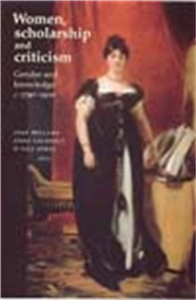
Brings together the varied artistic, critical and cultural productions by women scholars, critics and artists between 1790-1900, many of whom are little known in the canonical histories of the period. Questions the concepts of 'scholarship', 'criticism' and 'artist' across the different disciplines. Women discussed include authors (Mary Wollstonecraft Shelley, Sydney Morgan and Anna Jameson) actresses ( Elizabeth Siddons, Dorothy Jordan, and Mary Robinson) critics ( Margaret Oliphant and Mary Cowden Clarke) historians (Agnes Strickland, Lucy Aikin, Mary Anne Everett Green, Elizabeth Cooper and Lucy Toulmin Smith) as well as the writers and readers of Women's magazines, educationalists and translators. Makes a significant and original contribution to the development of gender studies by extending the frontiers of existing knowledge and research. ;
Trusted Partner


Marcus Hammerschmitt schreibt Science-fiction-Erzählungen, die technologische Phantasie, psychologische Einsicht, Lust am gedanklichen Experiment und poetische Erfindungskraft vereinen. Wie Herbert W. Franke oder Peter Schattschneider basiert er seine Geschichten auf einer soliden Grundlage, entwickelt seine Szenarios und Fabeln spielerisch, verknüpft sie aber dramatisch mit den größeren Problemen von Ökologie einerseits und den Zweifeln und inneren Konflikten des einzelnen andererseits.
Trusted Partner

Looking at contemporary film and television, this book explores how popular genres frame our understanding of on-screen performance. Previous studies of screen performance have tended to fix upon star actors, directors, or programme makers, or they have concentrated upon particular training and acting styles. Moving outside of these confines, this book provides a truly interdisciplinary account of performance in film and television and examines a much neglected area in our understanding of how popular genres and performance intersect on screen. Each chapter concentrates upon a particular genre or draws upon generic case studies in examining the significance of screen performance. Individual chapters examine contemporary film noir, horror, the biopic, drama-documentary, the western, science fiction, comedy performance in 'spoof news' programmes and the television 'sit com' and popular Bollywood films.
Trusted Partner
Trusted Partner

Coline Serreau became famous in 1985 when her third film, Trois hommes et un couffin (Three Men and a Baby), the most successful French film of the 1980s. She was already known in France for her major contribution to feminist documentaries with the acclaimed Mais qu'est-ce qu'elles veulent?, a series of interviews with French women made between 1975 and 1977. She is now a key figure in French cinema and drama, with international hits including Romuald et Juliette (1989) and La Crise (1992). This appraisal of her work situates her films within the social, cultural and political context of France since May 1968, and assesses th emajor impact of the women's movement on French society and culture. Politics and sexual politics, two key aspects of Serreau's films and plays, are thoroughly examined. This book also considers the cultural influences of her work, and provides an overview of her films and filmic skills. Special attention is given to comedy, the cinematographic genre favoured by Serreau and the French audience, which is apprehended from a historical and gendered perspective. The clarity of the style and the wide-ranging analysis of Serreau's films and filming techniques make this book relevant both to students of film and film enthusiasts.



