Your Search Results

      • Trusted Partner
      • Trusted Partner
      • Trusted Partner
        Humanities & Social Sciences
        June 2026

        Arctic state identity

        by Ingrid A. Medby

      • Trusted Partner
        Teaching, Language & Reference
        June 2025

        Pluriversal sovereignty and the state

        by Ajay Parasram

      • Trusted Partner
      • Trusted Partner
        Humanities & Social Sciences
        October 2008

        Political responsibility and the European Union

        by Myrto Tsakatika

        This book addresses the question of political legitimacy in the European Union from the much neglected angle of political responsibility. It develops an original communitarian approach to legitimacy based on Alasdair MacIntyre's ethics of virtues and practices, that can be contrasted with prevalent liberal-egalitarian and neo-republican approaches. Tsakatika argues that a 'responsibility deficit', quite distinct from the often discussed 'democratic deficit', can be diagnosed in the European Union. This is documented in chapters that provide in-depth analysis of accountability, transparency and the difficulties associated with identifying responsibility in European governance. Closing this gap requires going beyond institutional engineering. It calls for gradual convergence towards certain core social and political practices and for the flourishing of the virtues of political responsibility in Europe's nascent political community. Throughout the book, normative political theory is brought to bear on concrete dilemmas of institutional choice faced by the EU during the recent constitutional debates. 'Political responsibility and the European Union' will be of interest to specialists and postgraduate students of political theory, constitutional law and European Union Studies. ;

      • Trusted Partner
        Humanities & Social Sciences
        September 2012

        Rescaling the state

        Devolution and the geographies of economic governance

        by Mark Goodwin, Martin Jones, Rhys Jones

        Rescaling the state provides a theoretically-informed and empirically-rich account of the process of devolution undertaken in the UK since 1997, focusing in particular on the devolution of economic governance. Using case studies from England, Scotland, Northern Ireland and Wales, the book examines the purported reasons for, and the unintended consequences of, devolution. As well as comparing policy and practice across the four devolved territories, the book also explores the pitfalls and instances of good practice associated with devolution in the UK. Rescaling the state is an important text for all social scientists - particularly political scientists, sociologists, anthropologists and human geographers - interested in the devolution of power in the UK and, indeed, all instances of contemporary state restructuring. It is also a significant book for all policy-makers interested in understanding the increasing complexity of the policy landscapes of economic governance in the UK. ;

      • Trusted Partner
        Humanities & Social Sciences
        July 2026

        Citizens gone

        How emigration transforms the European state

        by Christof Roos, Anna Kyriazi

        Emigration of scale challenges states at the European periphery at their core. The book documents these struggles along their effects for politics and policy within their economic and welfare dimensions. The politics of emigration describe changing voter attitudes and behaviour pointing towards more support for nationalist and right-wing parties. The policies of emigration show state and local level efforts for the return of emigrant citizens. The welfare and economic dimensions explore the context for emigration and its effects for growth models and systems of health and care within the European single market. The book observes two types of state transformations: the re-emergent nation-state that re-discovers its core resource, the citizenry, as well as states that functionally and socially adapt to population loss.

      • Trusted Partner
        Humanities & Social Sciences
        May 2008

        Intervention and state-building in the Pacific

        The legitimacy of 'cooperative intervention'

        by Peter Lawler, Greg Fry, Tarcisius Kabutaulaka, Emmanuel Pierre Guittet, Alan Rutter

        State-building intervention in weak, war-torn or failing states has become a priority for the international community. However, the question of how to legitimately engage in the shaping of national governance remains, at the very least, a vexed one. This book explores this key issue through a critical examination of a new model of state-building intervention which has recently emerged in relation to the Pacific 'arc of crisis'. Initiated by the Australian Government in 2003, this 'cooperative intervention' doctrine, built on declared principles of partnership and respect for sovereignty, seems to offer a legitimate way to engage in state-building intervention. Drawing on a group of distinguished Pacific specialists, this book mounts a critique of these claims, showing how international legitimacy does not automatically translate into political legitimacy among those in the affected societies; and how the attempt to legitimise the intervention internationally may actually work against such legitimacy in the recipient state. These insights will be of value to those interested in public policy studies, international law, development studies and international relations. ;

      • Trusted Partner
        Humanities & Social Sciences
        July 2015

        The social face of the Regulatory State

        Reforming public services in Europe

        by Sandra Eckert

        Capitalism in Europe is transformed as a result of liberalisation, privatisation and regulatory reform. Unravelling the state as service provider and employer has posed significant social policy challenges to the emerging regulatory state. The book examines how these challenges have been addressed in different varieties of capitalism and across sectors. It compares change in France, Germany and the United Kingdom, takes stock of the reform movement in Europe and internationally, and discusses policy approaches in telecoms and electricity. It pays special attention to falling mail volumes as a driver of change and a new wave of privatisation triggered by the European sovereign debt crisis. The analysis reveals whether and how social policy goals have been addressed by means of regulation and redistribution. The book explains why liberal market economies have been postal reform latecomers and why the regulatory state benefits consumers, but is likely to leave employees' interests behind. ;

      • Trusted Partner
        Humanities & Social Sciences
        August 2016

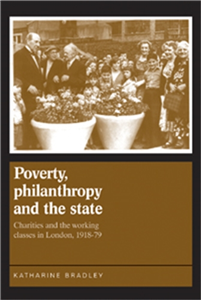
        Poverty, philanthropy and the state

        Charities and the working classes in London, 1918–79

        by Katharine Bradley

        This book looks at a number of charities in London between 1918 and 1979, and the ways in which they negotiated the growth of the welfare state and changes in the communities around them.These charities - the 'university settlements'- were founded in the 1880's and 1890's and brought young graduates such as William Beveridge & Clement Attlee to deprived areas of cities to undertake social work. It is of interest to those who wish to know more about the complexities of the relationships between charities, the welfare state and individuals in the course of the twentieth century. Bradley argues that whilst the settlements often had difficulties in sustaining their work with the vulnerable, they remained an important factor between the individual and the impacts of poverty. Aimed at scholars in the fields of history, social policy, sociology and criminology this book will also be of interest to practitioners in the voluntary sector and government. ;

      • Trusted Partner
        First World War
        November 2009

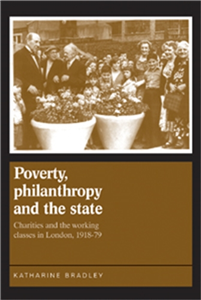
        Poverty, philanthropy and the state

        Charities and the working classes in London, 1918–79

        by Katharine Bradley

        This book looks at a number of charities in London between 1918 and 1979, and the ways in which they negotiated the growth of the welfare state and changes in the communities around them.These charities - the 'university settlements'- were founded in the 1880's and 1890's and brought young graduates such as William Beveridge & Clement Attlee to deprived areas of cities to undertake social work. It is of interest to those who wish to know more about the complexities of the relationships between charities, the welfare state and individuals in the course of the twentieth century. Bradley argues that whilst the settlements often had difficulties in sustaining their work with the vulnerable, they remained an important factor between the individual and the impacts of poverty. Aimed at scholars in the fields of history, social policy, sociology and criminology this book will also be of interest to practitioners in the voluntary sector and government.

      • Trusted Partner
        Humanities & Social Sciences
        January 2019

        Beyond the state

        The colonial medical service in British Africa

        by Anna Greenwood, Andrew Thompson, John M. MacKenzie

        The Colonial Medical Service was the personnel section of the Colonial Service, employing the doctors who tended to the health of both the colonial staff and the local populations of the British Empire. Although the Service represented the pinnacle of an elite government agency, its reach in practice stretched far beyond the state, with the members of the African service collaborating, formally and informally, with a range of other non-governmental groups. This collection of essays on the Colonial Medical Service of Africa illustrates the diversity and active collaborations to be found in the untidy reality of government medical provision. The authors present important case studies covering former British colonial dependencies in Africa, including Kenya, Malawi, Nigeria, Tanzania, Uganda and Zanzibar. They reveal many new insights into the enactments of colonial policy and the ways in which colonial doctors negotiated the day-to-day reality during the height of imperial rule in Africa. The book provides essential reading for scholars and students of colonial history, medical history and colonial administration.

      • Trusted Partner
        Humanities & Social Sciences
        June 2023

        Worrier state

        Risk, anxiety and moral panic in South Africa

        by Nicky Falkof

        Risk, anxiety and moral panic are endemic to contemporary societies and media forms. How do these phenomena manifest in a place like South Africa, which features heightened insecurity, deep inequality and accelerated social change? What happens when cultures of fear intersect with pervasive systems of gender, race and class? Worrier state investigates four case studies in which fear and anxiety appear in radically different ways: the far right myth of 'white genocide'; so-called 'Satanist' murders of young women; an urban legend about township crime; and social theories about safety and goodness in the suburbs. Falkof foregrounds the significance of emotion as a socio-political force, emphasising South Africa's imbrication within globalised conditions of anxiety and thus its fundamental and often-ignored hypermodernity. The book offers a bold and creative perspective on the social roles of fear and emotion in South Africa and thus on everyday life in this complex place.

      • Trusted Partner
        Teaching, Language & Reference
        February 2012

        Workers, state and development in Brazil

        Powers of labour, chains of value

        by Benjamin Selwyn

        How do changing class relations contribute to processes of capitalist development? Within development studies the importance of class relations is usually relegated to lesser status than the roles of states and markets in generating and allocating resources. This book argues that the changing class relations are central to different patterns of capitalist development and that processes and outcomes of class struggle co-determine the form that development takes. Workers, State and Development in Brazil, nominated for the International Political Economy Group (IPGG) Book Prize 2013 and now available in paperback, illuminates these claims through a detailed empirical investigation of class dynamics and capitalist development in North East Brazil's São Francisco valley. It details how workers in the valley's export grape sector have won significant concessions from employers, contributing to a progressive pattern of regional capitalist development. The book will appeal to students and researchers interested in processes of capitalist development, agrarian political economy and international political economy. ;

      • Trusted Partner
        Humanities & Social Sciences
        April 2007

        Labour, the state, social movements and the challenge of neo-liberal globalisation

        by Andrew Gamble, Steven Fielding, Steve Ludlam, John Callaghan, Andrew Taylor, Steve Ludlam, Stephen Wood

        With the emergence of neo-liberalism in the 1980s as the dominant domestic and international political-economic orthodoxy, labour as both a social category and political movement tended to be written off or ignored by academics, politicians and commentators. However, at a time when the world's working class is growing faster than at any previous time in history and neo-liberalism is widely challenged, this orthodoxy is clearly inadequate. The spread of global production means that to ignore labour, its organisations, interests and politics, is to ignore one of the key components of that process. Labour organisations have not gone away and neither has the state: their relationship remains as significant as ever. The strategic relationship between trade unions and social movements, nationally and internationally, has also developed markedly, especially in the south. New patterns of resistance are emerging to challenge global capital and those who assert that globalisation is irresistible. ;

      • Trusted Partner
        Social issues (Children's/YA)
        June 2014

        Youth policy, civil society and the modern Irish state

        by Fred Powell, Martin Geoghegan, Margaret Scanlon, Katharina Swirak

        This book, now available in paperback, explores the development of youth policy and youth work in Ireland from the mid-nineeenth century to the present day. Based on original research, funded by the Irish Research Council for the Humanities and Social Sciences (IRCHSS), it looks at the social construction of youth, the emergence of the early youth movements and the nature and scope of contemporary youth work. Key issues include: the shift from mainstream to targeted provision, the professionalisation of the sector and the increased partnership between the state and voluntary sector. A second major theme is the treatment of young people in industrial and reformatory schools, with particular reference to the findings of the Ryan Report on child abuse (2009). This is the only book which combines an exploration of the history and current scope of youth work and youth policy, and which is based on comprehensive original research. It will be essential reading for lecturers and students in youth work, social sciences, social history and related fields.

      • Trusted Partner
        Business, Economics & Law
        January 2026

        International organisations, non-State actors, and the formation of customary international law

        by Sufyan Droubi, Jean d'Aspremont

        This volume offers new practical and theoretical perspectives on one of the most complex questions regarding the formation of international law, namely that actors other than states contribute to the making of customary international law. Notwithstanding the International Law Commission's valuable contribution, the making of customary international law remains riddled with acute practical and theoretical controversies that continue to be intensively debated. Making extensive reference to the case-law of international law courts and tribunals, as well as the most recent scholarly work on customary international law, this volume provides a comprehensive study of the contribution of international organisations and non-state actors to the formation of customary international law. With innovative tools and guidance for law students, legal scholars, and researchers in law, as well as legal practitioners, advisers, judges, arbitrators, and counsels, this collection is essential reading for those wishing to understand and address contemporary questions of international law-making.

      Subscribe to our

      newsletter