
Franz Steiner Verlag / Berliner Wissenschafts-Verlag
Academic publishing house (ancient history of economics, history of science/medicine, geography, musicology, philosophy of law). Berliner Wissenschaft-Verlag is an imprint.
View Rights Portal Trusted Partner

Academic publishing house (ancient history of economics, history of science/medicine, geography, musicology, philosophy of law). Berliner Wissenschaft-Verlag is an imprint.
View Rights Portal


Transnational solidarity excavates the forgotten histories of solidarity that were vital to radical political imaginaries during the 'long' 1960s. It decentres the conventional Western focus of this critical historical moment by foregrounding transnational solidarity with, and across, anticolonial and anti-imperialist liberation struggles. The book traces the ways in which solidarity was conceived, imagined and enacted in the border crossings - of nation, race and class - made by grassroots activists. This diverse collection draws links between exiled revolutionaries in Uruguay, post-colonial immigrants in Britain, and Greek communist refugees in East Germany who campaigned for their respective causes from afar while identifying and linking up with wider liberation struggles. Meanwhile, Arab immigrants in France, Pakistani volunteers and Iraqi artists found myriad ways to express solidarity with the Palestinian cause. Neglected archives also reveal Tricontinental Cuban-based genealogies of artistic militancy, as well as transnational activist networks against Portuguese colonial rule in Africa. Bringing together original research with contributions from veteran activists and artists, this interdisciplinary volume explores how transnational solidarity was expressed in and carried through the itineraries of migrants and revolutionaries, film and print cultures, art and sport, political campaigns and armed struggle. It presents a novel perspective on radical politics of the global sixties which remains crucial to understanding anti-racist solidarity today. With a foreword by Vijay Prashad.
Trusted Partner
 Trusted Partner
 Trusted Partner
 Trusted Partner
 Trusted Partner
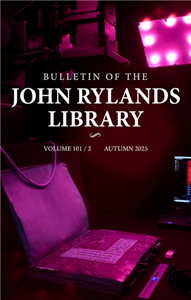
The John Rylands Library houses one of the finest collections of rare books, manuscripts and archives in the world. The collections span five millennia, have a global reach and cover a wide range of subjects, including art and archaeology; economic, social, political, religious and military history; literature, drama and music; science and medicine; theology and philosophy; travel and exploration. For over a century, the Bulletin of the John Rylands Library has published research that complements the Library's special collections. An electronic edition of this issue is freely available under a Creative Commons (CC BY-NC-ND) licence.
Trusted Partner
 Trusted Partner
 Trusted Partner
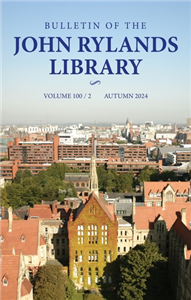
The John Rylands Library houses one of the finest collections of rare books, manuscripts and archives in the world. The collections span five millennia, have a global reach and cover a wide range of subjects, including art and archaeology; economic, social, political, religious and military history; literature, drama and music; science and medicine; theology and philosophy; travel and exploration. For over a century, the Bulletin of the John Rylands Library has published research that complements the Library's special collections.
Trusted Partner
For nearly half a century Anne Lake Prescott has been a force and an inspiration in Renaissance studies. A force, because of her unique blend of learning and wit and an inspiration through her tireless encouragement of younger scholars and students. Her passion has always been the invisible bridge across the Channel: the complex of relations, literary and political, between Britain and France. The essays in this long-awaited collection range from Edmund Spenser to John Donne, from Clément Marot to Pierre de Ronsard. Prescott has a particular fondness for King David, who appears several times; and the reader will encounter chessmen, bishops, male lesbian voices and Roman whores. Always Prescott's immense erudition is accompanied by a sly and gentle wit that invites readers to share her amusement. Reading her is a joyful education.
Trusted Partner
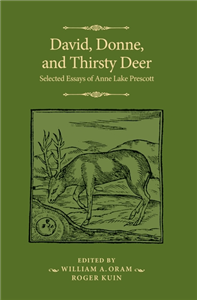
For nearly half a century Anne Lake Prescott has been a force and an inspiration in Renaissance studies. A force, because of her unique blend of learning and wit and an inspiration through her tireless encouragement of younger scholars and students. Her passion has always been the invisible bridge across the Channel: the complex of relations, literary and political, between Britain and France. The essays in this long-awaited collection range from Edmund Spenser to John Donne, from Clément Marot to Pierre de Ronsard. Prescott has a particular fondness for King David, who appears several times; and the reader will encounter chessmen, bishops, male lesbian voices and Roman whores. Always Prescott's immense erudition is accompanied by a sly and gentle wit that invites readers to share her amusement. Reading her is a joyful education.
Trusted Partner


Über die Folgen der Globalisierung für die Kultur wird in den letzten Jahren heftig gestritten. Prophezeien die einen eine Homogenisierung der Weltkultur, verheißen die anderen kulturelle Desintegration bzw. Fragmentierung allerorten. Doch ein Blick auf die Kulturgeschichte der letzen Jahrhunderte lehrt, dass diese beunruhigenden Diagnosen nur zum Teil zutreffen. Viel wahrscheinlicher ist indes, so der Kulturhistoriker Peter Burke, dass eine neue kulturelle Ordnung entsteht, sich neue Formen kultureller Rekonfiguration herauskristallisieren werden, wobei Bausteine des Alten in ein neues Muster eingefügt werden. Burke untersucht daher in diesem Buch den kulturellen Austausch in vergleichender und historischer Perspektive. Er erkundet die Vielfalt der Konzepte, mit denen dieser Austausch beschrieben und analysiert wurde, und befasst sich mit seinen Kontexten und Konsequenzen. Sein Hauptaugenmerk gilt dabei drei möglichen Szenarien einer Reaktion auf kulturellen »Import« bzw. kulturelle »Invasionen«: Akzeptanz, Abwehr und Segregation.
Trusted Partner
The John Rylands Library houses one of the finest collections of rare books, manuscripts and archives in the world. The collections span five millennia, have a global reach and cover a wide range of subjects, including art and archaeology; economic, social, political, religious and military history; literature, drama and music; science and medicine; theology and philosophy; travel and exploration. For over a century, the Bulletin of the John Rylands Library has published research that complements the Library's special collections. An electronic edition of this issue is freely available under a Creative Commons (CC BY-NC-ND) licence.
Trusted Partner
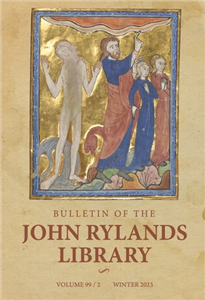
The John Rylands Library houses one of the finest collections of rare books, manuscripts and archives in the world. The collections span five millennia and cover a wide range of subjects, including art and archaeology; economic, social, political, religious and military history; literature, drama and music; science and medicine; theology and philosophy; travel and exploration. For over a century, the Bulletin of the John Rylands Library has published research that complements the Library's special collections. The editors invite the submission of articles in these fields and welcome discussion of in-progress projects.
Trusted Partner
 Trusted Partner

The names Edmund Spenser and John Donne are typically associated with different ages in English poetry, the former with the sixteenth century and the Elizabethan Golden Age, the latter with the 'metaphysical' poets of the seventeenth century. This collection of essays, part of The Manchester Spenser series, brings together leading Spenser and Donne scholars to challenge this dichotomous view and to engage critically with both poets, not only at the sites of direct allusion, imitation, or parody, but also in terms of common preoccupations and continuities of thought, informed by the literary and historical contexts of the politically and intellectually turbulent turn of the century. Juxtaposing these two poets, so apparently unlike one another, for comparison rather than contrast changes our understanding of each poet individually and moves towards a more holistic, relational view of their poetics.
Trusted Partner
Trusted Partner
Trusted Partner

The forgotten legacy of religious Jewish anarchism, and the adventures and ideas of its key figures, finally comes to light in this book. Set in the decades surrounding both world wars, No masters but God identifies a loosely connected group of rabbis and traditionalist thinkers who explicitly appealed to anarchist ideas in articulating the meaning of the Torah, traditional practice, Jewish life and the mission of modern Jewry. Full of archival discoveries and first translations from Yiddish and Hebrew, it explores anarcho-Judaism in its variety through the works of Yaakov Meir Zalkind, Yitshak Nahman Steinberg, Yehudah Leyb Don-Yahiya, Avraham Yehudah Heyn, Natan Hofshi, Shmuel Alexandrov, Yehudah Ashlag and Aaron Shmuel Tamaret. With this ground-breaking account, Hayyim Rothman traces a complicated story about the modern entanglement of religion and anarchism, pacifism and Zionism, prophetic anti-authoritarianism and mystical antinomianism.


