Your Search Results

      • Zhejiang Publishing United Group

        More than 1,000 titles of books by Zhejiang Publishing United Group have been traded with over 100 foreign publishing houses including Bertelsmann, Pearson, Hachette, Larousse, Gallimard, MacMillan, Random, DK, Shogakukan Inc., Kodansha Inc., Simon & Schuster and other world-famous university publishing houses such as Oxford, Cambridge, Harvard, Princeton, Stanford.

        View Rights Portal
      • China Education Publishing & Media Group

        China Education Publishing & Media Groupis the largest educational publishing enterprise in China. Itspecialises in publishing and distributing textbooks,periodicals, electronic audio andvideo products, digital publications, along with cinema andtheatre chain, film andTV program production and investment, and in importing andexportingbooks, journals and educational instrument andequipment.

        View Rights Portal
      • Trusted Partner
        Humanities & Social Sciences
        January 2020

        Higher education in a globalising world

        Community engagement and lifelong learning

        by Peter Mayo, Michael Osborne

        This book focuses on current policy discourse in Higher Education, with special reference to Europe. It discusses globalisation, Lifelong Learning, the EU's Higher Education discourse, this discourse's regional ramifications and alternative practices in Higher Education from both the minority and majority worlds with their different learning traditions and epistemologies. It argues that these alternative practices could well provide the germs for the shape of a public good oriented Higher Education for the future. It theoretically expounds on important elements to consider when engaging Higher Education and communities, discussing the nature of the term 'community' itself. Special reference is accorded to the difference that lies at the core of these ever-changing communities. It then provides an analysis of an 'on the ground project' in University community engagement, before suggesting signposts for further action at the level of policy and provision.

      • Trusted Partner
      • Trusted Partner
        Humanities & Social Sciences
        January 2011

        Public Schools and Private Education

        The Clarendon Commission 1861–64 and the Public Schools Acts

        by Colin Shrosbree

        The great public schools are central to any discussion of English secondary education. Founded as public endowments, they are the basis of private education. Set apart from the other grammar schools by the Clarendon Commission of 1861, their influence on the state system has been enormous. Severed from the national provision of public education, they have put prestige and ancient endowments at the service of wealth and patronage. This book, available in paperback for the first time, shows how this came to pass. How the schools' attempts at reform, reliance on fees, the defence of the Classics, public criticism of Eton, European ideas and foreign economic competition led to the Carendon Commission. How Lord Clarendon himself, in conflict with Palmerston over foreign policy, came to lead the Commission and attempt curricular reform. How the Public Schools Acts created a separate school system for the benefit of Eton and how the Lords sought to establish that system for the upper classes. How the fee-paying, class-based principles of the Commission influenced the other grammar schools and all later English education. How the Public schools Acts reduced the influence of local parents and how new governors were appointed nationally. How Shrewsbury School, an example of an endowed grammar school with strong local connections, came to be part of the public school system. It is not the conflict between state education and private schools that makes so much discussion of English education bitter and controversial. It is the loss to state education of the public schools - the original political purpose of the Acts - and the impoverishment of national education by the class divisions of Victorian legislation. ;

      • Trusted Partner
        Nursing & ancillary services

        Nursing Education Manual

        Theory - Empiricism - Practice

        by Maria A. Marchwacka (Ed.)

        The handbook explains theoretical approaches to nursing education, provides empirical findings on the concept of education in nursing, and shows possibilities for practical applications and implementation of nursing education using examples in vocational education, such as interdisciplinary learning, competence orientation, simulation testing, and inclusion, as well as professionalism and awareness of language registers of teachers.

      • Trusted Partner
      • Trusted Partner
      • Trusted Partner
      • Trusted Partner
        Humanities & Social Sciences
        March 2017

        The language of empire

        Myths and metaphors of popular imperialism, 1880-1918

        by Robert Macdonald

        The debate about the Empire dealt in idealism and morality, and both sides employed the language of feeling, and frequently argued their case in dramatic terms. This book opposes two sides of the Empire, first, as it was presented to the public in Britain, and second, as it was experienced or imagined by its subjects abroad. British imperialism was nurtured by such upper middle-class institutions as the public schools, the wardrooms and officers' messes, and the conservative press. The attitudes of 1916 can best be recovered through a reconstruction of a poetics of popular imperialism. The case-study of Rhodesia demonstrates the almost instant application of myth and sign to a contemporary imperial crisis. Rudyard Kipling was acknowledged throughout the English-speaking world not only as a wonderful teller of stories but as the 'singer of Greater Britain', or, as 'the Laureate of Empire'. In the last two decades of the nineteenth century, the Empire gained a beachhead in the classroom, particularly in the coupling of geography and history. The Island Story underlined that stories of heroic soldiers and 'fights for the flag' were easier for teachers to present to children than lessons in morality, or abstractions about liberty and responsible government. The Education Act of 1870 had created a need for standard readers in schools; readers designed to teach boys and girls to be useful citizens. The Indian Mutiny was the supreme test of the imperial conscience, a measure of the morality of the 'master-nation'.

      • Trusted Partner
        Humanities & Social Sciences
        June 2026

        Radicalisation, counter-radicalisation, and Prevent

        A vernacular approach

        by Lee Jarvis, Andrew Whiting, Stuart Macdonald

        This book offers the first sustained investigation into non-elite understandings of radicalisation and counter-radicalisation policy. Drawing on original focus group research with students from universities across England and Wales, the book explores how 'ordinary' citizens understand radicalisation, how they make sense of counter-radicalisation initiatives like the UK Prevent Strategy, and how they evaluate its functioning and effects across society. Radicalisation, counter-radicalisation and Prevent demonstrates that these non-elite insights often contradict and diverge from traditional (elite) security knowledge and thus shed new light on wider questions around the politics of security. This has vitally important implications not only for counter-radicalisation and counter-terrorism policy but for the very study and practice of security.

      • Trusted Partner
        Humanities & Social Sciences
        June 2026

        Arctic state identity

        by Ingrid A. Medby

      • Trusted Partner
        Humanities & Social Sciences
        May 2020

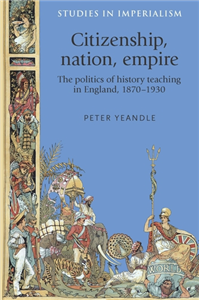
        Citizenship, nation, empire

        The politics of history teaching in England, 1870–1930

        by Andrew Thompson, Peter Yeandle, John M. MacKenzie

        Citizenship, nation, empire investigates the extent to which popular imperialism influenced the teaching of history between 1870 and 1930. It is the first book-length study to trace the substantial impact of educational psychology on the teaching of history, probing its impact on textbooks, literacy primers and teacher-training manuals. Educationists identified 'enlightened patriotism' to be the core objective of historical education. This was neither tub-thumping jingoism, nor state-prescribed national-identity teaching, but rather a carefully crafted curriculum for all children which fused civic as well as imperial ambitions. The book will be of interest to those studying or researching aspects of English domestic imperial culture, especially those concerned with questions of childhood and schooling, citizenship, educational publishing and anglo-British relations. Given that vitriolic debates about the politics of history teaching have endured into the twenty-first century, Citizenship, nation, empire is a timely study of the formative influences that shaped the history curriculum in English schools

      • Trusted Partner
        Humanities & Social Sciences
        July 2026

        Citizens gone

        How emigration transforms the European state

        by Christof Roos, Anna Kyriazi

        Emigration of scale challenges states at the European periphery at their core. The book documents these struggles along their effects for politics and policy within their economic and welfare dimensions. The politics of emigration describe changing voter attitudes and behaviour pointing towards more support for nationalist and right-wing parties. The policies of emigration show state and local level efforts for the return of emigrant citizens. The welfare and economic dimensions explore the context for emigration and its effects for growth models and systems of health and care within the European single market. The book observes two types of state transformations: the re-emergent nation-state that re-discovers its core resource, the citizenry, as well as states that functionally and socially adapt to population loss.

      • Trusted Partner
        Humanities & Social Sciences
        January 2026

        Migration and social policy in a changing world

        Histories, challenges and dilemmas

        by Bryan Fanning

        Migration and social policy in a changing world bridges the generally separate fields of social policy and migration studies. This book traces social policy responses to migration from the Industrial Revolution to today's era of globalisation and large-scale migration. Through case studies from across the globe, the book explores key themes including rural-urban migration, social citizenship, welfare internationalism and diasporic care systems. It examines how migrants are included in or excluded from social citizenship in host societies, and how they become providers of welfare services such as health and social care. Moving beyond a methodological nationalist focus, the book investigates migrant incorporation into welfare states through family networks, faith communities, and other informal welfare structures. It combines migrants' experiences with host societies' immigration politics, institutional perspectives and policies to present a comprehensive analysis of the migration-welfare relationship. This volume fills a gap in academic literature and offers policymakers, practitioners and scholars a framework for understanding the interplay between migration and social policy in our changing world.

      • Trusted Partner
        Humanities & Social Sciences
        September 2023

        Missionaries and modernity

        Education in the British Empire, 1830-1910

        by Felicity Jensz

        Many missionary societies established mission schools in the nineteenth century in the British Empire as a means to convert non-Europeans to Christianity. Although the details, differed in various colonial contexts, the driving ideology behind mission schools was that Christian morality was highest form of civilisation needed for non-Europeans to be useful members of colonies under British rule. This comprehensive survey of multi-colonial sites over the long time span clearly describes the missionary paradox that to draw in pupils they needed to provide secular education, but that secular education was seen to lead both to a moral crisis and to anti-British sentiments.

      • Trusted Partner
        Humanities & Social Sciences
        July 2024

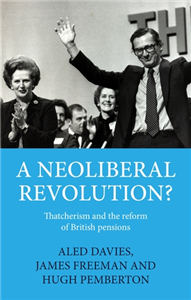
        A neoliberal revolution?

        Thatcherism and the reform of British pensions

        by Hugh Pemberton, James Freeman, Aled Davies

        This book examines the Thatcher government's attempt to revolutionise Britain's pensions system in the 1980s and create a nation of risk-taking savers with an individual stake in capitalism. Drawing upon recently-released archival records, it shows how the ideas motivating these reforms journeyed from the writings of neoliberal intellectuals into government and became the centrepiece of a plan to abolish significant parts of the UK's welfare state and replace these with privatised personal pensions. Revealing a government that veered between political caution and radicalism, the book explains why this revolution failed and charts the malign legacy left by the evolutionary changes that ministers salvaged from the wreckage of their reforms. The book contributes to understanding of policy change, Thatcherism, and international neoliberalism by showing how major reforms to social security could reflect neoliberal thought and yet profoundly disappoint their architects.

      • Trusted Partner
        Humanities & Social Sciences
        June 2026

        A neoliberal revolution?

        Thatcherism and the reform of British pensions

        by Aled Davies, James Freeman, Hugh Pemberton

        This book examines the Thatcher government's attempt to revolutionise Britain's pensions system in the 1980s and create a nation of risk-taking savers with an individual stake in capitalism. Drawing upon recently-released archival records, it shows how the ideas motivating these reforms journeyed from the writings of neoliberal intellectuals into government and became the centrepiece of a plan to abolish significant parts of the UK's welfare state and replace these with privatised personal pensions. Revealing a government that veered between political caution and radicalism, the book explains why this revolution failed and charts the malign legacy left by the evolutionary changes that ministers salvaged from the wreckage of their reforms. The book contributes to understanding of policy change, Thatcherism, and international neoliberalism by showing how major reforms to social security could reflect neoliberal thought and yet profoundly disappoint their architects.

      • Trusted Partner
        Humanities & Social Sciences
        April 2012

        The Labour party and citizenship education

        Policy networks and the introduction of citizenship lessons in schools

        by Ben Kisby

        The Labour Party and citizenship education provides the definitive account of why and how Labour introduced citizenship education as a compulsory subject in the National Curriculum. Based on interviews with the key players, it contributes to our understanding of the role of ideas and policy networks in the policy process, to debates about the nature of New Labour as a political phenomenon, and addresses the significant and topical issues of political disaffection and community cohesion. This book is essential reading for academics and students of political science, public and social policy, education, contemporary history, and political theory. Written in an accessible style, it will also be of interest to the general reader concerned about issues of citizenship, political participation, disengagement and re-engagement. ;

      • Trusted Partner

      Subscribe to our

      newsletter