
January 2016
Your Search Results
-
Promoted Content


-
Promoted Content
-
 Trusted Partner
-
Trusted Partner
-
Trusted Partner

 April 2023
Evolutionary Epistemology
by Gerhard Vollmer
— The seminal work reissued — A science and philosophy classic — On the occasion of the author's 80th birthday According to evolutionary epistemology, the fact that we can know the world is neither coincidence nor divine providence, but has a natural explanation. Thinking and cognition are achievements of the human brain. Our cognitive structures fit into our world because they have evolved in adaptation to this world. This fit is not ideal, but it is enough for survival under competition. Gerhard Vollmer was instrumental in developing evolutionary epistemology. In his standard work, he explains the achievements and failures of our cognitive apparatus.
-
Trusted Partner
-
Trusted Partner

 The ArtsJanuary 2026
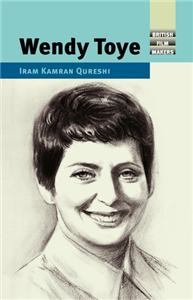
Wendy Toye
by Iram Kamran Qureshi
This groundbreaking book delves into the remarkable career of Wendy Toye, one of Britain's most prolific, versatile and pioneering directors. Spanning a fascinating journey through her work in cinema, television, and advertising, the study highlights her mastery of visual storytelling, choreographic brilliance, and technical innovation. From her landmark short film The Stranger Left No Card to her contributions in musicals, comedy, fantasy films, and television productions, Toye's work consistently broke boundaries in a male-dominated industry. This insightful analysis also examines her ability to combine artistry with precision, her influence on the postwar cultural landscape, and her lasting legacy as a multidimensional creative force. A must-read for cinema enthusiasts, scholars, and anyone inspired by women's achievements in the media landscape.
-
Trusted Partner

 Health & Personal Development
THE 6 MINUTE SUCCESS JOURNAL
PLAN YOUR HAPPINESS - A goal without a plan is just a wish
by Dominik Spenst
Thousands of readers of Dominik Spenst’s best-selling book The 6 Minute Diary used mindfulness and gratitude to lead happier, more fulfilled lives. In his new book, The 6 Minute Journal, Spenst melds mindfulness with productivity to offer us new ways of realising our goals that are based on proven tools from positive psychology. His approach builds productive behaviour, combining target-orientated determination with calm and serenity, for example by encouraging us to reflect on our strengths every day or working in a mindful way. The skills promoted here let us focus on aspirations and dreams that would otherwise be drowned out in our hectic daily work routines. Attain your unique definition of personal and professional success in only 6 minutes a day!
-
Trusted Partner
 Literature & Literary StudiesJuly 2008
Anthony Burgess and modernity
by Alan Roughley
Anthony Burgess and Modernity provides a variety of new perspectives and contexts for exploring Burgess's literature and music. A range of international scholars and critics explore the writer's novels, music and linguistic productions to explore and define how Burgess contributed to modernist and postmodernist art. The scholars who contributed to the book provide original explorations of Burgess's work and the theological, psychological, linguistic, literary and musical contexts in which Burgess's achievements can best be understood. It will appeal to scholars and students, but it also offers an appreciation of Burgess's artistic achievements that will provide general readers of Burgess's work with an insight into some of the exciting contexts in which Burgess novels can be read. ;
-
Trusted Partner

 Psychology
When Great AchiWhen Great Achievements Lead to Great Self-doubtevements Lead to Great Self-doubt
The Impostor Self-image and its Effects
by Sonja Rohrmann
They are successful high performers and to the outsider they appear to be capable, qualified, and skilled. Nevertheless, despite obvious evidence of their actual capacities, some of them fear that they will not be able to repeat their successes. They tend to attribute career success not to personal expertise but to excessive effort or uncontrollable factors such as luck. People with the impostor self-image or “imposter syndrome” are convinced that they are not as intelligent and capable as they ap-pear to others and that they have arrived in their positions undeservedly. They thus experience themselves as “frauds” or “impostors” and fear that sooner or later they will be exposed as such.This book examines the characteristics of the impostor self-image, how it can be identified, how widespread it is, how it develops, its links with other personality traits, and its effects. Finally, the question of countering the impostor self-image is explored, along with how people can arrive at a realistic assessment of their own skills, counter self-doubt, and achieve greater psychological well-being. For: • interested lay people• academic specialists and practitioner
-
Trusted Partner
 Humanities & Social SciencesMarch 2017
Ephemeral vistas
by Paul Greenhalgh
The international exhibitions held around the world between 1851 and 1939 were spectacular gestures, which briefly held the attention of the world before disappearing into an abrupt oblivion, of the victims of their planned temporality. Known in Britain as Great Exhibitions, in France as Expositions Universelles and in America as World's Fairs, the genre became a self-perpetuating phenomenon, the extraordinary cultural spawn of industry and empire. Thoroughly in the spirit of the first industrial age, the exhibitions illustrated the relation between money and power, and revelled in the belief that the uncontrolled expression of that power was the quintessence of freedom. Philanthropy found its place on exhibition sites functioning as a conscience to the age although even here morality was inextricably linked to economic efficiency and expansion. Imperial achievement was celebrated to the full at international exhibitions. Nevertheless, most World's Fairs maintained an imperial element and out of this blossomed a vibrant racism. Between 1889 and 1914, the exhibitions became a human showcase, when people from all over the world were brought to sites in order to be seen by others for their gratification and education. In essence, the English national profile fabricated in the closing decades of the nineteenth century was derived from the pre-industrial world. The Fine Arts were an important ingredient in any international exhibition of calibre. This book incorporates comparative work on European and American empire-building, with the chronological focus primarily on the nineteenth and twentieth centuries, when these cultural exchanges were most powerfully at work.
-
Trusted Partner
 Humanities & Social SciencesSeptember 2008
Destination Australia
Migration to Australia since 1901
by Eric Richards
In 1901 most Australians were loyal, white subjects of the British Empire with direct connections to Britain. Within a hundred years, following an unparalleled immigration program, its population was one of the most diverse on earth. No other country has achieved such radical social and demographic change in so short a time. Destination Australia tells the story of this extraordinary transformation. Against the odds, this change has caused minimal social disruption and tension. While immigration has generated some political and social anxieties, Australia has maintained a stable democracy and a coherent social fabric. One of the impressive achievements of this book is in explaining why this might be so. Eric Richards recounts the experiences of many individual migrants from all over the world, examines the dramas and challenges of officials involved in this grand experiment and ends up telling a truly remarkable story. Compelling and revealing, Destination Australia is essentially the Australian story of the twentieth century. ;
-
Trusted Partner
 Humanities & Social SciencesAugust 2011
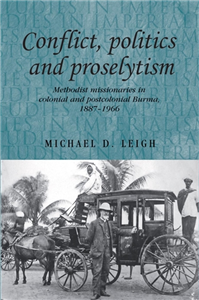
Conflict, Politics and Proselytism
Methodist missionaries in colonial and postcolonial Burma, 1887–1966
by Michael D. Leigh, Andrew Thompson, John Mackenzie
This book is a study of the ambitions, activities and achievements of Methodist missionaries in northern Burma from 1887-1966 and the expulsion of the last missionaries by Ne Win. The story is told through painstaking original research in archives which contain thousands of hitherto unpublished documents and eyewitness accounts meticulously recorded by the Methodist missionaries. This accessible study constitutes a significant contribution to a very little-known area of missionary history. Leigh pulls together the themes of conflict, politics and proselytisation in to a fascinating study of great breadth. The historical nuances of the relationship between religion and governance in Burma are traced in an accessible style. This book will appeal to those teaching or studying colonial and postcolonial history, Burmese politics, and the history of missionary work. ;
-
Trusted Partner
 Humanities & Social SciencesFebruary 2017
Conflict, Politics and Proselytism
Methodist missionaries in colonial and postcolonial Burma, 1887–1966
by Andrew Thompson, Michael D. Leigh, John M. MacKenzie
This book is a study of the ambitions, activities and achievements of Methodist missionaries in northern Burma from 1887-1966 and the expulsion of the last missionaries by Ne Win. The story is told through painstaking original research in archives which contain thousands of hitherto unpublished documents and eyewitness accounts meticulously recorded by the Methodist missionaries. This accessible study constitutes a significant contribution to a very little-known area of missionary history. Leigh pulls together the themes of conflict, politics and proselytisation in to a fascinating study of great breadth. The historical nuances of the relationship between religion and governance in Burma are traced in an accessible style. This book will appeal to those teaching or studying colonial and postcolonial history, Burmese politics, and the history of missionary work.
-
Trusted Partner
-
Trusted Partner
-
Trusted Partner
-
Trusted Partner
-
Trusted Partner
-
Trusted Partner
 Humanities & Social SciencesJuly 2002
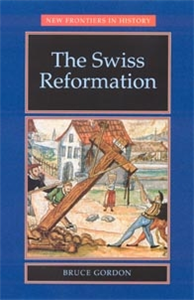
The Swiss Reformation
The Swiss Reformation
by Bruce Gordon, Mark Greengrass
The Swiss Reformation was a seminal event of the sixteenth century which created a Protestant culture whose influence spread across Europe from Transylvania to Scotland. Offers the first comprehensive study of the Swiss Reformation and argues that the movement must be understood in terms of the historical evolution of the Swiss Confederation, its unique and fluid structures, the legacy of the mercenary trade, the distinctive character of Swiss theology, the powerful influence of Renaissance humanism, and, most decisively, the roles played by the dominant figures, Huldrych Zwingli and Heinrich Bullinger. Marked by astounding creative energy, incendiary preaching, burning political passions, peasant revolts, and breath-taking scholarship, as well as by painful divisions, civil war, executions and dashed hopes, the story of the Swiss Reformation is told with extensive use of primary sources. Explores the narrative of events before turning to consider themes such as the radical opposition, church and community, daily life in the Confederation, cultural achievements and the Swiss place in the wider European Reformation world. ;



