
Your Search Results


-
Promoted Content

 2020
2020How Animals Hammer, Drill and Strike
Tool Use in the Animal Kingdom
by Peter-René Becker
From insects to fish as well as birds and primates: the use of tools is amazingly widespread in the animal kingdom. It’s a misnomer to presume that humans are distinguished by tool use and conscious capacity. So where is culture initiated? The biologist Peter-René Becker has evaluated numerous studies and cites plenty of evidence for the use of the hammer and anvil, lances, bait or sponges. Animals also use “tools as social implements”. Ultimately, the depth of man’s conscience singles him out from other animals.
-
Promoted Content

 November 2025
Reimagining business schools for the 21st century
Alliance Manchester Business School
by Kenneth McPhail, James Pendrill
Whether it's dealing with regional economic disparities, global geopolitical upheaval, climate change, or the impact of new technologies such as artificial intelligence, we are living in pivotal times. To mark its 60th anniversary in 2025, this accessible book from Alliance Manchester Business School outlines in detail how business schools can play a significant role in confronting these huge challenges, and equip the next generation of business leaders with the skills they need to embrace them. Informing public and political debate on the role of business in both the causes and solutions to our biggest challenges the book offers a rethinking of the role of business in society. It will also discuss specific examples of how collaborations with business are leading to impact and change in society. Featuring a range of thought-provoking essays co-authored by eminent academics and business leaders, this collection will challenge the status quo and outline how business and management research is helping address grand challenges, generate economic growth, inform policy development, and define business thinking over the next generation.
-
 Trusted Partner

 August 2016
How to Survive the First Years of School
by Petra Jansen, Stefanie Richter
With a pinch of humor, the authors tell the story of Julia, her husband Peter, and their little whirlwind Alexander, who is starting elementary school. How do the three of them deal with this new stage in Alexander’s life? What problems do they encounter and what do they find stressful? The book sets out to help parents, uncles, aunts, and grandparents understand how children of elementary school age develop. Professionals who work with children of this age may also find it of interest. Petra Jansen and Stefanie Richter are both parents and psychologists. Through the fictional Julia they share their subjective experience as mothers, while also providing background information based on scientific studies. They demonstrate in a clear and entertaining way that some of the problems experienced by children of this age are not unexpected and are no cause for despair. Target Group: Parents of children in their early years at school.
-
Trusted Partner
-
Trusted Partner

 2023
2023Pharmaceutical Technician Training: the Connecticum
Learning field-oriented and interdisciplinary 1st school year
by Simone Gansewig and Dr. Robert Wulff
Scenes from the life of a pharmaceutical technician in her everyday life in a shared flat and the pharmacy are the gimmicks (and cliffhangers) in this book on pharmaceutical technician training. These develop into their connections to everyday life in a pharmacy and to the pharmaceutical knowledge that is conveyed at pharmaceutical technician school classes. The work combines different media forms and learning types as “Connecticum”. Podcasts, videos, and worksheets that can be accessed via QR code, as well as references to literature and information sources, supplement the content and make learning more varied and interesting. This innovative workbook for pharmaceutical technician training – each school year is accompanied by its own volume - is the ideal partner for subject-oriented and interdisciplinary teaching. It is also suitable for practically-oriented, independent work and a review of the entire training content – with a guaranteed fun factor!
-
Trusted Partner
 Humanities & Social Sciences
Preparing Children for School Through Play
by Astrid Wirth, Efsun Birtwistle, Anna Mues, Frank Niklas
Playful learning is an excellent way to help children acquire skills from an early age. This book illustrates ways to promote the development of preschool- age children through play in everyday family and kindergarten life – entirely without expensive resources! Promotion of (written) language development and mathematical development forms a focus of this book, while preparing your child optimally for the two school subjects English and Mathematics. For:• parents and guardians• interested laypeople• educational specialists (such asteachers, childcare workers, socialworkers)
-
Trusted Partner
 Humanities & Social SciencesJanuary 2024
Dog politics
Species stories and the animal sciences
by Mariam Motamedi Fraser
Do dogs belong with humans? Scientific accounts of dogs' 'species story,' in which contemporary dog-human relations are naturalised with reference to dogs' evolutionary becoming, suggest that they do. Dog politics dissects this story. This book offers a rich empirical analysis and critique of the development and consolidation of dogs' species story in science, asking what evidence exists to support it, and what practical consequences, for dogs, follow from it. It explores how this story is woven into broader scientific shifts in understandings of species, animals, and animal behaviours, and how such shifts were informed by and informed transformative political events, including slavery and colonialism, the Second World War and its aftermath, and the emergence of anti-racist movements in the twentieth and twenty-first centuries. The book pays particular attention to how species-thinking bears on 'race,' racism, and individuals.
-
Trusted Partner
 Humanities & Social SciencesOctober 2020
Christmas in nineteenth-century England
by Neil Armstrong
Whether for reasons of family, food, shopping or religion, it's hard to imagine a British winter without Christmas, or to think of a more traditional national festival. But how and when did Christmas cards, pantomimes and advertising become part of that tradition? This book looks at how people in the nineteenth and early twentieth centuries experienced Christmas and how today's priorities and rituals began and endured. It explores the origins of our deeply held notions around Christmas traditions and demonstrates how those ideas were in fact shaped by the fast-paced modernisation of English life. A fascinating account of the development of many things we now take for granted, the book touches on the history of childhood and the family, philanthropy and work, and the beginnings of consumerism that shaped the Christmas we know today.
-
Trusted Partner

 January 2009
Lay linguistics and school teaching
An empirical sociolinguistic study in the Moselle-Franconian dialect area
by Wagner, Melanie M.
-
Trusted Partner
 Lifestyle, Sport & LeisureAugust 2016
Culture in Manchester
Institutions and urban change since 1850
by Janet Wolff, Mike Savage
This book brings together studies of cultural institutions in Manchester from 1850 to the present day, giving an unprecedented account of the city's cultural evolution. These bring to light the remarkable range of Manchester's contribution to modern cultural life, including the role of art education, popular theatre, religion, pleasure gardens, clubs and societies. The chapters show the resilience and creativity of Manchester's cultural institutions since 1850, challenging any simple narrative of urban decline following the erosion of Lancashire's industrial base, at the same time illustrating the range of activities across the social classes. This book will appeal to everyone interested in the cultural life of the city of Manchester, including cultural historians, sociologists and urban geographers, as well as general readers with interests in the city. It is written by leading international authorities, including Viv Gardner, Stephen Milner, Mike Savage, Bill Williams and Janet Wolff.
-
Trusted Partner
 The ArtsJune 2026
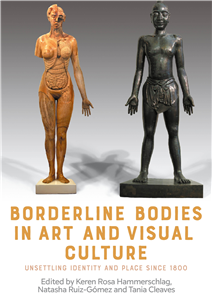
Borderline bodies in art and visual culture
Unsettling identity and place since 1800
by Keren Hammerschlag, Natasha Ruiz-Gómez, Tania Anne Cleaves
Borderline bodies offers original interpretations of visual representations of human bodies as bounded and unbounded, fortified and permeable, mobile and static-subject to borders and able to traverse and challenge them. It also takes as its focus images and objects that might be considered 'borderline' because they sit at the intersection of disciplines or sit outside accepted notions of what constitutes serious 'art.' By mapping the ways human bodies traverse borders and straddle-even dismantle-categories, this volume's essays approach afresh the relationship of bodies to traditional modes of representation, especially in art and medicine, and encourage us to think anew about how we understand the relationship between human corporeality, identity and place. Critical transdisciplinary and transnational analyses of objects and images from a range of geographies shed new light on the themes of: bodies and identity; typologies of the body; racialised bodies; 'normal' and 'abnormal' bodies; encounters between bodies; bodies in transition; bodies and mobility; and the bounded and unbounded human body. The outcome is a fresh approach to depictions of the human body produced for the purposes of artistic and medical education, aesthetic edification, and scientific and professional advancement, which disrupts assumptions about the normative human body perpetuated through Western image-making traditions.
-
Trusted Partner
 April 2021
On the Purposes of Life and Whether They Exist
A philosophical fitting
by Axel Braig
The musician, doctor and philosopher Axel Braig considers philosophy a little like the weather: he looks for the right clothes for every situation. Braig is primarily concerned with practical, effective things from the two-and-a-half millennia fund of (Western) thinking, such as helpful approaches in existential crises. In this book, he introduces us to philosophical thinkers from Plato to Montaigne to Levinas and Feyerabend. Braig not only shares his own philosophical biography, but above all encourages us to philosophise ourselves.
-
Trusted Partner
-
Trusted Partner
 Health & Personal DevelopmentJanuary 2017
The Memo Training Program
by Regula Everts, Barbara Ritter
Memo is a circus elephant who lives in Switzerland, but because it is too cold for him there, he wants to return to his home country of Botswana. Unfortunately, though, Memo is very forgetful. So it’s a good thing that he has lots of friends among the other circus animals who teach him memory techniques to help him on his adventurous journey. Target Group: parents; teachers; social workers specializing in education; school psychological and medical services; psychiatric services for children; student teachers The memory training program with Memo the elephant is based on neuroscientific principles and has been developed, used, and successfully tested at the University Children’s Hospital in Bern, Switzerland. The program focuses on teaching effective memory strategies and improves the working memory. Its six simple units have been shown to produce sustainable improvement in learning in children from the age of seven. Memo Training is the product of a major research project conducted at the Inselspital in Bern by the neuropsychologists PD Dr. Regula Everts and Dr. Barbara Ritter.
-
Trusted Partner
 The ArtsApril 2025
Beautiful doom
The work of Dennis Kelly on stage and screen
by Jacqueline Bolton, Nicholas Holden
Dennis Kelly's award-winning plays have been translated into over thirty languages and produced on six continents. His endlessly inventive vision has produced a diverse body of work for a variety of audiences across a range of forms, genres, and media, from the Olivier and Tony Award-winning Matilda the Musical (2010), to the Channel Four cult-classic series Utopia. His 2008 play DNA, written for National Theatre Connections, is a set text on the AQA GCSE English Literature syllabus. This collection of essays written by leading scholars, teachers, and practitioners of theatre provides the first multi-authored study of Kelly's critically acclaimed oeuvre. Featuring an original interview with Kelly himself, this volume captures the full range and scope of his writing for stage and screen, from the quirky fringe debut Debris (2003) to the globally-distributed film adaptation of Matilda the Musical (2022).
-
Trusted Partner
 Humanities & Social SciencesDecember 2024
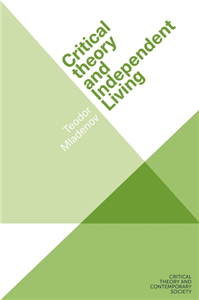
Critical theory and Independent Living
by Teodor Mladenov
Critical theory and Independent Living explores intersections between contemporary critical theory and disabled people's struggle for self-determination. The book highlights the affinities between the Independent Living movement and studies of epistemic injustice, biopower, and psychopower. It discusses in depth the activists' critical engagement with welfare-state paternalism, neoliberal marketisation, and familialism. This helps develop a pioneering comparison between various welfare regimes grounded in Independent Living advocacy. The book draws on the activism of disabled people from the European Network on Independent Living (ENIL) by developing case studies of the ENIL's campaigning for deinstitutionalisation and personal assistance. It is argued that this work helps rethink independence as a form of interdependence, and that this reframing is pivotal for critical theorising in the twenty-first century.
-
Trusted Partner
 Geography & the EnvironmentJanuary 2024
Researching animal research
by Gail Davies, Beth Greenhough, Pru Hobson-West, Robert G. W. Kirk, Alexandra Palmer, Emma Roe
-
Trusted Partner
-
Trusted Partner
 Humanities & Social SciencesJanuary 2023
Rural quality of life
by Pia Heike Johansen, Anne Tietjen, Evald Bundgård Iversen, Henrik Lauridsen Lolle, Jens Kaae Fisker
-
Trusted Partner

 August 2021
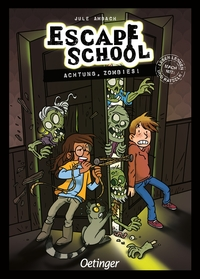
Escape School 4. Achtung, Zombies!
by Jule Ambach, Timo Müller-Wegner, Stefanie Wegner
Die Zombies sind los! Halloween in der Escape School: Die Schülerinnen und Schüler feiern in gruseligen Kostümen und mit dabei sind natürlich auch die Leser:innen. Doch was ist das? Plötzlich stürmen echte Zombies die Party auf der Suche nach etwas Essbarem. Jetzt gilt es, die gruseligen Kreaturen wieder loszuwerden, bevor sie noch Appetit auf Menschen entwickeln. Wer hilft mit? Spannendes Escape-Rätsel für Kinder ab 7 Jahren. Packende Storyline und viele Rätsel, inklusive Rätsel-Postkarte. Perfekt geeignet, um Leseanfänger für das Lesen zu begeistern. In der Escape-School-Reihe sind bisher fünf Bände erschienen. Gelistet bei Antolin.



