Your Search Results

      • Regio Ltd.

        Regio has nearly 30 years of experience in the publication of maps and atlases of all kinds, which have been internationally recognised and awarded on numerous occasions. Regio has two main fields of activity: mapping and geospatial data. We design accurate, up-to-date maps at all scales and for all purposes. In addition to printed maps we provide maps for internet applications, GPS and mobile devices. We are flexible and will assist you in the planning, consultation anddevelopment of all cartographic products. In geospatial data area Regio owns and maintains the most detailed geospatial database of Estonia and the Baltic States, including buildings, address data, points of interest, land cover, road network and navigation datasets.

        View Rights Portal
      • Hotel de las Ideas

        Hotel de las ideas is a cooperative, with 10 co-founders.

        View Rights Portal
      • Trusted Partner
        Literature & Literary Studies
        May 2026

        Translating hell

        Vernacular theology and apocrypha in the medieval North Sea

        by Stephen C. E. Hopkins

        In the Middle Ages, hell was useful because it was vaguely defined. Canonical scriptures scarcely mention hell, leaving much to the imaginations of early Christians, who used it to sort out who belonged within the faith. This book explores how hell became a place for literary experiments with local challenges in theology and identity. Following the reception and transformations of two popular hell apocrypha, it argues that they served as this role because of their liminal textual authority. As noncanonical scriptures, apocrypha afforded medieval writers space to revise their hells (since they were not actually scripture), while also encouraging readers to revere those experiments as valid (since they seemed like scripture). The book brings together adaptations from early medieval England, Iceland, Ireland, and Wales, placing the early vernacular theologies of the North Sea in comparative conversation.

      • Trusted Partner
        September 2022

        Identity or Not?

        by Jean-Pierre Wils (ed.)

        Questions of identity trigger controversial and highly emotional discussions in the political and social debate. The positions range from radically emancipatory perspectives to authoritarian and restorative efforts on the far right wing of politics. Liberal democracies are now opening up – slowly – as identity- and gender-sensitive forums. Opposite them are the 'new ethics' of illiberal democracies and totalitarian states that are aimed at ethnic homogeneity and gender uniformity. But that's not to say that there is unity in the liberal settings on the necessary degree of identity politics. Both language and gender politics are deeply controversial. Do we need an 'identity' and, if so, which one or how many? Can the identity debate be extended by means of other concepts?

      • Trusted Partner
        Humanities & Social Sciences
        June 2026

        Arctic state identity

        by Ingrid A. Medby

      • Trusted Partner
        Humanities & Social Sciences
        August 2017

        Cultivating political and public identity

        by Rodney Barker

      • Trusted Partner
        Medicine
        April 2021

        Leprosy and identity in the Middle Ages

        From England to the Mediterranean

        by Elma Brenner, François-Olivier Touati

        For the first time, this volume explores the identities of leprosy sufferers and other people affected by the disease in medieval Europe. The chapters, including contributions by leading voices such as Luke Demaitre, Carole Rawcliffe and Charlotte Roberts, challenge the view that people with leprosy were uniformly excluded and stigmatised. Instead, they reveal the complexity of responses to this disease and the fine line between segregation and integration. Ranging across disciplines, from history to bioarchaeology, Leprosy and identity in the Middle Ages encompasses post-medieval perspectives as well as the attitudes and responses of contemporaries. Subjects include hospital care, diet, sanctity, miraculous healing, diagnosis, iconography and public health regulation. This richly illustrated collection presents previously unpublished archival and material sources from England to the Mediterranean.

      • Trusted Partner
        The Arts
        December 2025

        New Basque Gothic

        Trauma, screen media and transnationalism

        by Rebecca Wynne-Walsh

        This monograph addresses the twenty-first century upsurge in Gothic screen media emanating from the Autonomous Basque Community, Euskadi, in Northern Spain. The book focuses on online video sharing, streaming and social media platforms, demonstrating the impact of multi-national co-production and distribution on the development of Basque film production; looking to the future of regional production in the digital era. This monograph fills a critical gap, presenting Basque Gothic screen media as a regionalist challenge to national models of cinema and identity. Wynne-Walsh establishes Basque Gothic as an expression of transgenerational trauma engendered by a history of state-suppression and socio-political violence. This regional iteration of the mode is addressed as a window into community perception and projection. While this project centres a Basque case study, it establishes a model for the reimagination of critical approaches to global, twenty-first century screen cultures.

      • Trusted Partner
        The Arts
        April 2017

        The BBC and national identity in Britain, 1922–53

        by Jeffrey Richards, Thomas Hajkowski

        Examining the ways in which the BBC constructed and disseminated British national identity during the second quarter of the twentieth century, this book is the first study that focuses in a comprehensive way on how the BBC, through its radio programs, tried to represent what it meant to be British. The BBC and national identity in Britain offers a revision of histories of regional broadcasting in Britain that interpret it as a form of cultural imperialism. The regional organization of the BBC, and the news and creative programming designed specifically for regional listeners, reinforced the cultural and historical distinctiveness of Scotland, Wales, and Northern Ireland. The BBC anticipated, and perhaps encouraged, the development of the hybrid "dual identities" characteristic of contemporary Britain.

      • Trusted Partner
        Humanities & Social Sciences
        March 2017

        Cultural identities and the aesthetics of Britishness

        by Dana Arnold

        Considers how notions of Britishness were constructed and promoted through architecture, landscape, painting, sculpture and literature. Maps important moments in the self-conscious evolution of the idea of 'nation' against a broad cultural historical framework. An important addition to the field of postcolonial studies as it looks at how British identity creation affected those living in England - most study in this area has thus far focused on the effect of such identity creation upon the colonial subject. Broad appeal due to wide subject matter covered. Examines just how 'constructed' a national identity is - past and present.

      • Trusted Partner
      • Trusted Partner
        Humanities & Social Sciences
        July 2025

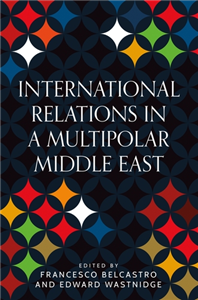
        International Relations in a multipolar Middle East

        by Francesco Belcastro, Edward Wastnidge

        This volume explores the international relations of today's Middle East, a region that has become increasingly multi-polar. The tumult following the Arab Uprisings has expanded the arenas competed over by regional powers, global actors and non-state players. The United States, once seemingly intent on a hegemonic 'Pax Americana' has stepped back, leaving powers such as Russia, China, India and the EU, with opportunities to increase their reach and expand their influence. Meanwhile, regional rivalries and alliances have continued to shape conflict and cooperation in the Middle East. As global politics moves towards a new, multipolar era, this volume sheds important light on how this transition will impact on the region. Comprised of two macro sections that offer theoretical reflections and empirical case studies, this volume is essential reading for scholars of the politics and international relations of the Middle East.

      • Trusted Partner
        Humanities & Social Sciences
        April 2025

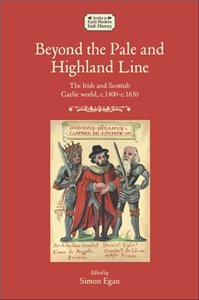
        Beyond the Pale and Highland Line

        The Irish and Scottish Gaelic world

        by Simon Egan

        This book offers important new insights into the history and culture of the Gaelic-speaking world from the mid-fifteenth century through to the reign of James VI and I. Throughout this period, the reach of the English and Scottish crowns within these western regions was limited. The initiative lay with local communities and royal power was contingent upon negotiating with well-established and largely autonomous aristocratic lineages. Moreover, events within this western world could exert a powerful, often unpredictable, influence upon the affairs of the wider archipelago. Using a series of case studies, this collection examines the evolving relationship between Ireland and Scotland in rich detail. It demonstrates how this world interacted with the encroaching English and Scottish states and underlines the importance of paying closer attention to this neglected area of Irish and British history.

      • Trusted Partner
      • Trusted Partner
        International relations
        September 2005

        Naming security - constructing identity

        ‘Mayan-women’ in Guatemala on the eve of ‘peace’

        by Maria Stern

        How do people seek security in relation to their sense of 'who they are'? How can one make sense of insecurity at the intersection of competing identity claims? Based on the voices of Mayan women, Stern critically re-considers the connections between security, subjectivity and identity. By engaging in a careful reading of how Mayan women 'speak' security in relation to the different contexts that inform their lives, she explores the multiplicity of both identity and security, and questions the main story of security imbedded in the modern 'paradox of sovereignty.' Her provocative analysis thus raises vital questions about what might constitute 'security', and the 'insecurity' that is its inevitable supplement. Her study also offers an innovative methodology that bridges many different disciplines and substantively develops the method of 'reading' politics as a 'textual practice'. It will be essential reading for students of security, identity politics, feminism, and Latin American studies.

      • Trusted Partner
        Humanities & Social Sciences
        March 2026

        Negotiating identity conflicts in a fragmenting world order

        by Paul Willem Meerts, Mark Anstey

        At every level of human interaction new levels of identity-based tension are in evidence. Contributors to this book explore facets of fragmentation processes within systems of state and interstate organisation, how they influence the use of negotiation, and how negotiation might be used to effect renewed coherence. Following Anstey's (Ch1) introductory chapter framing the nature and shape of fragmentation dynamics, Zartman (Ch 2) argues that the use of negotiation as a process of conflict resolution is deeply shaped by identity groups whose internal coherence is dependent on sustaining a negative identity of others. International relations are no longer solely the realm of experienced diplomats but are shaped as Meerts (Ch3) points out by politicians seeking to be responsive to voting publics rather than wider concerns. Anstey digs into problems of fragmentation (Ch. 4) and Troitskiy (Ch 5) points out how a reluctant acceptance of the power of 'the other' can lead to a form of strategic stability in relations. Anstey and Meerts (Ch 6) point out in their analysis of the Israeli-Palestinian case as an identity conflict turned very bad. Guggenbuhl (Ch 7 ) reveals how structures and processes have been designed within the EU to prevent, contain and regulate conflicts to limit risks of confrontation and fragmentation. Schuessler (Ch 8) to advocates a shift away from a template or roadmap approach to EU membership to a cohesion based on non-dominance. There is still a strong desire on the part of some states, like Northern Macedonia, to become EU members, as reflected in Manton's (Ch 9). Paula Garzon and Frans Schram explain the success of the Colombia Peace Negotiations (Ch 10), while Odigie and da Rocha (Ch 11) analyse the struggle faced by ECOWAS to influence coup leaders in Mali to return to constitutional government and changes of government by constitutional means. Liang (Ch12) discusses how the internet as the modern vehicle of inter-state, inter-group and interpersonal communication has become weaponised. In Ch 13 Anstey draws some lessons from contributions to the compilation.

      • Trusted Partner
        Humanities & Social Sciences
        January 2017

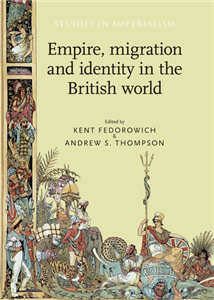
        Empire, migration and identity in the British World

        by Andrew Thompson, Kent Fedorowich, John M. MacKenzie, Andrew Thompson, Keith Povey

        The essays in this volume have been written by leading experts in their respective fields and bring together established scholars with a new generation of migration and transnational historians. Their work weaves together the 'new' imperial and the 'new' migration histories, and is essential reading for scholars and students interested in the interplay of migration within and between the local, regional, imperial, and transnational arenas. Furthermore, these essays set an important analytical benchmark for more integrated and comparative analyses of the range of migratory processes - free and coerced - which together impacted on the dynamics of power, forms of cultural circulation and making of ethnicities across a British imperial world.

      • Trusted Partner
        The Arts
        May 2009

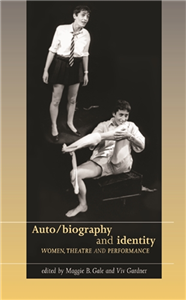
        Auto/biography and identity

        by Kate Dorney, Maggie B. Gale, Viv Gardner, Maggie B. Gale

        This groundbreaking book shows how female performers - one of the first groups of professional women - used and still use autobiography and performance as both a means of expression and control of their private and public selves, the 'face and the mask'. It looks at how a range of women in the theatre - actors, managers, writers and live artists - have done this on the page and on the stage from the late eighteenth-century to the present day, testing the boundaries between gender, theatre and autobiographical form. This paperback edition facilitates connections - between texts and performances, past and present practitioners, professional and private selves, individuals and communities, all of which have in some way renegotiated identity through autobiography and the creative act. 'Auto/biography and identity' is a landmark in theatre history and performance analysis, in gender and cultural theory, and autobiographical studies. ;

      • Trusted Partner
        Humanities & Social Sciences
        June 2013

        Islam and identity politics among British-Bangladeshis

        A leap of faith

        by Ali Riaz

        This book probes the causes of and conditions for the preference of the members of the British-Bangladeshi community for a religion-based identity vis-à-vis ethnicity-based identity, and the influence of Islamists in shaping the discourse. The first book-length study to examine identity politics among the Bangladeshi diaspora delves into the micro-level dynamics, the internal and external factors and the role of the state and locates these within the broad framework of Muslim identity and Islamism, citizenship and the future of multiculturalism in Europe. Empirically grounded but enriched with in-depth analysis, and written in an accessible language this study is an invaluable reference for academics, policy makers and community activists. Students and researchers of British politics, ethnic/migration/diaspora studies, cultural studies, and political Islam will find the book extremely useful. ;

      • Trusted Partner
        Humanities & Social Sciences
        March 2010

        Towards a regional political class?

        Professional politicians and regional institutions in Catalonia and Scotland

        by Klaus Stolz

        Focussing on professional politicians Klaus Stolz investigates the interrelationship between political career patterns and political institutions in two of the most widely discussed cases of regionalism: Catalonia and Scotland. The study deals with two different yet closely related sets of questions: Firstly, how do professional politicians pursue their careers in the regional context. And secondly, how do they shape and reshape the political institutions in which they pursue these careers. The monograph is based on extensive empirical research including a comprehensive data set on the careers of Catalan and Scottish parliamentarians, systematic surveys of regional representatives as well as in-depth interviews of a wide range of politicians and experts in both regions. Exploring the effects of political professionalisation on regional democracy, Stolz goes way beyond traditional studies of regionalism and decentralization, while his focus on the regional career arena introduces a much needed territorial dimension to the study of political careers. Rich original data, innovative theoretical concepts and a strictly comparative approach are the basis for a study that considerably deepens and enhances our understanding of the tremendous political changes both Catalonia and Scotland are undergoing. Thus, the book is of interest to the still growing number of scholars concerned with devolution in the UK, the Spanish autonomous communities as well as to those interested in regional politics and regionalisation in general. Furthermore, its theoretical focus makes it highly relevant for scholars working on political careers, political professionalisation and democratic theory. ;

      Subscribe to our

      newsletter