
Humanities & Social Sciences
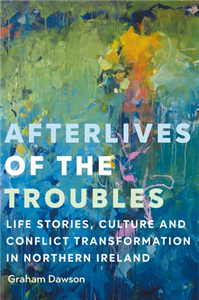
Afterlives of the Troubles
Life stories, culture and conflict transformation in Northern Ireland
by Graham Dawson
Description
Focusing on experiential life stories across a range of forms and practices, this book investigates subjectivity, culture and the cultural politics of representation as a neglected dimension of conflict transformation in the Northern Irish peace process. Interdisciplinary critical perspectives from historical cultural studies, oral history and popular-memory theory inform close interpretive engagement with life stories in their cultural, historical and geographical contexts. This enables exploration of the complex temporal dynamics of 'post-conflict' subjectivities in the lengthening 'afterlife' of the Troubles, where feelings attached to conflict experiences are not 'past' but haunt the present, and memory-work carries future-oriented desires for truth, justice and reconciliation. Through case studies responding to the evolving peace process through this prism of life-storytelling, Afterlives maps a contested history of legacy policy-making and approaches to 'dealing with the past', from devolution in 2005-7 through to the Legacy and Reconciliation Act of 2023.
More Information
Rights Information
Albania, Algeria, Angola, Argentina, Armenia, Australia, Austria, Bahrain, Belgium, Belize, Benin, Bolivia, Bosnia and Herzegovina, Botswana, Brazil, Bulgaria, Burkina Faso, Burundi, Cameroon, Canada, Cape Verde, Central African Republic, Chad, Chile, China, Colombia, Comoros, Congo [DRC], Congo, Republic of the, Costa Rica, Ivory Coast, Croatia, Czech Republic, Denmark, Djibouti, Ecuador, Egypt, El Salvador, Equatorial Guinea, Eritrea, Estonia, Ethiopia, Faroe Islands, Finland, France, French Guiana, Gabon, Gambia, Georgia, Germany, Ghana, Greece, Guatemala, Guinea, Guinea-Bissau, Guyana, Honduras, Hongkong, Hungary, Iceland, India, Indonesia, Iran, Iraq, Ireland, Israel, Italy, Japan, Jordan, Kazakhstan, Kenya, Kuwait, Latvia, Lebanon, Lesotho, Liberia, Libya, Lithuania, Luxembourg, Macau, China, Macedonia [FYROM], Madagascar, Malawi, Malaysia, Mali, Malta, Mauritania, Mauritius, Mayotte, Mexico, Mongolia, Montenegro, Morocco, Mozambique, Namibia, Netherlands, New Zealand, Nicaragua, Niger, Nigeria, Norway, Oman, Pakistan, Panama, Paraguay, Peru, Philippines, Poland, Portugal, Puerto Rico, Qatar, Reunion, Romania, Russia, Rwanda, Saint Helena, Sao Tome and Principe, Saudi Arabia, Senegal, Serbia, Seychelles, Sierra Leone, Singapore, Slovakia, Slovenia, Somalia, South Africa, South Korea, Spain, Sri Lanka, Sudan, Suriname, Swaziland, Sweden, Switzerland, Syria, Taiwan, Tanzania, Thailand, Timor-Leste, Togo, Tokelau, Tunisia, Turkey, Uganda, Ukraine, United Arab Emirates, United Kingdom, United States, Uruguay, Venezuela, Vietnam, Western Sahara, Yemen, Zambia, Zimbabwe, South Sudan, Cyprus, Palestine, Bangladesh, Cambodia, Liechtenstein, Azerbaijan, Jamaica, Kyrgyzstan, Dominican Republic, Myanmar, Monaco
Endorsements
Afterlives of the Troubles develops a pioneering critical investigation of subjectivity, culture and the cultural politics of representation as a neglected dimension of conflict transformation in the Northern Irish peace process. Focusing on experiential life stories across a range of forms and storytelling practices, from oral history and published memoir to personal narratives of justice campaigners and collections of community-based storytelling projects, the book investigates the continuing emotional charge and felt significance of conflict memories at an increasing distance from the happenings of the Troubles. In this lengthening temporal 'afterlife' of conflict, conflict experience is not 'past' but haunts the present, and memory carries future-oriented desires for truth, justice and reconciliation. Through detailed interpretive engagement with selected life stories set in their cultural, historical and geographical contexts, the book explores the complex temporal dynamics of 'post-conflict' subjectivities in their endeavour to make sense of remembered experiences of conflict and the feelings attached to them both at the time and afterwards. Researched and written over fifteen years as a series of case studies responding to developments, obstacles and contestations in the evolving peace process seen through this prism of life-storytelling, Afterlives maps a contested history of legacy policy-making and cultural practices engaged in 'dealing with the past', from the establishment of devolution in 2005-7 through to the Legacy and Reconciliation Act of 2023. It is the first book-length investigation into conflict transformation in Northern Ireland from interdisciplinary critical perspectives rooted in historical cultural studies, oral history and popular memory theory.
Reviews
Afterlives of the Troubles develops a pioneering critical investigation of subjectivity, culture and the cultural politics of representation as a neglected dimension of conflict transformation in the Northern Irish peace process. Focusing on experiential life stories across a range of forms and storytelling practices, from oral history and published memoir to personal narratives of justice campaigners and collections of community-based storytelling projects, the book investigates the continuing emotional charge and felt significance of conflict memories at an increasing distance from the happenings of the Troubles. In this lengthening temporal 'afterlife' of conflict, conflict experience is not 'past' but haunts the present, and memory carries future-oriented desires for truth, justice and reconciliation. Through detailed interpretive engagement with selected life stories set in their cultural, historical and geographical contexts, the book explores the complex temporal dynamics of 'post-conflict' subjectivities in their endeavour to make sense of remembered experiences of conflict and the feelings attached to them both at the time and afterwards. Researched and written over fifteen years as a series of case studies responding to developments, obstacles and contestations in the evolving peace process seen through this prism of life-storytelling, Afterlives maps a contested history of legacy policy-making and cultural practices engaged in 'dealing with the past', from the establishment of devolution in 2005-7 through to the Legacy and Reconciliation Act of 2023. It is the first book-length investigation into conflict transformation in Northern Ireland from interdisciplinary critical perspectives rooted in historical cultural studies, oral history and popular memory theory.
Author Biography
Graham Dawson is a Reader in Cultural History at the University of Brighton. His research has focused on the inter-relations between cultural memory, narrative and identity, and on the memory of war in modern times. He is author of Soldier Heroes: Briti
 Trusted Partner

Manchester University Press
Manchester University Press is a leading UK publisher known for excellent research in the humanities and social sciences.
View all titlesBibliographic Information
- Publisher Manchester University Press
- Publication Date January 2026
- Orginal LanguageEnglish
- ISBN/Identifier 9781526146496 / 1526146495
- Publication Country or regionUnited Kingdom
- FormatPrint PDF
- Pages344
- ReadershipCollege/higher education; Professional and scholarly
- Publish StatusPublished
- Dimensions234 X 156 mm
- Biblio NotesDerived from Proprietary 5112
- Reference Code12763
Thank you for proceeding with this offer.
Manchester University Press has chosen to review this offer before it proceeds.
You will receive an email update that will bring you back to complete the process.
You can also check the status in the My Offers area
Manchester University Press has chosen to review this offer before it proceeds.
You will receive an email update that will bring you back to complete the process.
You can also check the status in the My Offers area

Please wait while the payment is being prepared.
Do not close this window.

(c) Copyright 2026 - Frankfurter Buchmesse GmbH. All Right Reserved