
Humanities & Social Sciences
Fighting with money
War, patriotic thrift and citizenship in the British world, 1939-45
by Carol Summers
Description
During the second world war, war savings campaigns reframed money as a means to
to defend children, secure freedom, and enact citizenship across the British world. Patriotic thrift propaganda urged people to reject consumer goods and instead invest deliberately in stamps, certificates and bonds, presenting saving as a patriotic act that transformed subjects into accountable citizens. Officials and volunteers built a state-directed mobilisation that documented participation and linked household decisions to national victory. In Britain, these initiatives brought workers together and validated housewives' expertise, while Canada and Australia developed parallel schemes. Even colonies such as Uganda invested actively in British defence. Fighting with money examines how activists constructed these campaigns, the identities they imagined and their limits in a shifting wartime and postwar landscape.
More Information
Rights Information
Albania, Algeria, Angola, Argentina, Armenia, Australia, Austria, Bahrain, Belgium, Belize, Benin, Bolivia, Bosnia and Herzegovina, Botswana, Brazil, Bulgaria, Burkina Faso, Burundi, Cameroon, Canada, Cape Verde, Central African Republic, Chad, Chile, China, Colombia, Comoros, Congo [DRC], Congo, Republic of the, Costa Rica, Ivory Coast, Croatia, Czech Republic, Denmark, Djibouti, Ecuador, Egypt, El Salvador, Equatorial Guinea, Eritrea, Estonia, Ethiopia, Faroe Islands, Finland, France, French Guiana, Gabon, Gambia, Georgia, Germany, Ghana, Greece, Guatemala, Guinea, Guinea-Bissau, Guyana, Honduras, Hongkong, Hungary, Iceland, India, Indonesia, Iran, Iraq, Ireland, Israel, Italy, Japan, Jordan, Kazakhstan, Kenya, Kuwait, Latvia, Lebanon, Lesotho, Liberia, Libya, Lithuania, Luxembourg, Macau, China, Macedonia [FYROM], Madagascar, Malawi, Malaysia, Mali, Malta, Mauritania, Mauritius, Mayotte, Mexico, Mongolia, Montenegro, Morocco, Mozambique, Namibia, Netherlands, New Zealand, Nicaragua, Niger, Nigeria, Norway, Oman, Pakistan, Panama, Paraguay, Peru, Philippines, Poland, Portugal, Puerto Rico, Qatar, Reunion, Romania, Russia, Rwanda, Saint Helena, Sao Tome and Principe, Saudi Arabia, Senegal, Serbia, Seychelles, Sierra Leone, Singapore, Slovakia, Slovenia, Somalia, South Africa, South Korea, Spain, Sri Lanka, Sudan, Suriname, Swaziland, Sweden, Switzerland, Syria, Taiwan, Tanzania, Thailand, Timor-Leste, Togo, Tokelau, Tunisia, Turkey, Uganda, Ukraine, United Arab Emirates, United Kingdom, United States, Uruguay, Venezuela, Vietnam, Western Sahara, Yemen, Zambia, Zimbabwe, South Sudan, Cyprus, Palestine, Bangladesh, Cambodia, Liechtenstein, Azerbaijan, Jamaica, Kyrgyzstan, Dominican Republic, Myanmar, Monaco
Endorsements
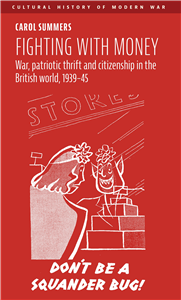
Money was a weapon during the second world war. Money mattered at the level of elite politics and military finances, but also in the daily lives of the ordinary people who made up the British world. Omnipresent war savings propaganda and networks of mobilized activists called on everyone - from Britain, and its dominions, colonies and protectorates - to stop being consumers. This book explores the ideas, propaganda and mobilisation of this fight. Wartime thrift was patriotic. It allowed all sorts of people to act usefully in the war effort. Patriotic savers looked at price lists and funded Britain's bombs and guns, rather than their own curtains, clothes or candies. Such saving, at least in the world of wartime propaganda, transformed Britons and British subjects into accountable, active citizens. Spending on consumer goods, conversely, associated with a pathogenic (and probably treasonous) "squander bug". Fighting with money uses case studies of propaganda and practice from Britain, Canada, Australia and Uganda to track how patriotic thrift campaigns and the investments of informed savers suggested new identities for people across the British world. Savings campaigners fought with money both to win the war and to construct active citizenship across the British world. Afterwards, though, with military victory in a changing postwar world, savers and citizens found their new identities challenged and sometimes betrayed by imperial austerity, reconstruction, demobilization and consumerism.
Reviews
Money was a weapon during the second world war. Money mattered at the level of elite politics and military finances, but also in the daily lives of the ordinary people who made up the British world. Omnipresent war savings propaganda and networks of mobilized activists called on everyone - from Britain, and its dominions, colonies and protectorates - to stop being consumers. This book explores the ideas, propaganda and mobilisation of this fight. Wartime thrift was patriotic. It allowed all sorts of people to act usefully in the war effort. Patriotic savers looked at price lists and funded Britain's bombs and guns, rather than their own curtains, clothes or candies. Such saving, at least in the world of wartime propaganda, transformed Britons and British subjects into accountable, active citizens. Spending on consumer goods, conversely, associated with a pathogenic (and probably treasonous) "squander bug". Fighting with money uses case studies of propaganda and practice from Britain, Canada, Australia and Uganda to track how patriotic thrift campaigns and the investments of informed savers suggested new identities for people across the British world. Savings campaigners fought with money both to win the war and to construct active citizenship across the British world. Afterwards, though, with military victory in a changing postwar world, savers and citizens found their new identities challenged and sometimes betrayed by imperial austerity, reconstruction, demobilization and consumerism.
Author Biography
Carol Summers is the Samuel Chiles Mitchell/Jacob Billikopf Professor of History at the University of Richmond
 Trusted Partner

Manchester University Press
Manchester University Press is a leading UK publisher known for excellent research in the humanities and social sciences.
View all titlesBibliographic Information
- Publisher Manchester University Press
- Publication Date December 2026
- Orginal LanguageEnglish
- ISBN/Identifier 9781526193469 / 1526193469
- Publication Country or regionUnited Kingdom
- FormatPrint PDF
- Pages320
- ReadershipGeneral/trade; College/higher education; Professional and scholarly
- Publish StatusPublished
- Dimensions216 X 138 mm
- Biblio NotesDerived from Proprietary 6469
- SeriesCultural History of Modern War
- Reference Code17950
Thank you for proceeding with this offer.
Manchester University Press has chosen to review this offer before it proceeds.
You will receive an email update that will bring you back to complete the process.
You can also check the status in the My Offers area
Manchester University Press has chosen to review this offer before it proceeds.
You will receive an email update that will bring you back to complete the process.
You can also check the status in the My Offers area

Please wait while the payment is being prepared.
Do not close this window.

(c) Copyright 2026 - Frankfurter Buchmesse GmbH. All Right Reserved