
Business, Economics & Law
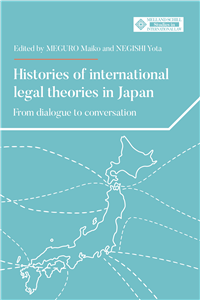
Histories of international legal theories in Japan
From dialogue to conversation
by Maiko Meguro, Yota Negishi
Description
This volume presents the first systematic account of Japanese international legal theory; edited by Japanese scholars, the volume traces thirteen influential scholars and spans over a century. It examines how theorists positioned outside international law's Western centre developed sophisticated frameworks to address tensions between Western modernity and their own experiences.
The book's central contribution proposes 'conversation'-continuous engagement that respects differences between legal traditions-as an alternative to 'dialogue', which often reproduces existing hierarchies by assuming all perspectives can be reconciled. Through detailed intellectual biographies across six historical periods, contributors reveal how Japanese scholars strategically employed legal positivism, articulated transcivilizational perspectives, and developed concepts of normative multilateralism.
Addressed at scholars of international law, legal theory, and comparative legal traditions, this volume demonstrates that the discipline's future requires genuinely reciprocal exchange where diverse perspectives can coexist productively.
More Information
Rights Information
Albania, Algeria, Angola, Argentina, Armenia, Australia, Austria, Bahrain, Belgium, Belize, Benin, Bolivia, Bosnia and Herzegovina, Botswana, Brazil, Bulgaria, Burkina Faso, Burundi, Cameroon, Canada, Cape Verde, Central African Republic, Chad, Chile, China, Colombia, Comoros, Congo [DRC], Congo, Republic of the, Costa Rica, Ivory Coast, Croatia, Czech Republic, Denmark, Djibouti, Ecuador, Egypt, El Salvador, Equatorial Guinea, Eritrea, Estonia, Ethiopia, Faroe Islands, Finland, France, French Guiana, Gabon, Gambia, Georgia, Germany, Ghana, Greece, Guatemala, Guinea, Guinea-Bissau, Guyana, Honduras, Hongkong, Hungary, Iceland, India, Indonesia, Iran, Iraq, Ireland, Israel, Italy, Japan, Jordan, Kazakhstan, Kenya, Kuwait, Latvia, Lebanon, Lesotho, Liberia, Libya, Lithuania, Luxembourg, Macau, China, Macedonia [FYROM], Madagascar, Malawi, Malaysia, Mali, Malta, Mauritania, Mauritius, Mayotte, Mexico, Mongolia, Montenegro, Morocco, Mozambique, Namibia, Netherlands, New Zealand, Nicaragua, Niger, Nigeria, Norway, Oman, Pakistan, Panama, Paraguay, Peru, Philippines, Poland, Portugal, Puerto Rico, Qatar, Reunion, Romania, Russia, Rwanda, Saint Helena, Sao Tome and Principe, Saudi Arabia, Senegal, Serbia, Seychelles, Sierra Leone, Singapore, Slovakia, Slovenia, Somalia, South Africa, South Korea, Spain, Sri Lanka, Sudan, Suriname, Swaziland, Sweden, Switzerland, Syria, Taiwan, Tanzania, Thailand, Timor-Leste, Togo, Tokelau, Tunisia, Turkey, Uganda, Ukraine, United Arab Emirates, United Kingdom, United States, Uruguay, Venezuela, Vietnam, Western Sahara, Yemen, Zambia, Zimbabwe, South Sudan, Cyprus, Palestine, Bangladesh, Cambodia, Liechtenstein, Azerbaijan, Jamaica, Kyrgyzstan, Dominican Republic, Myanmar, Monaco
Endorsements
How can international law become genuinely global when its frameworks remain Eurocentric? This volume presents the first systematic account of Japanese international legal theory edited by Japanese scholars, offering perspectives from a tradition that has navigated between Western modernity and its own experiences for over a century. The book examines thirteen influential Japanese scholars whose theoretical contributions challenge conventional assumptions about international law's foundations. It traces their intellectual journeys across six historical periods, from nineteenth-century debates over sovereignty and civilisation to contemporary theories of normative multilateralism. The volume demonstrates how scholars positioned outside international law's Western centre developed sophisticated frameworks addressing fundamental questions: How can legal traditions communicate across difference? What happens when seeking common ground reproduces existing hierarchies? The editors propose 'conversation' as an alternative mode of engagement-one that respects incommensurability (the recognition that some differences cannot be reconciled) while enabling continuous productive exchange. Through detailed intellectual biographies, the contributors reveal how Japanese theorists strategically employed legal positivism, articulated transcivilisational perspectives, and developed concepts of international administrative law that addressed the structural limitations of Western-centric approaches. Addressed at scholars of international law, legal theory and comparative legal traditions, this volume indicates a future direction that the discipline builds on genuinely reciprocal exchange where diverse perspectives can coexist productively without hierarchical integration.
Reviews
How can international law become genuinely global when its frameworks remain Eurocentric? This volume presents the first systematic account of Japanese international legal theory edited by Japanese scholars, offering perspectives from a tradition that has navigated between Western modernity and its own experiences for over a century. The book examines thirteen influential Japanese scholars whose theoretical contributions challenge conventional assumptions about international law's foundations. It traces their intellectual journeys across six historical periods, from nineteenth-century debates over sovereignty and civilisation to contemporary theories of normative multilateralism. The volume demonstrates how scholars positioned outside international law's Western centre developed sophisticated frameworks addressing fundamental questions: How can legal traditions communicate across difference? What happens when seeking common ground reproduces existing hierarchies? The editors propose 'conversation' as an alternative mode of engagement-one that respects incommensurability (the recognition that some differences cannot be reconciled) while enabling continuous productive exchange. Through detailed intellectual biographies, the contributors reveal how Japanese theorists strategically employed legal positivism, articulated transcivilisational perspectives, and developed concepts of international administrative law that addressed the structural limitations of Western-centric approaches. Addressed at scholars of international law, legal theory and comparative legal traditions, this volume indicates a future direction that the discipline builds on genuinely reciprocal exchange where diverse perspectives can coexist productively without hierarchical integration.
Author Biography
Maiko Meguro is Research Fellow at Amsterdam Centre for International Law, University of Amsterdam and Lead Coordinator and Senior Policy Analyst of the OECD Yota Negishi is Professor of Public International Law at Seinan Gakuin University, Fukuoka, Japan
 Trusted Partner

Manchester University Press
Manchester University Press is a leading UK publisher known for excellent research in the humanities and social sciences.
View all titlesBibliographic Information
- Publisher Manchester University Press
- Publication Date June 2026
- Orginal LanguageEnglish
- ISBN/Identifier 9781526174949 / 1526174944
- Publication Country or regionUnited Kingdom
- FormatPrint PDF
- Pages312
- ReadershipCollege/higher education; Professional and scholarly
- Publish StatusPublished
- Dimensions234 X 156 mm
- Biblio NotesDerived from Proprietary 5760
- SeriesMelland Schill Perspectives on International Law
- Reference Code15128
Thank you for proceeding with this offer.
Manchester University Press has chosen to review this offer before it proceeds.
You will receive an email update that will bring you back to complete the process.
You can also check the status in the My Offers area
Manchester University Press has chosen to review this offer before it proceeds.
You will receive an email update that will bring you back to complete the process.
You can also check the status in the My Offers area

Please wait while the payment is being prepared.
Do not close this window.

(c) Copyright 2026 - Frankfurter Buchmesse GmbH. All Right Reserved