
Literature & Literary Studies
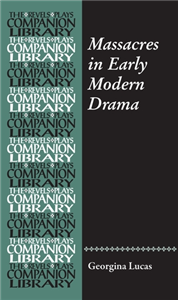
Massacres in Early Modern Drama
by Georgina Lucas
Description
Massacres in Early Modern Drama analyses the dynamically ambivalent meanings constructed by the language and action of massacre on the early modern stage. Informed by theories drawn from massacre studies, the monograph challenges orthodoxies about senseless violence, illuminates archaic forms of massacres, and attests to their brutally diverse stage representations.
Anchored by the contention that the St Bartholomew's Day Massacre in Paris (1572) was instrumental to early modern understandings of massacre, the book uses this atrocity, and its most famous dramatic depiction - Christopher Marlowe's The Massacre at Paris - as a hook to explore larger concerns about massacre in plays by Robert Greene, George Chapman, John Fletcher, and William Shakespeare.
Thus, Massacres in Early Modern Drama considers how early modern drama forms part of a continual cultural process of trying to piece together the contentious and traumatic phenomenon of massacre.
More Information
Rights Information
Albania, Algeria, Angola, Argentina, Armenia, Australia, Austria, Bahrain, Belgium, Belize, Benin, Bolivia, Bosnia and Herzegovina, Botswana, Brazil, Bulgaria, Burkina Faso, Burundi, Cameroon, Canada, Cape Verde, Central African Republic, Chad, Chile, China, Colombia, Comoros, Congo [DRC], Congo, Republic of the, Costa Rica, Ivory Coast, Croatia, Czech Republic, Denmark, Djibouti, Ecuador, Egypt, El Salvador, Equatorial Guinea, Eritrea, Estonia, Ethiopia, Faroe Islands, Finland, France, French Guiana, Gabon, Gambia, Georgia, Germany, Ghana, Greece, Guatemala, Guinea, Guinea-Bissau, Guyana, Honduras, Hongkong, Hungary, Iceland, India, Indonesia, Iran, Iraq, Ireland, Israel, Italy, Japan, Jordan, Kazakhstan, Kenya, Kuwait, Latvia, Lebanon, Lesotho, Liberia, Libya, Lithuania, Luxembourg, Macau, China, Macedonia [FYROM], Madagascar, Malawi, Malaysia, Mali, Malta, Mauritania, Mauritius, Mayotte, Mexico, Mongolia, Montenegro, Morocco, Mozambique, Namibia, Netherlands, New Zealand, Nicaragua, Niger, Nigeria, Norway, Oman, Pakistan, Panama, Paraguay, Peru, Philippines, Poland, Portugal, Puerto Rico, Qatar, Reunion, Romania, Russia, Rwanda, Saint Helena, Sao Tome and Principe, Saudi Arabia, Senegal, Serbia, Seychelles, Sierra Leone, Singapore, Slovakia, Slovenia, Somalia, South Africa, South Korea, Spain, Sri Lanka, Sudan, Suriname, Swaziland, Sweden, Switzerland, Syria, Taiwan, Tanzania, Thailand, Timor-Leste, Togo, Tokelau, Tunisia, Turkey, Uganda, Ukraine, United Arab Emirates, United Kingdom, United States, Uruguay, Venezuela, Vietnam, Western Sahara, Yemen, Zambia, Zimbabwe, South Sudan, Cyprus, Palestine, Bangladesh, Cambodia, Liechtenstein, Azerbaijan, Jamaica, Kyrgyzstan, Dominican Republic, Myanmar, Monaco
Endorsements
Massacres in Early Modern Drama analyses the dynamically ambivalent meanings constructed by the language and action of massacre on the early modern stage. Informed by theories drawn from massacre studies, the book challenges orthodoxies about senseless violence, illuminates archaic forms of massacre, and attests to their brutally diverse stage representations. Massacres scarred the early modern period. Its wars - civil, religious, and colonial - were each impelled, attended, or characterised by massacres. This violence intersected with some of the gravest political questions of the age. What is (who counts as) a human? What makes (and unmakes) a king? What makes (and breaks) a state? Do wars have rules, and to whom do they (or do they not) apply? Massacres in Early Modern Drama explores these questions by analysing the ways in which massacres expose the contingency of three different concepts: humanness, statehood, and war. Anchored by the contention that the St Bartholomew's Day massacre in Paris in 1572 was instrumental to early modern understandings of massacre, the book uses this atrocity, and its most famous dramatic depiction - Christopher Marlowe's The Massacre at Paris - as a hook to examine larger concerns about massacre in plays by Robert Greene, George Chapman, John Fletcher, and William Shakespeare. In doing so, this valuable study considers how early modern drama forms part of a continual cultural process of trying to piece together the contentious and traumatic phenomenon of massacre.
Reviews
Massacres in Early Modern Drama analyses the dynamically ambivalent meanings constructed by the language and action of massacre on the early modern stage. Informed by theories drawn from massacre studies, the book challenges orthodoxies about senseless violence, illuminates archaic forms of massacre, and attests to their brutally diverse stage representations. Massacres scarred the early modern period. Its wars - civil, religious, and colonial - were each impelled, attended, or characterised by massacres. This violence intersected with some of the gravest political questions of the age. What is (who counts as) a human? What makes (and unmakes) a king? What makes (and breaks) a state? Do wars have rules, and to whom do they (or do they not) apply? Massacres in Early Modern Drama explores these questions by analysing the ways in which massacres expose the contingency of three different concepts: humanness, statehood, and war. Anchored by the contention that the St Bartholomew's Day massacre in Paris in 1572 was instrumental to early modern understandings of massacre, the book uses this atrocity, and its most famous dramatic depiction - Christopher Marlowe's The Massacre at Paris - as a hook to examine larger concerns about massacre in plays by Robert Greene, George Chapman, John Fletcher, and William Shakespeare. In doing so, this valuable study considers how early modern drama forms part of a continual cultural process of trying to piece together the contentious and traumatic phenomenon of massacre.
Author Biography
Georgina Lucas is a Lecturer in Early Modern Literature at Edinburgh Napier University
 Trusted Partner

Manchester University Press
Manchester University Press is a leading UK publisher known for excellent research in the humanities and social sciences.
View all titlesBibliographic Information
- Publisher Manchester University Press
- Publication Date May 2026
- Orginal LanguageEnglish
- ISBN/Identifier 9781526147318 / 1526147319
- Publication Country or regionUnited Kingdom
- FormatPrint PDF
- Pages336
- ReadershipGeneral/trade
- Publish StatusPublished
- Dimensions216 X 138 mm
- Biblio NotesDerived from Proprietary 5135
- SeriesRevels Plays Companion Library
- Reference Code12820
Thank you for proceeding with this offer.
Manchester University Press has chosen to review this offer before it proceeds.
You will receive an email update that will bring you back to complete the process.
You can also check the status in the My Offers area
Manchester University Press has chosen to review this offer before it proceeds.
You will receive an email update that will bring you back to complete the process.
You can also check the status in the My Offers area

Please wait while the payment is being prepared.
Do not close this window.

(c) Copyright 2026 - Frankfurter Buchmesse GmbH. All Right Reserved