
Annika Parance Éditeur
Livres Canada Books
View Rights Portal

Founded in 2010, the Parisian agency is a literary agency based in Paris. We represent a selected group of international writers of literary fiction such as multi-awarded Icelandic author Gudrun Eva Minervudottir and Hungarian novelist Arpad Kun, winner of the prestigious Aegon Award. We also represent the stunning illustrated books of the British and the Bodleian Library (UK) abroad. Last, we are now open to represent new lists in literary fiction, crime fiction and non fiction. Welcome to the Parisian Agency!
View Rights Portal

The politics of Middle English parables examines the dynamic intersection of fiction, theology and social practice in late-medieval England. Parables occupy a prominent place in Middle English literature, appearing in dream visions and story collections as well as in lives of Christ and devotional treatises. While most scholarship approaches the translated stories as stable vehicles of Christian teaching, this book highlights the many variations and points of conflict across Middle English renditions of the same story. In parables related to labour, social inequality, charity and penance, the book locates a creative theological discourse through which writers attempted to re-construct Christian belief and practice. Analysis of these diverse retellings reveals not what a given parable meant in a definitive sense but rather how Middle English parables inscribe the ideologies, power structures and cultural debates of late-medieval Christianity.
Any reader who has ever visited Asia knows that the great bulk of Western-language fiction about Asian cultures turns on stereotypes. This book, a collection of essays, explores the problem of entering Asian societies through Western fiction, since this is the major port of entry for most school children, university students and most adults. In the thirteenth century, serious attempts were made to understand Asian literature for its own sake. Hau Kioou Choaan, a typical Chinese novel, was quite different from the wild and magical pseudo-Oriental tales. European perceptions of the Muslim world are centuries old, originating in medieval Christendom's encounter with Islam in the age of the Crusades. There is explicit and sustained criticism of medieval mores and values in Scott's novels set in the Middle Ages, and this is to be true of much English-language historical fiction of the nineteenth and early twentieth centuries. Even mediocre novels take on momentary importance because of the pervasive power of India. The awesome, remote and inaccessible Himalayas inevitably became for Western writers an idealised setting for novels of magic, romance and high adventure, and for travellers' tales that read like fiction. Chinese fictions flourish in many guises. Most contemporary Hong Kong fiction reinforced corrupt mandarins, barbaric punishments and heathens. Of the novels about Japan published after 1945, two may serve to frame a discussion of Japanese behaviour as it could be observed (or imagined) by prisoners of war: Black Fountains and Three Bamboos.
 Trusted Partner
 Trusted Partner
Penny politics offers a new way to read early Victorian popular fiction such as Jack Sheppard, Sweeney Todd, and The Mysteries of London. It locates forms of radical discourse in the popular literature that emerged simultaneously with Brittan's longest and most significant people's movement. It listens for echoes of Chartist fiction in popular fiction. The book rethinks the relationship between the popular and political, understanding that radical politics had popular appeal and that the lines separating a genuine radicalism from commercial success are complicated and never absolute. With archival work into Newgate calendars and Chartist periodicals, as well as media history and culture, it brings together histories of the popular and political so as to rewrite the radical canon.
Trusted Partner

Through the Fiction of Phebe Gibbes places this prolific, newly recovered English writer at the centre of the revolutionary period. Gibbes's novels mark the struggles of women for agency in an expanding British empire, from the Seven Years' War to revolutions in American, Haiti and France. With Gibbes as a nexus in a lineage of women writers from Aphra Behn to Jane Austen, Kathryn S. Freeman offers a valuable perspective on the 'long eighteenth century', with Gibbes' own evolution mirroring that of the larger period. The study traces the development of Gibbes' authorial voice from satire to irony through a range of female characters subverting patriarchal oppression. Freeman guides the reader through patterns of narrative voice, concerns with gender and sexuality, and elements of wordplay through detailed discussion of five novels representing Gibbes' evolving representation of a subversive female subjectivity.
Trusted Partner

Edmund Spenser famously conceded to his friend Walter Raleigh that his method in The Faerie Queene 'will seeme displeasaunt' to those who would 'rather have good discipline delivered plainly in way of precepts, or sermoned at large'. Spenser's allegory and Elizabethan biblical exegesis is the first book-length study to clarify Spenser's comparison by introducing readers to the biblical typologies of contemporary sermons and liturgies. The result demonstrates that 'precepts ... sermoned at large' from lecterns and pulpits were themselves often 'clowdily enwrapped in allegoricall devises'. In effect, routine churchgoing prepared Spenser's first readers to enjoy and interpret The Faerie Queene. A wealth of relevant quotations invites readers to adopt an Elizabethan mindset and encounter the poem afresh. The 'chronicle history' cantos, Florimell's adventures, the Souldan episode, Mercilla's judgment on Duessa and even the two stanzas that close the Mutabilitie fragment, all come into sharper focus when juxtaposed with contemporary religious rhetoric.
Trusted Partner


Du sollst sie töten. Doch was, wenn du ohne sie nicht überleben kannst? Die Erde ist verseucht, der Meeresspiegel steigt und ein Konzern regiert Inesas Heimat. Dieser hat auch den Lauf des Lamms etabliert: einen tödlichen Wettkampf, der live übertragen wird und bei dem schwer verschuldete Menschen als „Lämmer“ von ausgebildeten „Engeln“ gejagt werden. Als Inesas Mutter zu tief in die Schulden rutscht, muss ihre Tochter für sie beim Lauf antreten. Doch der Kampf um Leben und Tod bringt Inesa ihrem Engel Melinoë näher als geahnt ... Der spannungsgeladene und berührende New York Times -Besteller Ava Reids Fable for the End of the World ist nicht nur eine mitreißende Dystopie, sondern auch eine bewegende Liebesgeschichte – verwoben mit tiefgründigen Themen und geschrieben in einem wunderschönen Stil. Der New York Times -Bestseller jetzt auf Deutsch : Über den Kampf ums Überleben, die Frage nach Menschlichkeit und den Glauben an die Hoffnung Fesselnde Dystopie : eine Welt, die unter den Folgen des Klimawandels leidet und ein tödlicher Wettkampf, der live übertragen wird. Mit queerer Liebesgeschichte : lesbische Enemies-to-Lovers-Romance Kapitalismuskritik : Ein Konzern regiert das Land, treibt seine Bevölkerung in die Schulden und handelt nur im Sinne des Profits. Feministische Botschaft : gegen Sexismus und die Objektifizierung von Frauen Poetischer Stil : SPIEGEL-Bestsellerautorin Ava Reid berührt mit wunderschönen Zeilen. Erstauflage mit opulentem Farbschnitt und exklusiver Charakterpostkarte - Nur in der 1. Auflage!
Trusted Partner

The short fiction that flourished in nineteenth-century France has attracted relatively little critical attention compared with the novel. This study focuses on some key stories by major authors of contes and nouvelles from the late 1820s to the 1890s, taking as a starting-point, aspects of narrative technique as a way of exploring not just characteristic strategies of short fiction, but also the ends to which they were put: recurrent themes, and the vision of mankind. Each chapter looks in some detail at three or four stories, referring briefly to other tales for illustration. The underlying point that emerges from this study is that the interest of a tale lies in the telling, not the events. ;
Trusted Partner
 Trusted Partner
Trusted Partner
Trusted Partner


Marcus Hammerschmitt schreibt Science-fiction-Erzählungen, die technologische Phantasie, psychologische Einsicht, Lust am gedanklichen Experiment und poetische Erfindungskraft vereinen. Wie Herbert W. Franke oder Peter Schattschneider basiert er seine Geschichten auf einer soliden Grundlage, entwickelt seine Szenarios und Fabeln spielerisch, verknüpft sie aber dramatisch mit den größeren Problemen von Ökologie einerseits und den Zweifeln und inneren Konflikten des einzelnen andererseits.
Trusted Partner
How might our friendships shape our politics? This book examines how contemporary American fiction has rediscovered the concept of civic friendship and revived a long tradition of imagining male friendship as interlinked with the promises and paradoxes of democracy in the United States. Bringing into dialogue the work of a wide range of authors - including Philip Roth, Paul Auster, Michael Chabon, Jonathan Lethem, Dinaw Mengestu, and Teju Cole - this innovative study advances a compelling new account of the political and intellectual fabric of the American novel today.
Trusted Partner
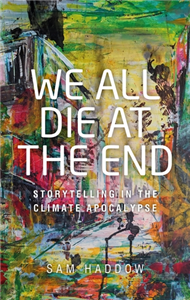
We all die at the end offers a survey of contemporary end-of-the-world fiction, spanning literature, children's fiction, video games, theatre and film. It draws on eco-critical philosophy and narrative theory to show ways in which the climate crisis is reorienting storytelling in the face of foreseeable human extinction. In the process, it argues that such stories have a role to play in helping us come to terms with the severity and scale of the crisis that we face.
Trusted Partner
Trusted Partner
 Trusted Partner

Dieser Abschlussband von Lems Essays enthält nur Arbeiten, die in der Insel-Ausgabe der Essays (1981) nicht enthalten waren. Stärker als die früheren Bände ist dieser persönlich bestimmt. Einmal handelt es sich um Essays, die autobiografisch sind oder sich auf das eigene Werk beziehen. Zum anderen gibt es Vorworte zu Rezensionen von Büchern und Autoren, die Lem menschlich besonders nahestehen: Szymon Kobyliński, Władysław Bartoszewski und Jan Józef Szczepański. Neben Rezensionen, die Lem deutsche RIAS Berlin schrieb, vornehmlich über populärwissenschaftliche und pseudowissenschaftliche Bücher, aus denen Lems rationalistische Denkhaltung offenbar wird, und spekulativen Aufsätzen enthält dieser Band auch einige von Lems scharfsinnigsten Kritiken zu Autoren, denen er sich geistesverwandt fühlt oder die ihm widerstreben: Dick, Borges, die Strugatzkis und eine scharfe Abrechnung mit der Gattung, der der Großteil von Lems eigenem Werk zugezählt wird: der Science-Fiction. Eine beachtliche Anzahl der Essays schrieb Lem gleich in deutscher Sprache. Weitere Essays von Stanisław Lem liegen in den Bänden Sade und die Spieltheorie und Über außersinnliche Wahrnehmungen vor.
Trusted Partner

Invasions is an ambitious, new and authoritative study of one of the defining cultural products of the Victorian and Edwardian eras. By the outbreak of war in 1914 invasion-scare fiction had profoundly changed British society, becoming not just a vibrant part of popular culture, but a reference point among military planners, advertisers, and politicians. This intersection between politics and culture, between entertainment and war planning, sets invasion-scare stories apart as one of the most versatile and interesting fictional products in modern British history. Building on recent work in both history and literature studies, Invasions is the first study of invasion-scare fiction to examine both the form (that is, fiction) and the function (the political argument) of the genre.
Trusted Partner

Sara Paretsky is known for her influential V.I. Warshawski series, which transformed the masculine hard-boiled detective formula into a vehicle for feminist values. But Paretsky does more than this. Her novels also illustrate the extent to which detective fiction acts as a literature of trauma, allowing Paretsky to address the politics of agency in ways that go beyond the personal, for trauma always has a social and a political dimension. Paretsky's work also exploits the way detective fiction mirrors the writing of history. Here, Paretsky uses the form to expose the partiality of historical accounts - whether they be personal, institutional, or national - that authorise 'forgetting' of a particularly insidious kind. Significantly, all these issues are explored within the framework of the traditional hard-boiled detective novel. As a result, Paretsky's achievement forces us to acknowledge the deeply subversive potential of detective fiction.
Trusted Partner

This book is the first full-length study of contemporary American fiction of passing. Its takes as its point of departure the return of racial and gender passing in the 1990s in order to make claims about wider trends in contemporary American fiction. The book accounts for the return of tropes of passing in fiction by Phillip Roth, Percival Everett, Louise Erdrich, Danzy Senna, Jeffrey Eugenides and Paul Beatty, by arguing meta-critical and meta-fictional tool. These writers are attracted to the trope of passing because passing narratives have always foregrounded the notion of textuality in relation to the (il)legibility of "black" subjects passing as white. The central argument of this book, then, is that contemporary narratives of passing are concerned with articulating and unpacking an analogy between passing and authorship. The title promises to inaugurate dialogue on the relationships between passing, postmodernism and authorship in contemporary American fiction.
Trusted Partner

Stanisław Lem wurde am 12. September 1921 in Lwów (Lemberg) geboren, lebte zuletzt in Krakau, wo er am 27. März 2006 starb. Er studierte von 1939 bis 1941 Medizin. Während des Zweiten Weltkrieges musste er sein Studium unterbrechen und arbeitete als Automechaniker. Von 1945 bis 1948 setze er sein Medizinstudium fort, nach dem Absolutorium erwarb Lem jedoch nicht den Doktorgrad und übte den Arztberuf nicht aus. Er übersetzte Fachliteratur aus dem Russischen und ab den fünfziger Jahren arbeitete Lem als freier Schriftsteller in Krákow. Er wandte sich früh dem Genre Science-fiction zu, schrieb aber auch gewichtige theoretische Abhandlungen und Essays zu Kybernetik, Literaturtheorie und Futurologie. Stanisław Lem zählt heute zu den erfolgreichsten Autoren Polens. Sein Werk wurde vielfach ausgezeichnet, verfilmt und in 57 Sprachen übersetzt.


