Your Search Results

      • Royal Collection Trust

        The publishing programme at Royal Collection Trust aims to create the highest-quality books, exhibition catalogues, guides and children's books to celebrate the royal residences and the works of art found within them. Our list includes beautifully produced printed books, apps and online catalogues and symposia. We also publish scholarly catalogues raisonnés, which demonstrate the highest standards of academic research.

        View Rights Portal
      • The Royal College of Psychiatrists

        Royal College of Psychiatrists publish a wide range of books on mental health for both psychiatrists and the general public, along withtheir flagship journal the British Journal of Psychiatry.

        View Rights Portal
      • Trusted Partner
        Literature & Literary Studies
        July 2018

        Shakespeare and Scotland

        by Willy Maley, Andrew Murphy

      • Trusted Partner
        Literature & Literary Studies
        January 2026

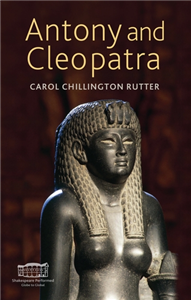
        Antony and Cleopatra

        by Carol Chillington Rutter

        This book writes a performance history of Antony and Cleopatra, Shakespeare's most ambiguous play, from 1606 to the present. It observes the choices that actors, directors, designers, musicians and adapters have made each time they have brought the play's thoughts on power, race, masculinity, regime change, exoticism, love, dotage and delinquency into alignment with a new present. Informed by close attention to theatre records - promptbooks, stage managers' reports, reviews - it offers in-depth analyses of fifteen international productions by (among others) the Royal Shakespeare Company, Citizens Theatre Glasgow, Northern Broadsides, Berliner Ensemble and Toneelgroep Amsterdam. It ends seeing Shakespeare's black Egyptian Queen Cleopatra - whited-out in performance for centuries - restored to the contemporary stage. Written in a lively and accessible style, this book will be of interest to students, academics, actors, directors and general readers alike.

      • Trusted Partner
        Literature & Literary Studies
        November 2025

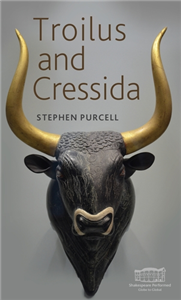
        Troilus and Cressida

        by Stephen Purcell

        A history of Shakespeare's play in performance, from John Dryden's Restoration adaptation to the rediscovery of the play in the twentieth century. What made this play so relevant to audiences who had lived through the horrors of two world wars and the rise of fascism? Why did it speak so directly to the 'angry young men' of the post-war generation and to the countercultural movements of the 1960s? This book investigates the many ways in which modern directors and actors have found their own world reflected in the play, from anti-war protests and the sexual revolution to feminism and postcolonialism. In doing so, it explores the play's own complexity and its refusal to give easy answers.

      • Trusted Partner
        Literature & Literary Studies
        August 2013

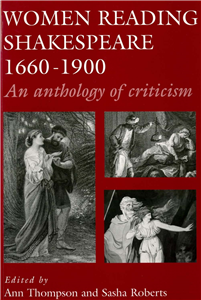
        Women reading Shakespeare 1660–1900

        An anthology of criticism

        by Ann Thompson, Sasha Roberts

        Women reading Shakespeare, 1660-1900 comprehensively rediscovers a lost tradition of women's writing on Shakespeare. Since Margaret Cavendish published the first critical essay on Shakespeare in 1664, women have written as scholars, critics, editors, performers and popularisers of Shakespeare. Many found in Shakespeare criticism the opportunity to raise a wide variety of issues, ranging from the use of women in society, family life, social relations and ethnic difference. In their different ways, women appropriated Shakespeare to their own ends - not always in step with their male contemporaries. Virtually none of this work is available today; it is unread and unknown. This fascinating anthology draws upon extensive new research to collect for the first time in one volume the Shakespeare criticism of some fifty British and American women writing before 1900. It includes the work of both familiar and unknown names and represents the diversity of literary genres used by women: the scholarly article, the periodical essay, book-length studies, personal memoirs, books for children, school editions. The volume also includes previously unknown Shakespeare illustrations by women, and a general introduction to the development of women's criticism of Shakespeare before 1900. ;

      • Trusted Partner
        Literature & Literary Studies
        September 2025

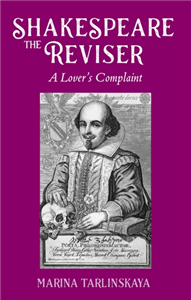
        Shakespeare the Reviser

        A Lover's Complaint

        by Marina Tarlinskaya

        The project researches the difference between a revision vs. a rewriting. The book explores the English poems and plays of the Early New English period, from the sixteenth to the beginning of seventeenth century, with over 50 entries examined. The main material is the poem A Lover's Complaint; the play Double Falsehood by Lewis Theobald; the revised and rewritten post-Restoration plays such as Richard II (revised by Lewis Theobald), and The Fatal Secret (rewritten Webster's The Duchess of Malfi) by Lewis Theobald. An example of authorial revision is Sonnets 2 and 138.

      • Trusted Partner
      • Trusted Partner
        Literature & Literary Studies
        June 2004

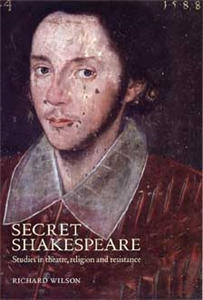
        Secret Shakespeare

        Studies in theatre, religion and resistance

        by Richard Wilson

        Shakespeare's Catholic context was the most important literary discovery of the last century. No biography of the Bard is now complete without chapters on the paranoia and persecution in which he was educated, or the treason which engulfed his family. Whether to suffer outrageous fortune or take up arms in suicidal resistance was, as Hamlet says, 'the question' that fired Shakespeare's stage. In 'Secret Shakespeare' Richard Wilson asks why the dramatist remained so enigmatic about his own beliefs, and so silent on the atrocities he survived. Shakespeare constructed a drama not of discovery, like his rivals, but of darkness, deferral, evasion and disguise, where, for all his hopes of a 'golden time' of future toleration, 'What's to come' is always unsure. Whether or not 'He died a papist', it is because we can never 'pluck out the heart' of his mystery that Shakespeare's plays retain their unique potential to resist. This is a fascinating work, which will be essential reading for all scholars of Shakespeare and Renaissance studies. ;

      • Trusted Partner
      • Trusted Partner
      • Trusted Partner
        Literature & Literary Studies
        March 2005

        Beginning Shakespeare

        by Lisa Hopkins, Peter Barry, John McLeod

        'Beginning Shakespeare' introduces students to the study of Shakespeare, and grounds their understanding of his work in theoretical discourses. After an introductory survey of the dominant approaches of the past, seven chapters examine the major current critical approaches to Shakespeare; psychoanalysis, New Historicism, Cultural Materialism, gender studies, queer theory, postcolonial criticism and performance criticism. A further chapter looks at the growing roles of biography, attribution studies and textual studies. Each chapter analyses the strengths and weaknesses of a particular perspective, allowing students to gain a clear critical purchase on the respective approaches, and to make informed choices between them. Each chapter ends with a list of suggested further reading and interactive exercises based on the key issues raised. An invaluable introduction, essential for anyone studying Shakespeare, 'Beginning Shakespeare' offers students a map of the current critical practices, and a sense of the possibilities for developing their own approaches. ;

      • Trusted Partner
        Literature & Literary Studies
        December 1998

        Shakespeare: the 'lost years'

        by E Honigmann

        This literary detective story throws light on the problem of what Shakespeare was doing between leaving school and appearing as an actor and playwright in London. Bringing forward historic and documentary evidence, this text argues that Shakespeare worked as a schoolmaster and player for a wealthy Catholic landowner in Lancashire and later for the Earl of Derby. One of the book's conclusions is that Shakespeare was probably a Roman Catholic. Step by step, this story of patronage, recusancy and aspiring talent is pursued through complex family relationships. ;

      • Trusted Partner
        September 1981

        Die großen Dramen, Tragödien, Historien und Komödien in zehn Bänden

        Ausgewählt, nach den Erstdrucken neu übersetzt und erläutert von Rudolf Schaller. Geschenkausgabe mit Dekorüberzug

        by William Shakespeare

        William Shakespeare wurde vermutlich am 23. April 1564 in Stratford-upon-Avon geboren. Seine schöpferische Sprachkraft und die meisterhafte psychologische Gestaltung seiner Charaktere begründen seine Bedeutung und seinen Ruhm als Dramatiker und Dichter. Werke wie König Johann, Ein Sommernachtstraum, Der Kaufmann von Venedig, oder seine Tragödien Hamlet, Romeo und Julia, Othello oder König Lear markieren Höhepunkte der Weltliteratur und sind von den großen internationalen Bühnen nicht mehr wegzudenken. William Shakespeare verstarb am 23. April 1616 in Stratford-upon-Avon.

      • Trusted Partner
        Literature & Literary Studies
        June 2025

        Dido, Queen of Carthage

        by Ruth Lunney

      • Trusted Partner
        Literature & Literary Studies
        March 2026

        What's in a name?

        How historians know Shakespeare was Shakespeare

        by Susan Dwyer Amussen

        A compelling tour of Shakespeare's England that makes a powerful contribution to the 'authorship question'. How do we know Shakespeare was Shakespeare? Could a glover's son who left school at fifteen really be the author behind such masterpieces as Hamlet, King Lear and The Tempest? Yes! says historian Susan Amussen. She transports readers back to early modern England, to travel the path that carried William Shakespeare from humble origins in Stratford to literary greatness on the London stage. This was a society undergoing rapid change. Grammar schools made education in Latin and Greek available to commoners, while touring players brought the latest dramatic productions to the masses. And in London, a metropolis filled with European visitors, ordinary people had the opportunity to see courtly life up close. No serious historian doubts that Shakespeare was the author of the plays that bear his name. Susan Amussen shares what they know: that Shakespeare's England was a complex and cosmopolitan place, with everything a talented young playwright needed to develop his craft and furnish his imagination.

      • Trusted Partner
        Literature & Literary Studies
        May 2000

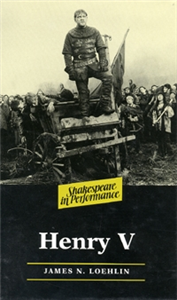
        Henry V

        by James Loehlin

        This study examines the profound changes that twentieth-century performance has wrought on Shakespeare's complex drama of war and politics. What was accepted at the turn of the century as a patriotic celebration of a national hero has emerged in the modern theatre as a dark and troubling analysis of the causes and costs of war. The book details the theatrical innovations and political insights that have turned one of Shakespeare's most traditional-bound plays into one of his most popular and provocative. Henry V gives details analyses of several important modern productions. Beginning with a consideration of the play's political significance in Elizabethan London, the book goes on the reveal its subsequent reinvention, both as patriotic pageant and anti-war manifesto. Individual chapters consider important productions by the Royal Shakespeare Company, and other British and North American companies, as well as the landmark film versions. A compelling account of the theatrical revolution that has transformed one of Shakespeare's most challenging plays. ;

      • Trusted Partner
        Literature & Literary Studies
        August 1994

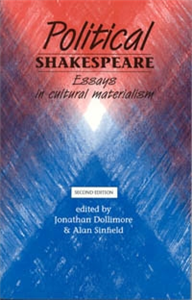
        Political Shakespeare

        Essays in cultural materialism

        by Jonathan Dollimore, Alan Sinfield

        The new wave of cultural materialists in Britain and new historicists in the United States here join forces to depose the sacred icon of the "eternal bard" and argue for a Shakespeare who meditates and exploits political, cultural and ideological forces. Ten years on, this second edition presents additional essays by Jonathan Dollimore and Alan Sinfield. ;

      • Trusted Partner
        Literature & Literary Studies
        November 2021

        Shakespeare and the denial of territory

        by Pascale Drouet

      • Trusted Partner
        June 1988

        Richard III

        Aus dem Englischen von Thomas Brasch

        by William Shakespeare, Thomas Brasch

        William Shakespeare wurde vermutlich am 23. April 1564 in Stratford-upon-Avon geboren. Seine schöpferische Sprachkraft und die meisterhafte psychologische Gestaltung seiner Charaktere begründen seine Bedeutung und seinen Ruhm als Dramatiker und Dichter. Werke wie König Johann, Ein Sommernachtstraum, Der Kaufmann von Venedig, oder seine Tragödien Hamlet, Romeo und Julia, Othello oder König Lear markieren Höhepunkte der Weltliteratur und sind von den großen internationalen Bühnen nicht mehr wegzudenken. William Shakespeare verstarb am 23. April 1616 in Stratford-upon-Avon. Thomas Brasch, Dichter, Dramatiker, Filmschaffender und Übersetzer, eine der markantesten Figuren der neuen deutschen Literatur, wurde 1945 in Westow/Yorkshire (England) als Sohn jüdischer Emigranten geboren. Bis zu dem Jahr, in dem er die DDR verließ (1976), lebte er in Ostberlin. 1977 erschien sein bekanntestes Buch, der Erzählband Vor den Vätern sterben die Söhne. 2001 ist er in Berlin gestorben.

      Subscribe to our

      newsletter