
Your Search Results
-

-

Hobby Japan Co., Ltd.
We release over 300 publications of various genres and formats every year
View Rights Portal
-
Promoted Content

 Business, Economics & LawJuly 2025
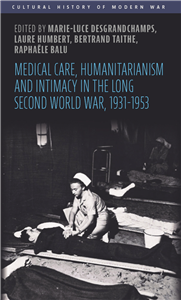
Medical care, humanitarianism and intimacy in the long Second World War, 1931-1953
by Marie-Luce Desgrandchamps, Laure Humbert, Bertrand Taithe, Raphaële Balu
This book offers a micro-global history of humanitarianism and medical care during the 'long' Second World War, which challenges the traditional and Eurocentric chronological boundaries of 1939/1945. It takes as its starting point the Japanese invasion of Manchuria in 1931, which led to the progressive dislocation of the League of Nations, with the Japanese, German and Soviet departures in the 1930s. It ends with the termination of the Korean War in 1953, and the subsequent dismantlement of the first United Coalition and UN Peace enforcement operation. It considers the slow, messy and ambivalent transformation of humanitarian actors' relations to the suffering of distant others through a study of humanitarian encounters, practices, spaces and affects. Paying close attention to a variety of actors, such as French colonial doctors, Swiss ICRC delegates, Egyptian relief workers, Chinese-style physicians, Peruvian and Ecuadorian nurses or American member of the Unitarian Service Committee, the book provides a more holistic story of humanitarianism.
-
Promoted Content
 Business, Economics & LawJune 2026
Histories of international legal theories in Japan
From dialogue to conversation
by Maiko Meguro, Yota Negishi
This volume presents the first systematic account of Japanese international legal theory; edited by Japanese scholars, the volume traces thirteen influential scholars and spans over a century. It examines how theorists positioned outside international law's Western centre developed sophisticated frameworks to address tensions between Western modernity and their own experiences. The book's central contribution proposes 'conversation'-continuous engagement that respects differences between legal traditions-as an alternative to 'dialogue', which often reproduces existing hierarchies by assuming all perspectives can be reconciled. Through detailed intellectual biographies across six historical periods, contributors reveal how Japanese scholars strategically employed legal positivism, articulated transcivilizational perspectives, and developed concepts of normative multilateralism. Addressed at scholars of international law, legal theory, and comparative legal traditions, this volume demonstrates that the discipline's future requires genuinely reciprocal exchange where diverse perspectives can coexist productively.
-
 Trusted Partner
 Humanities & Social SciencesJuly 2025
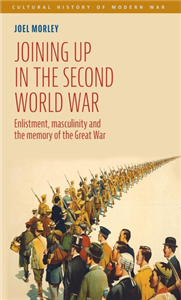
Joining up in the Second World War
Enlistment, masculinity and the memory of the Great War
by Joel Morley
This book connects the First and Second World Wars. It uses oral histories and Mass Observation material to explore men's attitudes to Second World War enlistment and the relationship they perceived between military service and masculinity, and how these were influenced by understandings of the First World War. Locating the cultural legacy of First World War in the subjectivities of men who participated in the Second World War demonstrates the breadth of sources that informed men's understandings of the First World War in interwar Britain. Its cultural legacy was omnipresent and diverse, and informed young men's attitudes and service preferences, but it reinforced Edwardian conceptions of wartime masculinity as often as it undermined them. Two decades after the First World War ended, they remained resilient in the subjective understandings of men who grew up in the Great War's shadow.
-
Trusted Partner
 Business, Economics & LawMarch 2026
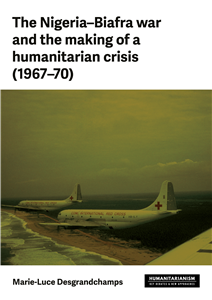
Humanitarianism in Civil War
The Biafra crisis, 1967-1970
by Marie-Luce Desgrandchamps
May 1967, in Nigeria, the Republic of Biafra declared its independence. Soon, civil war and famine ravaged the region and gradually entered the European and American media. Photographs of the conflict arouse considerable emotion in the West. The secessionist enclave and the areas taken over by the Nigerian army then became the scene of major relief operations, developed and financed by multiple organizations and governments. Part of a historiography of humanitarianism in full renewal, this book tells the story of the war, its metamorphosis into an international crisis and the responses that were provided. Based on a large body of sources from French, British, Swiss, Nigerian and American archives, it offers an insight into the world of humanitarian work at the end of the 1960s. It shows the reconfigurations taking place there. in the postcolonial era by proposing complementary scales of observation - international, national and local. The work also revisits some of the controversies which developed around the conflict regarding the instrumentalization of aid, its links with politics, the reception of relief operations on the ground or even the birth of borderlessness and testimony. It thus returns to the place occupied by the Biafran crisis in the history of humanitarian aid.
-
Trusted Partner
 Humanities & Social SciencesMarch 2017
New frontiers
Imperialism's new communities in East Asia, 1842–1953
by Robert Bickers, Christian Henriot
In the new world order mapped out by Japanese and Western imperialism in East Asia after the mid-nineteenth century opium wars, communities of merchants and settlers took root in China and Korea. New identities were constructed, new modes of collaboration formed and new boundaries between the indigenous and foreign communities were literally and figuratively established. Newly available in paperback, this pioneering and comparative study of Western and Japanese imperialism examines European, American and Japanese communities in China and Korea, and challenges received notions of agency and collaboration by also looking at the roles in China of British and Japanese colonial subjects from Korea, Taiwan and India, and at Chinese Christians and White Russian refugees. This volume will be of interest to students and scholars of the history and anthropology of imperialism, colonialism's culture and East Asian history, as well as contemporary Asian affairs.
-
Trusted Partner
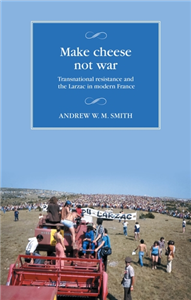 Humanities & Social SciencesFebruary 2026
Make cheese not war
Transnational resistance and the Larzac in modern France
by Andrew W. M. Smith
In 1971, the French government announced a massive extension of its military base on the Larzac plateau in southern France. Land was to be expropriated from 107 farms around the small town of La Cavalerie. Limited resistance was expected, but what happened next exceeded all expectations. Local sheep farmers set up protest camps and occupied the land. They soon attracted an astonishing level of support, pioneering a form of regional radicalism with global implications. Drawing out the international dimensions of the protest, Make cheese not war explores a transnational resistance movement in the 1970s that challenged dominant visions of modernity and became a wellspring of radical alternatives. Exploring previously unconsulted archives in France and elsewhere, the book offers an in-depth analysis of the decade-long peasant movement and its aftermath. Repositioning the Larzac struggle within a wider network of French and international solidarities, from the US to the UK, Germany, Burkina Faso, New Caledonia and Japan, the book retraces political networks of pacifist activism, as well as environmental movements and anti-nuclear protest. It shows how this French peasant campaign became both a platform and a model for popular engagement.
-
Trusted Partner
-
Trusted Partner
 The ArtsJanuary 2019
The war that won't die
The Spanish Civil War in cinema
by David Archibald
The war that won't die charts the changing nature of cinematic depictions of the Spanish Civil War. In 1936, a significant number of artists, filmmakers and writers - from George Orwell and Pablo Picasso to Joris Ivens and Joan Miró - rallied to support the country's democratically-elected Republican government. The arts have played an important role in shaping popular understandings of the Spanish Civil War and this book examines the specific role cinema has played in this process. The book's focus is on fictional feature films produced within Spain and beyond its borders between the 1940s and the early years of the twenty-first century - including Hollywood blockbusters, East European films, the work of the avant garde in Paris and films produced under Franco's censorial dictatorship. The book will appeal to scholars and students of Film, Media and Hispanic Studies, but also to historians and, indeed, anyone interested in why the Spanish Civil War remains such a contested political topic.
-
Trusted Partner
 The ArtsJune 2021
The war that won't die
The Spanish Civil War in cinema
by David Archibald
The war that won't die charts the changing nature of cinematic depictions of the Spanish Civil War. In 1936, a significant number of artists, filmmakers and writers - from George Orwell and Pablo Picasso to Joris Ivens and Joan Miró - rallied to support the country's democratically-elected Republican government. The arts have played an important role in shaping popular understandings of the Spanish Civil War and this book examines the specific role cinema has played in this process. The book's focus is on fictional feature films produced within Spain and beyond its borders between the 1940s and the early years of the twenty-first century - including Hollywood blockbusters, East European films, the work of the avant garde in Paris and films produced under Franco's censorial dictatorship. The book will appeal to scholars and students of Film, Media and Hispanic Studies, but also to historians and, indeed, anyone interested in why the Spanish Civil War remains such a contested political topic.
-
Trusted Partner
-
Trusted Partner
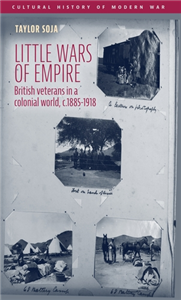 June 2026
Little wars of empire
British veterans in a colonial world, c.1885–1918
by Taylor Soja
Little Wars of Empire is a group biography of British veterans who experienced multiple wars across the British empire. Throughout the nineteenth century, Britain was constantly at war in its colonies, defending against anti-colonial resistance or trying to expand its influence. The veterans of these wars did not disappear once they were over, and many of them went on to later experience World War I. By using personal sources such as letters, diaries, and photograph albums, this book works to show how colonial violence and British military history depend upon one another, and argues that colonial war fundamentally shaped the British experience of empire. This was true for all kinds of British veterans, from British Army soldiers and officers to nurses and military families, whose experiences demonstrate the central place of colonial violence to British life.
-
Trusted Partner
 Humanities & Social SciencesJanuary 2022
Exiting war
The British Empire and the 1918–20 moment
by Romain Fathi, Margaret Hutchison, Andrekos Varnava, Michael Walsh, Alan Lester
Exiting war explores a particular 1918-20 'moment' in the British Empire's history, between the First World War's armistices of 1918, and the peace treaties of 1919 and 1920. That moment, we argue, was a challenging and transformative time for the Empire. While British authorities successfully answered some of the post-war tests they faced, such as demobilisation, repatriation, and fighting the widespread effects of the Spanish flu, the racial, social, political and economic hallmarks of their imperialism set the scene for a wide range of expressions of loyalties and disloyalties, and anticolonial movements. The book documents and conceptualises this 1918-20 'moment' and its characteristics as a crucial three-year period of transformation for and within the Empire, examining these years for the significant shifts in the imperial relationship that occurred and as laying the foundation for later change in the imperial system.
-
Trusted Partner
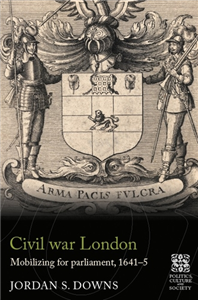 Humanities & Social SciencesSeptember 2023
Civil war London
Mobilizing for parliament, 1641–5
by Jordan S. Downs
This book looks at London's provision of financial and military support for parliament's war against King Charles I. It explores for the first time a series of episodic, circumstantial and unique mobilisations that spanned from late 1641 to early 1645 and which ultimately led to the establishment of the New Model Army. Based on research from two-dozen archives, Civil war London charts the successes and failures of efforts to move London's vast resources and in the process poses a number of challenges to longstanding notions about the capital's 'parliamentarian' makeup. It reveals interactions between London's Corporation, parochial communities and livery companies, between preachers and parishioners and between agitators, propagandists and common people. Within these tangled webs of political engagement reside the untold stories of the movement of money and men, but also of parliament's eventual success in the English Civil War.
-
Trusted Partner
 Humanities & Social SciencesJanuary 2021
Brothers in the Great War
by Linda Maynard, Penny Summerfield
-
Trusted Partner

 May 2022
In the Shadow of War
Diary notes from Ukraine
by Christoph Brumme
"What can you learn in war? Do you become numb, do you get used to it at some point? Does war make you "hard", uncaring, above pain? No. These are just clichés. Every day brings new horrors. At best, one learns for some time to suppress strong feelings, because to give in to them would weaken one's life instinct." In a very stirring and shocking, but sometimes humorous language, Christoph Brumme tells of the situation in Ukraine, the everyday life of his family and friends, of fears, longings and political assessments. The diary entries of the war and the resistance of the Ukrainians, starting from the first signs of the impending war in mid-January 2022 until the printing of this book, 1st May 2022, impressively bear witness to the brutality of these events.
-
Trusted Partner
 Humanities & Social SciencesMarch 2026
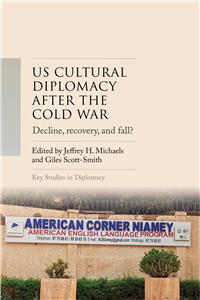
US cultural diplomacy after the Cold War
Decline, recovery, and fall
by Jeffrey H. Michaels, Giles Scott-Smith
In the decades following the USSR's collapse, the US has gone from unrivalled hegemon to a position of relative decline. With America 'triumphant' after 1991, its culture, like its diplomatic, military and economic power, remained unmatched. Such favourable circumstances seemed to undercut the need for cultural diplomacy. Why should the US government sell a product that was already selling so well? After 9/11, however, it was apparent the US image was less popular than previously assumed. To reverse this negative image, cultural diplomacy was revived. Despite being beset by internal and external challenges, US officials supported various cultural initiatives and partnerships to promote the American brand globally. Along the way, cultural diplomacy has made use of new forms of expression to promote American culture and build positive foreign relations. The arrival of the second Trump administration in 2025 has clearly signalled an end to using cultural diplomacy to further causes of empowerment and diversity, making the future uncertain for this field of activity.
-
Trusted Partner
 Humanities & Social SciencesJune 2022
Understanding governance in contemporary Japan
by Masahiro Mogaki
-
Trusted Partner
 Literature & Literary StudiesMarch 2017
Asia in Western fiction
by Robin Winks
Any reader who has ever visited Asia knows that the great bulk of Western-language fiction about Asian cultures turns on stereotypes. This book, a collection of essays, explores the problem of entering Asian societies through Western fiction, since this is the major port of entry for most school children, university students and most adults. In the thirteenth century, serious attempts were made to understand Asian literature for its own sake. Hau Kioou Choaan, a typical Chinese novel, was quite different from the wild and magical pseudo-Oriental tales. European perceptions of the Muslim world are centuries old, originating in medieval Christendom's encounter with Islam in the age of the Crusades. There is explicit and sustained criticism of medieval mores and values in Scott's novels set in the Middle Ages, and this is to be true of much English-language historical fiction of the nineteenth and early twentieth centuries. Even mediocre novels take on momentary importance because of the pervasive power of India. The awesome, remote and inaccessible Himalayas inevitably became for Western writers an idealised setting for novels of magic, romance and high adventure, and for travellers' tales that read like fiction. Chinese fictions flourish in many guises. Most contemporary Hong Kong fiction reinforced corrupt mandarins, barbaric punishments and heathens. Of the novels about Japan published after 1945, two may serve to frame a discussion of Japanese behaviour as it could be observed (or imagined) by prisoners of war: Black Fountains and Three Bamboos.
-
Trusted Partner
 Humanities & Social SciencesAugust 2012
French crime fiction and the Second World War
by Claire Gorrara, Bertrand Taithe, Penny Summerfield, Peter Gatrell, Max Jones, Ana Carden-Coyne
-
Trusted Partner
 The ArtsJune 2026
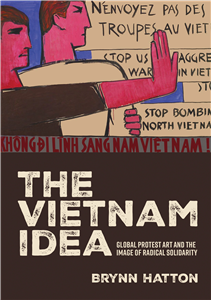
The Vietnam idea
Global protest art and the image of radical solidarity
by Brynn Hatton
The Vietnam idea examines how Vietnam became a potent symbol for global movements fighting colonialism, racism, and imperialism during the American War and its aftermath. Rather than focusing on Vietnam as a place, Brynn Hatton explores how artists and activists around the world used the idea of 'Vietnam' to express political identification and solidarity through posters, films, protest actions, exhibitions, and conceptual art. Drawing on international archives, the book reveals how diverse visual works helped shape the political imagination of the global left, and continue to influence how we see identity, conflict, and solidarity today.


