
Your Search Results


-
Promoted Content

 Humanities & Social SciencesDecember 2025
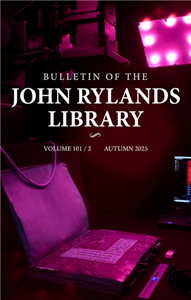
Bulletin of the John Rylands Library 101/2
Imaging Heritage Science Initiatives at The John Rylands Research Institute and Library
by Stefan Hanß, James Robinson
The John Rylands Library houses one of the finest collections of rare books, manuscripts and archives in the world. The collections span five millennia, have a global reach and cover a wide range of subjects, including art and archaeology; economic, social, political, religious and military history; literature, drama and music; science and medicine; theology and philosophy; travel and exploration. For over a century, the Bulletin of the John Rylands Library has published research that complements the Library's special collections. An electronic edition of this issue is freely available under a Creative Commons (CC BY-NC-ND) licence.
-
Promoted Content
 Literature & Literary StudiesJuly 2025
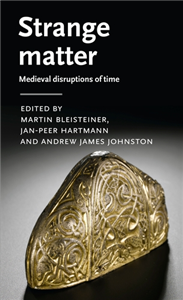
Strange matter
Medieval disruptions of time
by Martin Bleisteiner, Jan-Peer Hartmann, Andrew James Johnston
Medieval and early modern texts reflect a fascination with material objects, from ancient heirlooms to ingenious automata. Often imbued with power or beauty, these objects carry an uncanny sense of otherness, their mysterious origins evoking wonder and suggesting temporal and spatial distance. Acting as repositories of temporal alterity, such artefacts bridge the past and present in profound ways. This volume, featuring contributions from experts in literature and art history, explores how texts from these periods use material objects to engage with temporal otherness. From everyday items to marvellous creations, objects challenge distinctions between human and material, natural and cultural. Whether examining the hybrid status of Hector's body in Lydgate's Troy Book or the temporal agency of humble bubbles, the chapters illuminate the vibrant networks connecting people and objects. By highlighting the 'hybridity' of matter, the book offers fresh insights into Bruno Latour's critique of nature-culture divides.
-
 Trusted Partner
 Literature & Literary StudiesOctober 2023
The penny politics of Victorian popular fiction
by Rob Breton
Penny politics offers a new way to read early Victorian popular fiction such as Jack Sheppard, Sweeney Todd, and The Mysteries of London. It locates forms of radical discourse in the popular literature that emerged simultaneously with Brittan's longest and most significant people's movement. It listens for echoes of Chartist fiction in popular fiction. The book rethinks the relationship between the popular and political, understanding that radical politics had popular appeal and that the lines separating a genuine radicalism from commercial success are complicated and never absolute. With archival work into Newgate calendars and Chartist periodicals, as well as media history and culture, it brings together histories of the popular and political so as to rewrite the radical canon.
-
Trusted Partner
 Literature & Literary StudiesJuly 2025
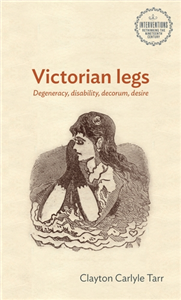
Victorian legs
Degeneracy, disability, decorum, desire
by Clayton Tarr
Victorian legs is about the science (sometimes spurious) and sexuality (often frivolous) of legs during the Victorian period. The book argues that legs occupy a particularly vexed position in Victorian culture. Strong legs formed the foundation (or the columns) of the civilized subject, but the politics of who could show their legs remained gendered. For the most part, men exhibited and admired, while women concealed and demurred. This book not only joins and advances the lively critical discourse on the Victorian body, but also marks new paths to pursue. While legs made us human, they could also dehumanize.
-
Trusted Partner

 November 2023
Pride
This damn superiority
by Ulla Steuernagel
Lucifer and Icarus are the best-known figures in the ancestral gallery of the arrogant. Pride, the original sin, or hubris, also known as class conceit, arrogance, vanity, haughtiness and narcissism, is widespread in many facets. We find celebrities from the past and present, fiction and reality, in this Cabinet of Sinners.
-
Trusted Partner
 Humanities & Social SciencesMarch 2025
Straight nation
Heteronormativity and other exigencies of postcolonial nationalism
by Pavan Mano
In Straight Nation, Pavan Mano reveals the logic of straightness that sits at the heart of postcolonial nationalism in Singapore. Mano rejects the romantic notion of the nation as a haven of belonging, showing it to be a relentless force that is allied with heteronormativity to create a host of minoritized and xenologized figures. Through meticulous exploration and close reading of a swathe of texts, Mano unveils the instrumental role of sexuality in structuring the national imaginary. The book adroitly demonstrates how queerness is rendered foreign in postcolonial Singapore and functions alongside technologies of "race", gender, and class. A provocative critique of narrow contemporary identity politics and its concomitant stymying of a more ambitious political critique, Straight Nation sets out an argument that moves beyond the negativity of traditional critique into a space of (re)thinking, (re)building and (re)imagining.
-
Trusted Partner
 Literature & Literary StudiesJune 2017
Victorian demons
Medicine, masculinity, and the Gothic at the fin-de-siècle
by Andrew Smith
Victorian demons provides the first extensive exploration of largely middle-class masculinities in crisis at the fin de siècle. It analyses how ostensibly controlling models of masculinity became demonised in a variety of literary and medical contexts, revealing the period to be much more ideologically complex than has hitherto been understood, and makes a significant contribution to Gothic scholarship. Andrew Smith demonstrates how a Gothic language of monstrosity, drawn from narratives such as 'The Strange Case of Dr Jekyll and Mr Hyde' and 'Dracula', increasingly influenced a range of medical and cultural contexts, destabilising these apparently dominant masculine scripts. He provides a coherent analysis of a range of examples relating to masculinity drawn from literary, medical, legal and sociological contexts, including Joseph Merrick ('The Elephant Man'), the Whitechapel murders of 1888, Sherlock Holmes's London, the writings and trials of Oscar Wilde, theories of degeneration and medical textbooks on syphilis.
-
Trusted Partner
 Geography & the EnvironmentNovember 2013
1 Angel Square
The Co-operative Group's new head office
by Len Grant
This book charts the building of 1 Angel Square, the remarkable new head office for The Co-operative Group in Manchester's new NOMA district. Combining text and photographs to illustrate the building from commissioning to completion, Len Grant has interviewed the whole project team - clients, architects, engineers, project managers and builders - and has had unreserved access to document the creation of this already award-winning structure. The design of 1 Angel Square by the architects 3DReid, is currently the UK's highest BREEAM (Building Research Establishment's Environmental Assessment Method) rated office building to date, and it is set to be one of the most sustainable buildings in Europe. 1 Angel Square, the book, is an intimate record of this fascinating building. Some of the impressive facts include: 3,157 internal and external window panels make up the façade; there are 10,500 data and power outlets; it sits on 539 foundation piles, with an average depth of 18 metres below ground; and there are approximately 22km of power cables. This book will be required reading for students of architecture and construction, sustainability studies and urban planning, and for those with an interest in the history of one of the world's great businesses. ;
-
Trusted Partner

 October 2017
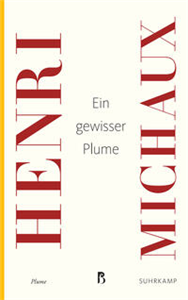
Ein gewisser Plume
by Henri Michaux, Kurt Leonhard
Der Dreh- und Angelpunkt dieser tollkühnen Textsammlung – ein gewisser »Plume« – ist ein Meister der absurden Welterfahrung. Tut ihm sein Finger weh, wird er ihm von einem eifrigen Chirurgen amputiert. Bestellt Plume in einem Restaurant ein Gericht, das nicht auf der Karte steht, wird er in einem kafkaesken Spektakel von Polizei und Geheimdienst gejagt. Eine Königin nötigt ihn so lange zum Liebesspiel, bis ihr Gemahl das Schlafgemach betritt. Und in einem Augenblick dummer Zerstreutheit läuft Plume »mit den Füßen über die Zimmerdecke, anstatt sie am Boden zu behalten. Als er dessen gewahr wurde, war es leider zu spät«. Henri Michaux, Reisender in wirklicher und imaginärer Fremde und Experimentator verborgener Bewusstseinsräume, hat mit der Gestalt des Plume eine prägnante wie tragische Spielfigur seiner eigenen Phantasie geschaffen. Die Prosatexte, Gedichte und Kurzdramen des vorliegenden Bandes offenbaren die Absurdität unhinterfragter Glaubenssätze und Verhaltenscodices. Zugleich kann Ein gewisser Plume auch als Hommage an alles Abseitige, Komische und Verquere gelesen werden. Michaux, der sich zunächst den Surrealisten nahe fühlte, widmete sich nach seinen ersten literarischen Publikationen verstärkt der Malerei und Experimenten mit Meskalin, über die er später viel beachtete Bücher schrieb. Als Künstler nahm er mehrmals an der Documenta teil, 1960 wurde ihm auf der Biennale von Venedig der Einaudi-Preis verliehen.
-
Trusted Partner
-
Trusted Partner
 Literature & Literary StudiesJune 2021
The penny politics of Victorian popular fiction
by Rob Breton, Anna Barton, Andrew Smith
-
Trusted Partner
-
Trusted Partner
 Humanities & Social SciencesJanuary 2025
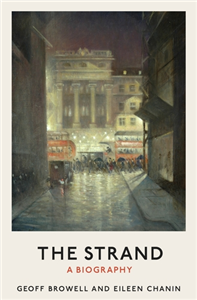
The Strand
A biography
by Geoff Browell, Eileen Chanin
The first history of one of London's most extraordinary streets. Running along the Thames's northern shore and spanning three-quarters of a mile from Trafalgar Square to Temple Bar, the Strand has been a witness to London's growth and change from the earliest years of the city's existence. In The Strand: A biography, Geoff Browell and Eileen Chanin uncover the deep history of this remarkable street. Tracing its origins in the Roman era, they reveal how it grew in importance as authority shifted from church to aristocracy, then to commerce, media and law. Over time, everything that mattered converged on the Strand: tradition and ceremony clashed with rebellion and destitution. By 1910, the street was known as the 'centre of the world'. Drawing on remarkable archival discoveries, Browell and Chanin present the most complete and compelling history of the Strand ever written. Filled with surprising, untold stories, The Strand: A biography is a must-read for lovers of one of the world's greatest cities.
-
Trusted Partner
-
Trusted Partner
 Humanities & Social SciencesJuly 2020
Victorian literary culture and ancient Egypt
by Eleanor Dobson
-
Trusted Partner
 The ArtsSeptember 2025
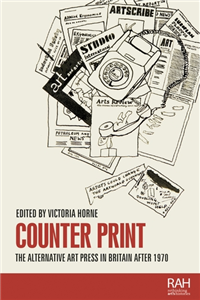
Counter print
The alternative art press in Britain after 1970
by Victoria Horne
The history of contemporary art is also a history of its newsletters, manifestos, magazines, pamphlets, and journals. Those periodical publications do not simply communicate or record ideas but have worked in exciting ways to shape art's practices, histories and communities. As a new generation of artists, activists and scholars seek to uncover the histories of alternative publishing and artistic networks, this book gathers original archival discoveries while offering methodologies for studying and thinking with those artefacts. As the first essay collection to focus on the periodical art press and the ways we study it, Counter print offers readers an alternative route into the past fifty years of contemporary art, one that is defiantly collaborative, border crossing and disruptive.
-
Trusted Partner

 Psychology
Up and Down
by Johanna Selge
The graphic novel uses expressive, humorousimages to make the topics ofmental health, depression and anxietydisorders in children and young peopleunderstandable. The first part of thenovel tells the story of 16-year-oldNoah.The second part provides informationto better understand mentalprocesses and strategies to deal withchallenges in a self-effective way. Withits preventative programme, “Up andDown” aims to strengthen the resilienceof all young people.
-
Trusted Partner
Literature & Literary StudiesMarch 2024
Borrowed objects and the art of poetry
Spolia in Old English verse
by Denis Ferhatovic
This study examines Exeter riddles, Anglo-Saxon biblical poems (Exodus, Andreas, Judith) and Beowulf in order to uncover the poetics of spolia, an imaginative use of recycled fictional artefacts to create sites of metatextual reflection. Old English poetry famously lacks an explicit ars poetica. This book argues that attention to particularly charged moments within texts - especially those concerned with translation, transformation and the layering of various pasts - yields a previously unrecognised means for theorising Anglo-Saxon poetic creativity. Borrowed objects and the art of poetry works at the intersections of materiality and poetics, balancing insights from thing theory and related approaches with close readings of passages from Old English texts.
-
Trusted Partner
 The ArtsSeptember 2019
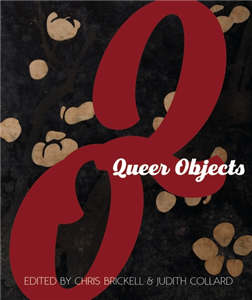
Queer Objects
by Chris Brickell, Judith Collard
Queer lives give rise to a vast array of objects: the things we fill our houses with, the gifts we share with our friends, the commodities we consume at work and at play, the clothes and accessories we wear, and the analogue and digital technologies we use to communicate with one another. But what makes an object queer? The sixty-three chapters in Queer Objects consider this question in relation to lesbian, gay and transgender communities across time, cultures and space. In this unique international collaboration, well-known and newer writers traverse world history to write about items ranging from ancient Egyptian tomb paintings and Roman artefacts to political placards, snapshots, sex toys and the smartphone. Fabulous, captivating, transgressive.
-
Trusted Partner
Children's & YADecember 2023
QuBuild
A guided approach to asking better scientific questions in primary schools
by Lynne Bianchi, Tina Whittaker
This book brings a new classroom approach for primary teachers to teach the explicit knowledge of scientific question-asking. This is an essential skill when children are involved in finding out about the world around them through science enquiry. Challenging the assumption that because children ask lots of questions in science, this automatically leads to meaningful learning of the enquiry curriculum, QuBuild is important for all children developing as scientific thinkers. It outlines an approach to explicitly plan for, practice and develop the craft of scientific question-asking. Unlock your children's science learning potential by exploring the QuBuild Process.



