
Your Search Results
-

-

Agencia Literaria Latinoamericana
The Latin American Literary Agency (ALL) was founded in 1986 with headquarters in Havana. It exercises, in matters of copyright, the legal representation of Cuban writers and other Latin American countries for all the languages and regions of the world. Represents and promotes authors in the fields of fiction and nonfiction, children and youth, scientific-technical and social sciences. The ALL has a wide catalog that includes writers of universal stature, several National Literature Awards and recognized contemporary authors and new generations.
View Rights Portal
-
Promoted Content

 Humanities & Social SciencesNovember 2025
Law, society and political culture in late medieval and Reformation Germany
by Duncan Hardy
-
Promoted Content
 Literature & Literary StudiesJanuary 2013
Popular protest in late-medieval Europe
Italy, France and Flanders
by Samuel Kline Cohn
The documents in this stimulating volume span from 1245 to 1424 but focus on the 'contagion of rebellion' from 1355 to 1382 that followed in the wake of the plague. They comprise a diversity of sources and cover a variety of forms of popular protest in different social, political and economic settings. Their authors range across a wide political and intellectual horizon and include revolutionaries, the artistocracy, merchants and representatives from the church. They tell gripping and often gruesome stories of personal and collective violence, anguish, anger, terror, bravery, and foolishness. Of over 200 documents presented here, most have been translated into English for the first time, providing students and scholars with a new opportunity to compare social movements across Europe over two centuries, allowing a re-evaluation of pre-industrial revolts, the Black Death and its consequences for political culture and action. This book will be essential reading for those seeking to better understand popular attitudes and protest in medieval Europe.
-
 Trusted Partner
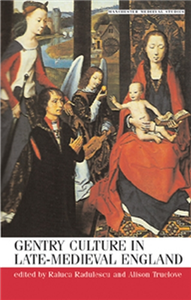 Humanities & Social SciencesJanuary 2006
Gentry culture in late-medieval England
by Raluca Radulescu, Steve Rigby, Alison Truelove
Essays in this fascinating and important collection examine the lifestyles and attitudes of the gentry in late medieval England. They consider the emergence of the gentry as a group distinct from the nobility, and explore the various available routes to gentility. Through surveys of the gentry's military background, administrative and political roles, social behaviour, and education, the reader is provided with an overview of how the group's culture evolved, and how it was disseminated. Studies of the gentry's literacy, creation and use of literature, cultural networks, religious activities and their experiences of music and the visual arts more directly address the practice and expression of this culture, exploring the extent to which the gentry's activities were different from those of the wider population. Joining the editors in contributing essays to this collection is an impressive array of eminent scholars, all specialists in their respective fields: Christine Carpenter, Peter Fleming, Maurice Keen, Philippa Maddern, Nicholas Orme, Tim Shaw, Thomas Tolley and Deborah Youngs. As a whole, the book offers a broad view of gentry culture that explores, reassesses, and sometimes even challenges the idea that members of the gentry cultivated their own distinctive cultural identity. It will appeal to students looking for a comprehensive introduction to late medieval gentry culture, as well as to researchers interested in gentry studies more generally. ;
-
Trusted Partner
 Literature & Literary StudiesJanuary 2013
The towns of Italy in the later Middle Ages
by Trevor Dean
The towns of Italy in the later middle ages presents over one hundred fascinating documents, carefully selected and coordinated from the richest, most innovative and most documented society of the European Middle Ages. No other English language sourcebook has the same geographical or chronological range. This collection is carefully structured around the crisis of the fourteenth century and arranged in contrasting groups of texts. By connecting documents in translation to recent scholarship and debates, it addresses five key areas of medieval urban history: the physical environment, civic religion, economy, society and politics. Offers students well-translated and effectively contextualised documents along with some guidance to the secondary work of Italian scholars which is largely inaccessible to undergraduate students.
-
Trusted Partner
 Humanities & Social SciencesJuly 1997
Picturing women in late medieval and renaissance art
by Christa Grossinger
This extensively illustrated book discusses the representation of women in the art of the late Middle Ages in Northern Europe. Drawing on a wide range of different media, but making particular use of the rich plethora of woodcuts, the author charts how the images of women changed during the period and proposes two basic categories - the Virgin and Eve, good and evil. Within these, however, we discover attitudes to sinful, foolish, married and unmarried women and the style and use of these images exposes the full extent of the misogyny entrenched in medieval society. ;
-
Trusted Partner
-
Trusted Partner
 Humanities & Social SciencesJanuary 2013
Crime, Law and Society in the Later Middle Ages
by Anthony Musson, Edward Powell
This book provides an accessible collection of translated legal sources through which the exploits of criminals and developments in the English criminal justice system (c.1215-1485) can be studied. Drawing on the wealth of archival material and an array of contemporary literary texts, it guides readers towards an understanding of prevailing notions of law and justice and expectations of the law and legal institutions. Tensions are shown emerging between theoretical ideals of justice and the practical realities of administering the law during an era profoundly affected by periodic bouts of war, political in-fighting, social dislocation and economic disaster. Introductions and notes provide both the specific and wider legal, social and political contexts in addition to offering an overview of the existing secondary literature and historiographical trends. This collection affords a valuable insight into the character of medieval governance as well as revealing the complex nexus of interests, attitudes and relationships prevailing in society during the later Middle Ages.
-
Trusted Partner
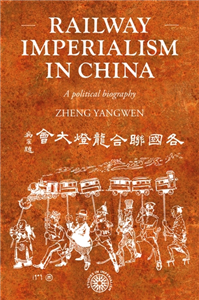 March 2026
Railway imperialism in China
A political biography
by Yangwen Zheng
Railway Imperialism in China: a Political Biography is the first and most comprehensive book on history and politics of all major railways in China from the late Qing to the post-Mao era. It investigates the transformation of railways from a bête noire within discussions about reform to the emblematic "engines for empire" as foreign powers used it to carve outspheres of control and exploit the late Qing, and as an instrument of nation making for Chinese regimes. The book introduces new archival sources and a wide range of secondary materials. Boldly conceived, it situates the making of modern China in the context of British, Russian, German, Japanese, American expansion. It traces China's transformation from a victim of railway imperialism in the Age of Empireto a railway expansionist in the twenty-first century.
-
Trusted Partner
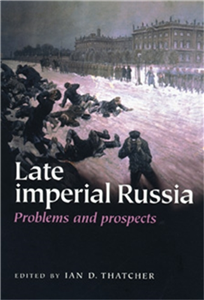 Humanities & Social SciencesJuly 2005
Late Imperial Russia
Problems and prospects
by Ian Thatcher
This volume offers a detailed examination of the stability of the late imperial regime in Russia. Students and scholars will appreciate the lively summaries of the latest scholarship in political, economic, social, cultural, and international history. Accessible yet insightful, contributions cover the historiography of complex topics such as peasants, workers, revolutionaries, foreign relations, and Nicholas II. In addition, there are original studies of some of the leading intellectuals of the time. The late imperial economy is examined through the writings of Tugan-Baranovsky. There is an account of M. N. Pokrovskii's radical interpretation of late imperial Russia's historical path of development. The state of the Russian theatre is studied through the lives of theatrical impresarios. Each chapter also highlights a unique interpretation, suggesting new lines of inquiry and research. This book will be compulsory reading for students of Russian and European history of the late nineteenth and early twentieth centuries seeking to better understand why Tsarism collapsed in 1917. ;
-
Trusted Partner
 Business, Economics & LawMay 2024
Deep transformations
by Hubert Buch-Hansen, Max Koch, Iana Nesterova
-
Trusted Partner
 Humanities & Social SciencesJanuary 2013
The Black Death
by Rosemary Horrox
This series provides texts central to medieval studies courses and focuses upon the diverse cultural, social and political conditions that affected the functioning of all levels of medieval society. Translations are accompanied by introductory and explanatory material and each volume includes a comprehensive guide to the sources' interpretation, including discussion of critical linguistic problems and an assessment of recent research on the topics covered. From 1348 to 1350 Europe was devastated by an epidemic that left between a third and one half of the population dead. This source book traces, through contemporary writings, the calamitous impact of the Black Death in Europe, with a particular emphasis on its spread across England from 1348 to 1349. Rosemary Horrox surveys contemporary attempts to explain the plague, which was universally regarded as an expression of divine vengeance for the sins of humankind. Moralists all had their particular targets for criticism. However, this emphasis on divine chastisement did not preclude attempts to explain the plague in medical or scientific terms. Also, there was a widespread belief that human agencies had been involved, and such scapegoats as foreigners, the poor and Jews were all accused of poisoning wells. The final section of the book charts the social and psychological impact of the plague, and its effect on the late-medieval economy.
-
Trusted Partner
The ArtsNovember 2023
Colouring the Caribbean
Race and the art of Agostino Brunias
by Mia L. Bagneris
Colouring the Caribbean offers the first comprehensive study of Agostino Brunias's intriguing pictures of colonial West Indians of colour - so called 'Red' and 'Black' Caribs, dark-skinned Africans and Afro-Creoles, and people of mixed race - made for colonial officials and plantocratic elites during the late-eighteenth century. Although Brunias's paintings have often been understood as straightforward documents of visual ethnography that functioned as field guides for reading race, this book investigates how the images both reflected and refracted ideas about race commonly held by eighteenth-century Britons, helping to construct racial categories while simultaneously exposing their constructedness and underscoring their contradictions. The book offers provocative new insights about Brunias's work gleaned from a broad survey of his paintings, many of which are reproduced here for the first time.
-
Trusted Partner
 Literature & Literary StudiesJanuary 2013
Late Merovingian France
by Paul Fouracre, Richard A. Gerberding
This collection of documents in translation brings together the seminal sources for the late Merovingian Frankish kingdom. It inteprets the chronicles and saint's lives rigorously to reveal new insights into the nature and significance of sanctity, power and power relationships. The book makes available a range of 7th- and early 8th-century texts, five of which have never before been translated into English. It opens with a broad-ranging explanation of the historical background to the translated texts and then each source is accompanied by a full commentary and an introductory essay exploring its authorship, language and subject matter. The sources are rich in the detail of Merovingian political life. Their subjects are the powerful in society and they reveal the successful interplay between power and sanctity, a process which came to underpin much of European culture throughout the early Middle Ages.
-
Trusted Partner
 Literature & Literary StudiesMarch 1996
Late Merovingian France
by Paul Fouracre
This collection of documents in translation brings together the seminal sources for the late Merovingian Frankish kingdom. It inteprets the chronicles and saint's lives rigorously to reveal new insights into the nature and significance of sanctity, power and power relationships. The book makes available a range of 7th- and early 8th-century texts, five of which have never before been translated into English. It opens with a broad-ranging explanation of the historical background to the translated texts and then each source is accompanied by a full commentary and an introductory essay exploring its authorship, language and subject matter. The sources are rich in the detail of Merovingian political life. Their subjects are the powerful in society and they reveal the successful interplay between power and sanctity, a process which came to underpin much of European culture throughout the early Middle Ages. ;
-
Trusted Partner
 Humanities & Social SciencesJanuary 2011
The Unorthodox Imagination in Late Medieval Britain
by Sophie Page, Julian Hoppit
The unorthodox imagination in late medieval Britain explores how medieval people responded to images, stories, beliefs and practices which were at odds with the normative world view, from the heretical and subversive to the marvellous and exotic. The chapter by Jean-Claude Schmitt examines why some unorthodox images were viewed as provocative and threatening and explores how successfully ecclesiastical authorities contained their impact. The power of unorthodoxy to provoke wonder, scepticism or disapproval provides an opportunity to view medieval culture from fresh perspectives. The essays in this volume show that unorthodoxy was embedded in mainstream medieval culture, from stories of fairies and witches which promoted orthodox moral values to the social conformity of practitioners of ritual magic. This book provides a guide to understanding medieval unorthodoxy and the roles played by experience and imagination in medieval encounters with the unorthodox. It will be essential reading for anyone interested in the exotic, provocative and deviant in medieval culture. ;
-
Trusted Partner
 Humanities & Social SciencesAugust 2006
Political culture in later medieval England
Essays by Simon Walker
by Mike Braddick
This is an important collection of pioneering essays penned by the late Simon Walker, a highly respected historian of late medieval England. One of the finest scholars of his generation, Walker's writing is lucid, inspirational, and has permanently enriched our understanding of the period. The eleven essays featured here examine themes such as kingship, lordship, warfare and sanctity. There are specific studies on subjects such as the changing fortunes of the family of Sir Richard Abberbury; Yorkshire's Justices of the Peace; the service of medieval man-at-arms, Janico Dartasso; Richard II's views on kingship, political saints, and an investigation of rumour, sedition and popular protest in the reign of Henry IV. An introduction by G.L. Harriss looks back across Walker's career, and discusses the historiographical context of his work. Both the new and previously published pieces here will be essential reading for those working on the late medieval period. ;
-
Trusted Partner
 Humanities & Social SciencesJanuary 2020
Political culture in later medieval England
Essays by Simon Walker
by Michael J. Braddick
This is an important collection of pioneering essays penned by the late Simon Walker, a highly respected historian of late medieval England. One of the finest scholars of his generation, Walker's writing is lucid, inspirational, and has permanently enriched our understanding of the period. The eleven essays featured here examine themes such as kingship, lordship, warfare and sanctity. There are specific studies on subjects such as the changing fortunes of the family of Sir Richard Abberbury; Yorkshire's Justices of the Peace; the service of medieval man-at-arms, Janico Dartasso; Richard II's views on kingship, political saints, and an investigation of rumour, sedition and popular protest in the reign of Henry IV. An introduction by G.L. Harriss looks back across Walker's career, and discusses the historiographical context of his work. Both the new and previously published pieces here will be essential reading for those working on the late medieval period.
-
Trusted Partner
 Literature & Literary StudiesMay 2018
Participatory reading in late-medieval England
by Heather Blatt, David Matthews, Anke Bernau
-
Trusted Partner
 Humanities & Social SciencesJanuary 2020
Gentry culture in late-medieval England
by S. H. Rigby, Raluca Radulescu, Alison Truelove
-
Trusted Partner


