
Your Search Results
-

-

Modjaji Books
Modjaji Books is a small, independent, feminist publishing company, that started in 2007 in Cape Town.
View Rights Portal
-
Promoted Content

 Humanities & Social SciencesJuly 2020
The modernisation of the Labour Party, 1979–97
by Christopher Massey
-
Promoted Content
 Humanities & Social SciencesSeptember 2013
The Spanish Socialist Party and the modernisation of Spain
by Paul Kennedy, Steven Fielding, John Callaghan, Steve Ludlam
This book considers the most electorally successful political party in Spain, the Spanish Socialist Workers' Party (PSOE), which was in government for two of the three decades since it won office under Felipe González in 1982. Providing rich historical background, the book's main focus is on the period since General Franco's death in 1975. It charts Spain's modernisation under the PSOE, with a particular focus on the role played by European integration in this process. Covering events including the 2011 general election, the book is one of the most up-to-date works available in English and will be of great interest to academics and undergraduate and postgraduate students in the field of Spanish and European studies. ;
-
 Trusted Partner
-
Trusted Partner
-
Trusted Partner
 Social & political philosophyJanuary 2017
Subjects of modernity
Time-space, disciplines, margins
by Saurabh Dube. Series edited by Professor Gurminder K. Bhambra
This book thinks through modernity and its representations by drawing in critical considerations of time and space. It explores the oppositions and enchantments, the contradictions and contentions, and the identities and ambivalences spawned under modernity as constitutive of our worlds. Instead of assuming a straightforward, singular trajectory of the phenomena, it discusses modernity as involving checkered, contingent and contended processes of meaning and power over the past five centuries. Subjects of modernity considers the overlaps yet distinctions between modernity, modernism and modernisation, further imaginatively exploring the relationship between history and anthropology. Critically engaging historical anthropology, subaltern studies, de-colonial understandings, and post-colonial procedures, it at once offers an innovative understanding of cultural identities and imaginatively reassess critical perspectives, from South Asia to Latin America. This book will be of interest to students and scholars of anthropology, history, sociology, post-colonial studies and cultural geography, among other subjects, finding adoption in different courses/seminars across disciplines.
-
Trusted Partner
 Literature & Literary StudiesAugust 2024
Instead of modernity
The Western canon and the incorporation of the Hispanic (c. 1850–75)
by Andrew Ginger
Instead of modernity goes to the very heart of comparative cultural study: the question of what happens when intimate, dynamic connections are made over place and time, what it is to feel at home amid the lavish diversity of culture. This ambitious interdisciplinary book reconsiders foundational figures of the modern western canon, from Darwin to Cameron, Baudelaire to Whistler. It weaves together brain images from France, preserved insects from the Americas, glass in London, poetry from Argentina, paintings from Spain. Flaubert, Whitman, and Nietzsche find themselves with Hostos from Puerto Rico and Gorriti from Argentina. The book ranges over theoretical fields: trauma and sexuality studies, theories of visuality, the philosophy of sacrifice and intimacy, the thought of Wittgenstein. Instead of modernity is an adventure in the practice of comparative writing: resonances join suggestively over place and time, the textures of words, phrases and images combine to form moods.
-
Trusted Partner
 The ArtsOctober 2013
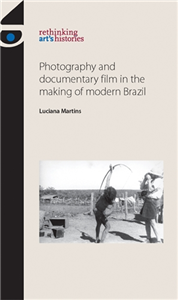
Photography and documentary film in the making of modern Brazil
by Luciana Martins, Amelia Jones, Marsha Meskimmon
Photography and documentary film in the making of modern Brazil provides a major contribution to the field of visual culture through a study of still and moving images of Brazil in the first four decades of the twentieth century, when the camera played a key role in making Brazilian peoples and places visible to a variety of audiences. The book explores what is distinctive about the visual representation of Brazil in an era of modernisation, also attending to the significance of the different technical properties of film and photography for the writing of new histories of visual technologies. It offers new insights into the work of key writers, photographers, anthropologists and filmmakers, including Claude Lévi-Strauss, Mário de Andrade, Silvino Santos and Aloha Baker. Unearthing a wealth of materials from archives in the USA, Britain, and Brazil, the book seeks to contribute to the postcolonial theoretical project of pinpointing locally distinctive histories of visual technologies and practices. ;
-
Trusted Partner
 Humanities & Social SciencesJuly 2026
Modernity and philosophy in Max Horkheimer
On the contemporary relevance of critical theory
by Raffaele Carbone
This book shows that Max Horkheimer's program of critical theory and his research throughout his career as a university professor and thinker are rooted in the cogency of philosophical questions and an in-depth knowledge of the historical development of philosophical problems in their close correlation with the socio-economic framework which shaped the 'bourgeois society' and the Modern Era. Indeed, his analyses of modern philosophers allows us to understand how the bourgeoisie seeks legitimisation and consolidation of its position, partly through the voices of its thinkers. In this way, in his investigation of early modern philosophy problems, and through constant dialogue with his colleagues Adorno, Marcuse, Pollock and Fromm, Horkheimer expresses a profound awareness of the critical force inherent in thought which, admittedly, is ever vulnerable to crisis and weakening, but which can always be reactivated.
-
Trusted Partner
 Literature & Literary StudiesOctober 2025
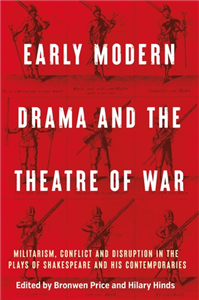
Early modern drama and the theatre of war
Militarism, conflict and disruption in the plays of Shakespeare and his contemporaries
by Bronwen Price, Hilary Hinds
This volume explores the disruptive effects of militarism, war and social unrest in early modern drama. Engaging with Simon Barker's seminal work on dramatic representations of war and militarism, contributors highlight what often lies hidden beneath the surface of martial narratives, treating them as formative interventions in contemporary discourses, whether in justifying war, excluding dissident voices or shaping cultural identities. Discussions include new examinations of militarism, the figure of the soldier and early modern theories of war in Shakespearean tragedy, history and comedy, alongside antimasque and dramatic satire by lesser-known playwrights. The essays investigate how ideas of war underpin emerging concepts of gender, leadership, marriage and the family, as well as the continuing mobilisation of Shakespearean drama in the context of modern armed conflict. Together, they offer rich new contributions to the current lively critical debates on this topic.
-
Trusted Partner
 Literature & Literary StudiesAugust 2025
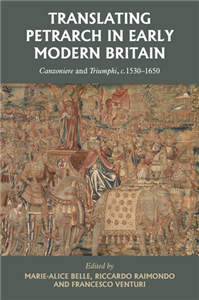
Translating Petrarch in early modern Britain
Canzoniere and Triumphi, c. 1530–1650
by Marie-Alice Belle, Riccardo Raimondo, Francesco Venturi
Translating Petrarch in early modern Britain gathers twelve essays by international scholars focusing on the translation of Petrarch's vernacular verse (Canzoniere and Triumphi) into English, from the Tudor age to the mid-seventeenth century (and beyond). Approaching translation as an interpretive process, but also a mode of literary emulation and cultural engagement with Petrarch's prestigious precedent, the collection explores the complex and interconnected trajectories of both poetic works in English and Scottish literary milieux. While situating each translation in its distinct historical, material, and literary context, the essays trace the reception of Petrarch's works in early modern Britain through the combined processes of linguistic and metric innovation, literary imitation, musical adaptation and cultural and material 'domestication'. The collection sheds light on the origins and development of early modern English Petrarchism as part of wider transnational - and indeed, translational-European literary culture.
-
Trusted Partner
 Literature & Literary StudiesJune 2022
The early modern English sonnet
Ever in motion
by Laetitia Sansonetti, Rémi Vuillemin, Enrica Zanin
This volume questions and qualifies commonly accepted assumptions about the early modern English sonnet: that it was a strictly codified form, most often organised in sequences, which only emerged at the very end of the sixteenth century and declined as fast as it had bloomed, and that minor poets merely participated in the sonnet fashion by replicating established conventions. Drawing from book history and relying on close reading and textual criticism, this collection offers a more nuanced account of the history of the sonnet. It discusses how sonnets were written, published and received in England as compared to mainland Europe, and explores the works of major (Shakespeare, Sidney, Spenser) and minor (Barnes, Harvey) poets alike. Reflecting on current editorial practices, it also provides the first modern edition of an early seventeenth-century Elizabethan miscellany including sonnets presumably by Sidney and Spenser.
-
Trusted Partner
The ArtsJune 2025
Death in modern theatre
Stages of mortality
by Adrian Curtin
Death in modern theatre offers a unique account of modern Western theatre, focusing on the ways in which dramatists and theatre-makers have explored historically informed ideas about death and dying in their work. It investigates the opportunities theatre affords to reflect on the end of life in a compelling and socially meaningful fashion. In a series of interrelated, mostly chronological, micronarratives beginning in the late nineteenth century and ending in the early twenty-first century, this book considers how and why death and dying are represented at certain historical moments using dramaturgy and aesthetics that challenge audiences' conceptions, sensibilities, and sense-making faculties. It includes a mix of well-known and lesser-known plays from an international range of dramatists and theatre-makers, and offers original interpretations through close reading and performance analysis.
-
Trusted Partner
 The ArtsDecember 2019
Screening the Paris suburbs
From the silent era to the 1990s
by Philippe Met, Annie Fourcaut, Roland-François Lack, Jean-Louis Pautrot, Keith Reader, Margaret Flinn, Eric Bullot, Tristan Jean, Malcolm Turvey, Elisabeth Cardonne-Arlyck, Térésa Faucon, Philippe Met, Camille Canteux, Derek Schilling, Guillaume Soulez, David Vasse, Derek Schilling
Decades before the emergence of a French self-styled 'hood' film around 1995, French filmmakers looked beyond the gates of the capital for inspiration and content. In the Paris suburbs they found an inexhaustible reservoir of forms, landscapes and social types in which to anchor their fictions, from bourgeois villas and bucolic riverside cafés to post-war housing estates and postmodern new towns. For the first time in English, contributors to this volume address key aspects of this long film history, marked by such towering figures as Jean Renoir, Jacques Tati and Jean-Luc Godard. Idyllic or menacing, expansive or claustrophobic, the suburb served divergent aesthetic and ideological programmes across the better part of a century. Themes central to French cultural modernity - class conflict, leisure, boredom and anti-authoritarianism - cut across the fifteen chapters.
-
Trusted Partner
 Socialism & left-of-centre democratic ideologiesJanuary 2014
The Spanish Socialist Party and the modernisation of Spain
by Paul Kennedy
-
Trusted Partner
 Literature & Literary StudiesOctober 2020
Instead of modernity
by Andrew Ginger, Andrew Smith, Anna Barton
-
Trusted Partner
 Literature & Literary StudiesAugust 2020
1913: The year of French Modernism
by Efthymia Rentzou, André Benhaïm
-
Trusted Partner

 October 2011
Unerfüllte Moderne?
Neue Perspektiven auf das Werk von Charles Taylor
by Michael Kühnlein, Matthias Lutz-Bachmann
Charles Taylor gehört zu den international renommiertesten Philosophen der Gegenwart. Sein Werk vereint Sozial- und politische Philosophie zu einer umfassenden Gütertheorie der Moderne. Als Vordenker des Kommunitarismus verteidigt er die normative Unhintergehbarkeit des Guten bei der Bestimmung des Menschen; als Theoretiker der Moderne kritisiert er den »Artikulationsstau« säkularer Großerzählungen. Der vorliegende Band, der aus Anlaß des 80. Geburtstages von Charles Taylor erscheint, beschäftigt sich mit zentralen Aspekten seines philosophischen Denkens. Er umfaßt Beiträge von Philosophen, Theologen, Soziologen und Juristen, darunter Christoph Menke, Karl Kardinal Lehmann, Hans Joas und Hartmut Rosa, sowie eine Replik von Charles Taylor.
-
Trusted Partner
-
Trusted Partner
 December 2014
Vergangenheit und Zukunft der Moderne
by Ulrich Beck, Martin Mulsow
Mit der Ankunft der Zeitgeschichtsschreibung in den siebziger und achtziger Jahren ist eine Reflexion auf die Geschichte der Moderne und ihre Vorgeschichte unabweisbar geworden. Es steht an, den internen Bruch zwischen »Erster« und »Zweiter« Moderne sowohl historisch als auch soziologisch zu verstehen. Zugleich muss dabei der Horizont einer Tiefenzeit der Moderne berücksichtigt werden, die weit hinter das 19. Jahrhundert zurückreicht, in die stufenweisen Modernisierungsschritte mindestens seit der Renaissance. Welche Konsequenzen haben solche Reflexionen für das soziologische Verständnis der »Zweiten Moderne« selbst? Wie ist unter diesen Umständen die Identität der Moderne zu verbürgen? Impliziert eine Identität der Moderne Kontinuitäten, die sich bei allen Brüchen durchhalten?
-
Trusted Partner
 October 1984
Die Struktur der Moderne
Grundmuster und differentielle Gestaltung des institutionellen Aufbaus der modernen Gesellschaften
by Richard Münch
Die Moderne verstehen – dies ist ein prominentes Thema der Soziologie. Richard Münch versucht in seinem neuen Buch, durch die soziologische Analyse ihres institutionellen Aufbaus zu einem Verständnis der Grundstruktur und der Strukturprobleme der modernen Gesellschaften zu gelangen. Im Vordergrund der Analyse steht zunächst die gemeinsame institutionelle Tiefenstruktur moderner Gesellschaften. Diese generalisierende Betrachtung wird dann durch die Analyse ihrer unterschiedlichen institutionellen Oberflächenstruktur im inter- und intrakulturellen Vergleich konkretisiert.



