Your Search Results
-

-

Narrative Landscape Press Ltd
Narrative Landscape Press is an independent publisher and a provider of publishing services and independent authors in Nigeria.
View Rights Portal
-
Promoted Content

 Literature & Literary StudiesJanuary 2023
The gift of narrative in medieval England
by Nicholas Perkins
This invigorating study places medieval romance narrative in dialogue with theories and practices of gift and exchange, opening new approaches to questions of storytelling, agency, gender and materiality in some of the most engaging literature from the Middle Ages. It argues that the dynamics of the gift are powerfully at work in romances: through exchanges of objects and people; repeated patterns of love, loyalty and revenge; promises made or broken; and the complex effects that time works on such objects, exchanges and promises. Ranging from the twelfth century to the fifteenth, and including close discussions of poetry by Chaucer, the Gawain-Poet and romances in the Auchinleck Manuscript, this book will prompt new ideas and debate amongst students and scholars of medieval literature, as well as anyone curious about the pleasures that romance narratives bring.
-
Promoted Content

 March 2021
Columbus, the Discarded Explorer
Disaster of the legendary sailor
by Wolfgang Wissler
There he stands, the man the whole of Spain cheered, before whom the most catholic regents Isabella and Ferdinand rose to their feet, his eyes on his ship Capitana, devoured by shipworm, stranded off Jamaica. Some of the crew mutiny, the locals can no longer be fobbed off with glass beads, the Spanish on the nearby island of Hispaniola do not help, the world doesn‘t want anything to do with him, the demanding whinger. He, Christopher Columbus, is a John Lackland, a king without land, a conqueror without conquest. Between fiction and historical truth, Wolfgang Wissler recounts the legendary sailor‘s last expedition in an entirely new way – and what a story it is!
-
 Trusted Partner
 July 2021
My Life with Viruses
A researcher’s history of the fascinating world of pathogens
by Ernst-Ludwig Winnacker in association with Jeanne Rubner
In times of the coronavirus pandemic many people have certainly condemned them, but Professor Ernst-Ludwig Winnacker has dedicated his life to researching them and is intrigued by viruses – even if sometimes he is keenly aware of their fatal effects. To mark his 80th birthday the biochemist describes the co-evolution and co-existence as well as the eternal ‘battle’ between humans and viruses. Winnacker takes up the cause of these ‘biological elements between animate and inanimate nature’ because they play an important role in fundamental research and genetic technology, and without them human beings would not be what they are.
-
Trusted Partner
 The ArtsJanuary 2019
Hispanic and Lusophone women filmmakers
Theory, practice and difference
by Parvati Nair, Julian Gutierrez-Albilla
This volume examines the films of Hispanic and Lusophone women filmmakers from the 1930s to the present day. It establishes productive connections between film practices across these geographical areas by identifying common areas of concern on the part of these female filmmakers. Focusing on aesthetic, theoretical and socio-historical analyses, it questions the manifest or latent gender and sexual politics that inform and structure the emerging cinematic productions by women filmmakers in Portugal, Spain, Latin America and the US. With a combination of scholars from the UK, the US, Spain and Latin America, the volume documents and interprets a fascinating corpus of films made by Hispanic and Lusophone women and proposes research strategies and methodologies that can expand our understanding of socio-cultural and psychic constructions of gender and sexual politics. An essential resource to rethink notions of gender identity and subjectivity, it is a unique contribution to Spanish and Latin American Film Studies and Film Studies.
-
Trusted Partner
 Humanities & Social SciencesJune 2023
Border images, border narratives
The political aesthetics of boundaries and crossings
by Johan Schimanski, Jopi Nyman
This interdisciplinary volume explores the role of images and narratives in different borderscapes. Written by experienced scholars in the field, Border images, border narratives provides fresh insight into how borders, borderscapes, and migration are imagined and narrated in public and private spheres. Offering new ways to approach the political aesthetics of the border and its ambiguities, this volume makes a valuable contribution to the methodological renewal of border studies and presents ways of discussing cultural representations of borders and related processes. Influenced by the thinking of philosopher Jacques Rancière, this timely volume argues that narrated and mediated images of borders and borderscapes are central to the political process, as they contribute to the public negotiation of borders and address issues such as the in/visiblity of migrants and the formation of alternative borderscapes. The contributions analyse narratives and images in literary texts, political and popular imagery, surveillance data, border art, and documentaries, as well as problems related to borderland identities, migration, and trauma. The case studies provide a highly comparative range of geographical contexts ranging from Northern Europe and Britain, via Mediterranean and Mexican-USA borderlands, to Chinese borderlands from the perspectives of critical theory, literary studies, social anthropology, media studies, and political geography.
-
Trusted Partner
 Literature & Literary StudiesFebruary 2021
The gift of narrative in medieval England
by Nicholas Perkins, David Matthews, Anke Bernau, James Paz
-
Trusted Partner
-
Trusted Partner
 Teaching, Language & ReferenceApril 2025
Anti-colonial research praxis
Methods for knowledge justice
by Caroline Lenette
How can anti-colonial research methodologies be transformative and achieve knowledge justice? This book brings together an eclectic group of leading scholars from around the world to share methodological knowledge grounded in First Nations and majority-world expertise and wisdom. The authors challenge western-centric and colonial approaches to knowledge production and redefine the possibilities of what we can achieve through social research. First Nations and majority-world perspectives are contextual and unique. They share a common aim of disrupting established beliefs on research methodologies and the unquestioned norms that dictate whose knowledge the academy values. The ten chapters in this edited collection describe how the authors draw on Indigenous knowledge systems, feminist frameworks, and creative methodologies as anti-colonial research praxis. The examples span several disciplines such as development studies, geography, education, sexual and reproductive health, humanitarian studies, and social work. Authors use a reflexive approach to discuss specific factors that shape how they engage in research ethically, to lead readers through a reflection on their own practices and values. The book reimagines social research using an anti-colonial lens and concludes with a collaboratively developed and co-written set of provocations for anti-colonial research praxis that situate this important work in the context of ongoing colonial violence and institutional constraints. This book is an essential guide for researchers and scholars within and beyond the academy on how anti-colonial research praxis can produce meaningful outcomes, especially in violent and troubled times. Cover art courtesy of Tawny Chatmon
-
Trusted Partner
 February 2022
On Narrative
Poetry of Everyday
by Hermann Bausinger
Narrative art Narrating is an art that is gifted to everyone. Narrative, for Hermann Bausinger, begins from the moment we wait together for the bus. When we complain of it being late again and the stories that emerge about travel by bus. The well-known cultural academic is also luckily a gifted narrator. His book is an extremely vivid and descriptive account of the multiple varieties of narrative. He takes us into the rich world of storytelling of fairy tales and fables, invoking the wit of language, focusing on narrative theory and the special significance of narrative in the online age. Full of variety and wonderful examples, Bausinger lets the narrative, and the stories shine. Because for him storytelling, our relationship with language, is what defines us as human beings.
-
Trusted Partner
 May 2023
How Philosophers Fail Themselves
The somewhat different historyof philosophy
by Otto A. Böhmer
— Philosophy for beginners — For philosophy enthusiasts — A pleasant read This truly brilliant book tells of the sometimes sublime, sometimes exhilarating efforts of philosophers to maintain their attitude in everyday life without forgetting the meaning of their own words – and how they ultimately failed to do so. The minor, sometimes bizarre events in the lives of the great philosophers fit so aptly in the picture of the respective philosophy that one has to assume they could have been conceived to keep the associated intellectual giant in a strange and memorable mood. A book of cheerful science, full of wit, narrative and linguistic eloquence.
-
Trusted Partner
 Humanities & Social SciencesMarch 2005
Charlemagne
Empire and society
by Edited by Joanna Story
The age of Charlemagne was a crucible for change in the history of Europe, bridging the divide between the medieval and the classical worlds and setting the political and cultural tone for centuries to come. This book focuses directly on the reign of Charlemagne, bringing together a wide range of approaches and sources from the diverse voices of fifteen of the top scholars of early medieval Europe. The contributors have taken a number of original aproaches to the subject, from the fields of archaeology and numismatics to thoroughly-researched essays on key historical texts. The essays are embedded in the scholarship of recent decades but also offer insights into new areas and new approaches for research. A full bibliography of works in English as well as key reading in European languages is provided, making the volume essential reading for experienced scholars as well as students new to the history of the early middle ages. ;
-
Trusted Partner
-
Trusted Partner
 Literature & Literary StudiesOctober 2012
Narration in nineteenth-century French short fiction
Prosper Mérimée to Marcel Schwob
by Peter Cogman
The short fiction that flourished in nineteenth-century France has attracted relatively little critical attention compared with the novel. This study focuses on some key stories by major authors of contes and nouvelles from the late 1820s to the 1890s, taking as a starting-point, aspects of narrative technique as a way of exploring not just characteristic strategies of short fiction, but also the ends to which they were put: recurrent themes, and the vision of mankind. Each chapter looks in some detail at three or four stories, referring briefly to other tales for illustration. The underlying point that emerges from this study is that the interest of a tale lies in the telling, not the events. ;
-
Trusted Partner
 Humanities & Social SciencesMay 2020
A history of humanitarianism, 1755–1989
In the name of others
by Silvia Salvatici
The book traces the history of international humanitarianism from the anti-slavery movement to the end of the cold war. It is based on an extensive survey of the international literature and is retold in an original narrative that relies on a close examination of the sources. The reconstruction of humanitarianism's long history unfolds around some crucial moments and events: the colonial expansion of European countries, the two world wars and their aftermaths, the emergence of a new postcolonial order. In terms of its contents, narrative style, interpretative approach the book is aimed at a large and diverse public including: scholars who are studying and teaching humanitarianism; students who need to learn about humanitarianism as part of their training or research; operators and volunteers who are engaged in the field; non-specialist readers who are interested in the topic because of its relevance to current events.
-
Trusted Partner
 Humanities & Social SciencesJuly 2025
Empirical art
Filmmaking for fieldwork in practice
by Andy Lawrence, Martha-Cecilia Dietrich
Empirical art: Filmmaking for fieldwork in practice is an insightful exploration of what the craft of filmmaking brings to social science research. Providing creative avenues on how to narrate encounters, relationships, and experiences during fieldwork, this comprehensive volume offers a rich tapestry of theoretical explorations and explorative methodologies. Skilfully connecting the worlds of ethnography, art and cinema, the contributors in this book act as a compass for filmmakers and researchers venturing to use a camera and microphone to relate and narrate their research collaborations and fieldsites. Drawing from the authors' extensive experience in disciplines like social anthropology, environmental humanities, and political science, "Empirical Art" breaks down the intricate process of crafting ethnographic films that departs from the researcher's subjectivity. Covering aspects of filmmaking from conceptualisation to production and distribution, readers are equipped with a treasure trove of collaborative techniques, innovative approaches, and ethical considerations necessary to generate and examine storytelling practices in contemporary fields of study. The authors discuss the significance of the multiple roles that technologies of filmmaking play in reflecting on cultural practices, social dynamics, and (beyond) human storytelling and their transformative potentials. Whether a seasoned filmmaker, an aspiring ethnographer, or an academic seeking new dimensions for their research, Empirical Art serves as a guide to integrating visual storytelling, cinema craft and empirical research.
-
Trusted Partner
The ArtsFebruary 2025
Tattoos in crime and detective narratives
Marking and remarking
by Kate Watson, Katharine Cox
Tattoos in crime and detective narratives examines representations of the tattoo and tattooing in literature, television and film, from two periods of tattoo renaissance (1851-1914, and c1955 to present). It makes an original contribution to understandings of crime and detective genre and the ways in which tattoos act as a mimetic device that marks and remarks these narratives in complex ways. With a focus on tattooing as a bodily narrative, the book incorporates the critical perspectives of posthumanism, spatiality, postcolonialism, embodiment and gender studies. The grouped essays examine the first tattoo renaissance, the rebirth of the tattoo in contemporary culture through literature, children's literature, film and television. The collection has a broad appeal, and will be of interest to all literature and media scholars, but in particular those with an interest in crime and detective narratives and skin studies.
-
Trusted Partner

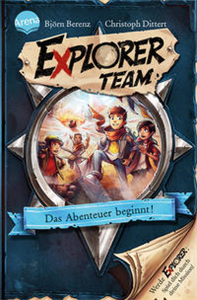 Children's & YA
Explorer Team (1). The Adventure Begins!
by Björn Berenz / Christoph Dittert
Become an explorer! Go with Lias on an exciting mission and solve the puzzles that will lead you to your goal. Eventually you must decide: how will the adventure continue? 3 paths – 3 adventures – which of them is for YOU? Join Lias, Mojo and Cookie on a mission to the Himalayas: together they must find out what has happened to Lias’s father. He disappeared six months ago and the only thing he left behind was his expedition diary, which is full of strange clues and puzzles. The reader will be able to move onto the next stage only if you can decipher them. A great adventure awaits you! And you decide In the end, you must decide: How should the adventure continue for you and the Explorer Team? Hunt with Lias through the forgotten world. Go with Tashi to discover the eternal ice or follow Cookie and Mojo through fire and lava. You will have to choose which of the Explorers you want to accompany on the next adventure.
-
Trusted Partner
 Literature & Literary StudiesApril 2022
The narrative grotesque in medieval Scottish poetry
by Caitlin Flynn
-
Trusted Partner
-
Trusted Partner
 Humanities & Social SciencesMay 2021
Doing digital history
by Jonathan Blaney, Jane Winters, Sarah Milligan, Martin Steer