
Éditions de la Pastèque
Livres Canada Books
View Rights Portal

Pastrengo is a Milan-based literary agency founded on September 2016 by Francesco Sparacino and Michele Turazzi. Pastrengo represents Italian authors of fiction (commercial and literary, young adult) and non fiction.
View Rights Portal

This book describes how human rights have given rise to a vision of benevolent governance that, if fully realised, would be antithetical to individual freedom. It describes human rights' evolution into a grand but nebulous project, rooted in compassion, with the overarching aim of improving universal welfare by defining the conditions of human well-being and imposing obligations on the state and other actors to realise them. This gives rise to a form of managerialism, preoccupied with measuring and improving the 'human rights performance' of the state, businesses and so on. The ultimate result is the 'governmentalisation' of a pastoral form of global human rights governance, in which power is exercised for the general good, moulded by a complex regulatory sphere which shapes the field of action for the individual at every turn. This, unsurprisingly, does not appeal to rights-holders themselves.
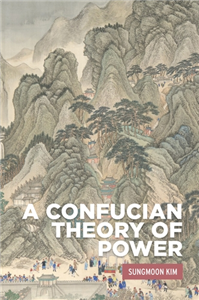
In the book's lead essay, Sungmoon Kim offers a comprehensive analysis of Confucian power. Through a blend of philosophical, political, and historical analysis, Kim challenges the dominant idea that Confucianism is primarily centred on virtue ethics. Instead, he argues that Confucianism perceives power through the prism of responsibility. Kim not only traces this perspective throughout history but also demonstrates its relevance to contemporary society. He contrasts this Confucian perspective with Western political theory's view of power as control. Political theorists and philosophers will offer essay responses to Sungmoon Kim's provocation, offering a dialogue approach to provide a comprehensive analysis of the Confucian conception of power.
 Trusted Partner

In this accessible and sophisticated exploration of the nature and workings of social and political power, Haugaard examines the interrelation between domination and empowerment. Building upon the perspectives of Steven Lukes, Michel Foucault, Amy Allen, Hannah Arendt, Anthony Giddens, Pierre Bourdieu and others, he offers a clear theoretical framework, delineating power in four interrelated dimensions. The first and second dimensions of power entail two different types of social conflict. The third dimension concerns tacit knowledge, uses of truth and reification. Drawing upon genealogical theory and accounts of slavery as social death, the fourth dimension of power concerns the power to create social subjects. The book concludes with an original normative pragmatist power-based account of democracy. Offering lucid and entertaining illustrations of complex theoretical perspectives, this book is essential reading for scholars and activists.
Trusted Partner
Writing power radically rethinks the place of the canon and canonicity as objects and concepts in contemporary academia and the everyday intellectual practices of academics. It is distinctive in its demonstration of how academics' engagements with canons shape their writing practices but also how scholars' writing practices, spaces, proclivities, and desires shape the canon and changing ideas of value in canonicity. The book thinks through frequently discussed problems of legitimacy and knowledge production from fresh perspectives of lived experience and the everyday to offer new insights into the politics of knowledge in contemporary social sciences.
Trusted Partner

This book is about power in welfare encounters. Present-day citizens are no longer the passive clients of the bureaucracy and welfare workers are no longer automatically the powerful party of the encounter. Instead, citizens are expected to engage in active, responsible and coproducing relationships with welfare workers. However, other factors impact these interactions; factors which often pull in different directions. Welfare encounters are thus influenced by bureaucratic principles and market values as well. Consequently, this book engages with both Weberian (bureaucracy) and Foucauldian (market values/NPM) studies when investigating the powerful welfare encounter. The book is targeted Academics, post-graduates, and undergraduates within sociology, anthropology and political science.
Trusted Partner

The pastor in print explores the phenomenon of early modern pastors who chose to become print authors, addressing ways authorship could enhance, limit or change clerical ministry and ways pastor-authors conceived of their work in parish and print. It identifies strategies through which pastor-authors established authorial identities, targeted different sorts of audiences and strategically selected genre and content as intentional parts of their clerical vocation. The first study to provide a book-length analysis of the phenomenon of early modern pastors writing for print, it uses a case study of prolific pastor-author Richard Bernard to offer a new lens through which to view religious change in this pivotal period. By bringing together questions of print, genre, religio-politics and theology, the book will interest scholars and postgraduate students in history, literature and theological studies, and its readability will appeal to undergraduates and non-specialists.
Trusted Partner
Trusted Partner
 Trusted Partner
 Trusted Partner

Environments of power provides unique case studies of environmental inclusion and exclusion across the Americas, Africa, Japan, India, and the South-Pacific. Using more-than-human and Indigenist approaches, chapters focus on Indigenous environmental resistance, marginalisation across social and physical environments, ecology as art, and how local communities are caught up in and resist development and infrastructure projects. The book demonstrates how environments influence which bodies and other matter belong (or not) in certain places.
Trusted Partner
 Trusted Partner

Renaissance pastoral poetry is gaining new interest for its distinctive imaginative vein, its varied allusive content, and the theoretical implications of the genre. This is by far the biggest ever anthology of English Renaissance pastoral poetry, with 277 pieces spanning two centuries. Spenser, Sidney, Jonson and Drayton are amply represented alongside their many contemporaries. There is a wide range of pastoral lyrics, weightier allusive pieces, and translations from classical and vernacular pastoral poetry; also, more unusually, pastoral ballads and poems set in all kinds of prose works. Each piece has been freshly edited from the original sources, with full apparatus and commentary. This book will be complemented by a second volume, to be published in 2017, which includes a book-length introduction, textual notes and analytic indices.
Trusted Partner
In the aftermath of the greed vs. grievance debate and the new wars paradigm, the focus of conflict studies shifted decisively to understanding "predatory" behaviours as the raison d'etre of contemporary conflict. Conflict was viewed as a continuum in which the more you engage in criminal behaviour, the less political you are.This approach has been robustly criticised over the past 15 years; however, in the process, we have been left with unsuitable concepts to handle the complex interactions between civil war, political power and criminality. The departure point here is the understanding of politics and criminality as two historically differentiated domains of human activity. Different, but interrelated, often co-constitutive and overlapping. Here, we empirically and theoretically explore their interactions, connections, and convergences, not focusing solely on irregular actors, thus bringing back the State and elites into this debate.
Trusted Partner
 Trusted Partner


"Patchwork Power!" von Marita Strubelt ist ein wegweisender Ratgeber für Eltern in Patchworkfamilien, der praktische Lösungen und Strategien für den Umgang mit den Herausforderungen des Patchwork-Lebens bietet. Strubelt, selbst eine erfahrene Patchwork-Familien-Expertin, teilt ihr umfassendes Wissen und persönliche Erfahrungen, um Leserinnen und Lesern zu helfen, die Dynamiken ihrer eigenen Patchworkfamilien besser zu verstehen und positiv zu gestalten. Das Buch legt einen starken Fokus auf die Selbstfürsorge, den Perspektivwechsel und die Wertschätzung aller Familienmitglieder. Es leitet dazu an, aus Problemen Kraft zu schöpfen und die einzigartige Struktur einer Patchworkfamilie als echten Bonus zu begreifen. Durch seine enge Anbindung an das Magazin "Leben & erziehen" und eine aktive Facebook-Gruppe bietet es eine kontinuierliche Unterstützung und Gemeinschaft für Leserinnen und Leser. "Patchwork Power!" richtet sich an Patchwork-Eltern, die nach einem modernen, empathischen und praxisnahen Ansatz suchen, um ihr Familienleben zu bereichern und zu harmonisieren. Modern und praxisnah: Bietet einen zeitgemäßen Ratgeber, der auf den neuesten Erkenntnissen und realen Erfahrungen basiert. Lösungsorientierte Ansätze: Stellt konkrete, umsetzbare Strategien zur Verfügung, die aus dem Alltag einer Patchwork-Coachin stammen. Fokus auf Selbstfürsorge und Empathie: Betont die Bedeutung von Selbstfürsorge und einem empathischen Umgang innerhalb der Familie. Unterstützung durch eine aktive Community: Zugang zu einer hilfreichen Facebook-Gruppe und der Expertise einer Patchwork-Familien-Expertin. Vielseitig einsetzbar: Bietet wertvolle Einsichten und Tipps, die über die Patchwork-Thematik hinaus in vielen Lebensbereichen anwendbar sind. Empathische und wertschätzende Sprache: Spricht Leserinnen und Leser auf eine persönliche und respektvolle Weise an. Bewältigung spezifischer Herausforderungen: Geht gezielt auf typische Fallstricke und Lösungswege in Patchworkfamilien ein. Für verschiedene Familienmodelle geeignet: Das Buch bietet einen soliden Grundstock an Rat und Unterstützung für viele Konstellationen innerhalb der Patchwork-Dynamik.
Trusted Partner
 Trusted Partner
Imperial power, both formal and informal, and research in the natural sciences were closely dependent in the nineteenth century. This book examines a portion of the mass-produced juvenile literature, focusing on the cluster of ideas connected with Britain's role in the maintenance of order and the spread of civilization. It discusses the political economy of Western ecological systems, and the consequences of their extension to the colonial periphery, particularly in forms of forest conservation. Progress and consumerism were major constituents of the consensus that helped stabilise the late Victorian society, but consumerism only works if it can deliver the goods. From 1842 onwards, almost all major episodes of coordinated popular resistance to colonial rule in India were preceded by phases of vigorous resistance to colonial forest control. By the late 1840s, a limited number of professional positions were available for geologists in British imperial service, but imperial geology had a longer pedigree. Modern imperialism or 'municipal imperialism' offers a broader framework for understanding the origins, long duration and persistent support for overseas expansion which transcended the rise and fall of cabinets or international realignments in the 1800s. Although medical scientists began to discern and control the microbiological causes of tropical ills after the mid-nineteenth century, the claims for climatic causation did not undergo a corresponding decline. Arthur Pearson's Pearson's Magazine was patriotic, militaristic and devoted to royalty. The book explores how science emerged as an important feature of the development policies of the Colonial Office (CO) of the colonial empire.
Trusted Partner

The new activity of trans-continental civil flying in the 1930s is a useful vantage point for viewing the extension of British imperial attitudes and practices. Cultures and caricatures of British imperial aviation examines the experiences of those (mostly men) who flew solo or with a companion (racing or for leisure), who were airline passengers (doing colonial administration, business or research), or who flew as civilian air and ground crews. For airborne elites, flying was a modern and often enviable way of managing, using and experiencing empire. On the ground, aviation was a device for asserting old empire: adventure and modernity were accompanied by supremacism. At the time, however, British civil imperial flying was presented romantically in books, magazines and exhibitions. Eighty years on, imperial flying is still remembered, reproduced and re-enacted in caricature.
Trusted Partner
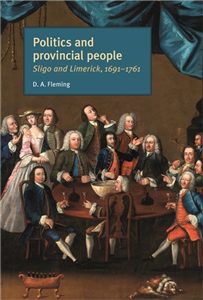
This ground-breaking study is the first to systematically examine the politics and political culture of provincial Ireland. The book compares two distinct localities that provide differing perspectives on how politics and power manifested itself in provincial Ireland: Sligo in the north west and Limerick in the south west. Drawing on a wealth of previously unknown and under-utilised contemporary material, David Fleming focuses on individuals who were determined to shape the political landscape and those who were affected by their actions. The book challenges many accepted models of how Ireland and the Irish were governed. While the propertied élite dominated many aspects of the political process, individuals and groups from the professional, mercantile, rural and other sections of society - the 'middling orders' - were also active in local institutions and office-holding. Their story, recounted here, reveals a far more complex set of relationships. Politics and provincial people is a carefully constructed story of people's motivations, ideas, and actions, and offers new insights into the complexity of their lives and the Irish political landscape. ;
Trusted Partner

This book examines the links between major contemporary public sector reforms and neoliberal thinking. The key contribution of the book is to enhance our understanding of contemporary neoliberalism as it plays out in the public administration and to provide a critical analysis of generally overlooked aspects of administrative power. The book examines the quest for accountability, credibility and evidence in the public sector. It asks whether this quest may be understood in terms of neoliberal thinking and, if so, how? The book makes the argument that while current administrative reforms are informed by several distinct political rationalities, they evolve above all around a particular form of neoliberalism: constructivist neoliberalism. The book analyses the dangers of the kinds of administrative power seeking to invoke the self-steering capacities of society and administration itself.


