Your Search Results

      • Cinosargo

        Cinosargo Editions is a Chilean publishing label based in Mexico. We are a cross-border project with a catalog of one hundred titles by Latin American authors. Cinosargo is a multimedia project that was born on the northern border of Chile (Arica), bordering Peru and Bolivia in 2003. Since 2010 we have become one of the Chilean independent publishers with the greatest projection and continuity.Cinosargo covers the digital dissemination of art through its magazine, and the production and distribution of the printed book thanks to our publishing house and the organization of Fairs, Festivals and Congresses. You can visit our sites www.cinosargo.cl and www.cinosargoediciones.comOur editorial team is led by Daniel Rojas Pachas, Milvia Alata and Gonzalo Geraldo.

        View Rights Portal
      • La Pollera Ediciones

        La Pollera's catalog includes narrative, essay, and chronicle of contemporary and classic authors.

        View Rights Portal
      • Trusted Partner
        The Arts
        January 2019

        European Film Noir

        by Andrew Spicer

        European Film Noir is the first book to bring together specialist discussions of film noir in specific European national cinemas. Written by leading scholars, this groundbreaking study provides an authoritative understanding of an important aspect of European cinema and of film noir itself, for too long considered as a solely American form. The Introduction reviews the problems of defining film noir, its key characteristics and discusses its significance to the development of European film, the relationship of specific national films noirs to each other, to American noir and to historical and social change. Eight chapters then discuss film noir in France, Germany, Britain and Spain, analysing both earlier developments and the evolution of neo-noir through to the present. A further chapter explores film noir in Italian cinema where its presence is not so well defined. Each piece provides a critical overview of the most significant films in relation to their industrial and social contexts. European Film Noir is an important contribution to the study of European cinema that will have a broad appeal to undergraduates, cinéastes, film teachers and researchers.

      • Trusted Partner
        The Arts
        June 2021

        Contemporary Spanish cinema and genre

        by Jay Beck, Vicente Rodríguez Ortega

        This volume is the first English-language collection exclusively dedicated to the study of genre in relation to Spanish cinema. Providing a variety of critical perspectives, the collection gives the reader a thorough account of the relationship between Spanish cinema and genre, drawing on case studies of several of the most remarkable Spanish films in recent years. The book analyses the significant changes in the aesthetics, production and reception of Spanish film from 1990 onwards. It brings together European and North American scholars to establish a critical dialogue on the topics under discussion, while providing multiple perspectives on the concepts of national cinemas and genre theory. In recent years film scholarship has attempted to negotiate the tension between the nationally specific and the internationally ubiquitous, discussing how globalisation has influenced film making and surrounding cultural practice. These broader social concerns have prompted scholars to emphasise a redefinition of national cinemas beyond strict national boundaries and to pay attention to the transnational character of any national site of film production and reception. This collection provides a thorough investigation of contemporary Spanish cinema within a transnational framework, by positing cinematic genres as the meeting spaces between a variety of diverse forces that necessarily operate within but also across territorial spaces. Paying close attention to the specifics of the Spanish cinematic and social panorama, the essays investigate the transnational economic, cultural and aesthetic forces at play in shaping Spanish film genres today.

      • Trusted Partner
        The Arts
        January 2019

        Contemporary Spanish cinema and genre

        by Jay Beck, Vicente Rodríguez Ortega

        This volume is the first English-language collection exclusively dedicated to the study of genre in relation to Spanish cinema. Providing a variety of critical perspectives, the collection gives the reader a thorough account of the relationship between Spanish cinema and genre, drawing on case studies of several of the most remarkable Spanish films in recent years. The book analyses the significant changes in the aesthetics, production and reception of Spanish film from 1990 onwards. It brings together European and North American scholars to establish a critical dialogue on the topics under discussion, while providing multiple perspectives on the concepts of national cinemas and genre theory. In recent years film scholarship has attempted to negotiate the tension between the nationally specific and the internationally ubiquitous, discussing how globalisation has influenced film making and surrounding cultural practice. These broader social concerns have prompted scholars to emphasise a redefinition of national cinemas beyond strict national boundaries and to pay attention to the transnational character of any national site of film production and reception. This collection provides a thorough investigation of contemporary Spanish cinema within a transnational framework, by positing cinematic genres as the meeting spaces between a variety of diverse forces that necessarily operate within but also across territorial spaces. Paying close attention to the specifics of the Spanish cinematic and social panorama, the essays investigate the transnational economic, cultural and aesthetic forces at play in shaping Spanish film genres today.

      • Trusted Partner
        The Arts
        December 2022

        The cinema of Pedro Almodóvar

        by Ana María Sanchez-Arce

        This book offers a comprehensive film-by-film analysis of Spain's most famous living director, Pedro Almodóvar. It shows how Almodóvar's films draw on various national cinemas and genres, including Spanish cinema of the dictatorship, European art cinema, Hollywood melodrama and film noir. It also argues that Almodóvar's work is a form of social critique, his films consistently engaging with and challenging stereotypes about traditional and contemporary Spain in order to address Spain's traumatic historical past and how it continues to inform the present. Drawing on scholarship in both English and Spanish, the book will be of interest to undergraduate and postgraduate students of film studies and Hispanic studies, scholars of contemporary cinema and general readers with a passion for the films of Pedro Almodóvar.

      • Trusted Partner
        The Arts
        January 2019

        Spanish cinema 1973–2010

        Auteurism, politics, landscape and memory

        by Maria M. Delgado, Robin Fiddian

        This collection offers a new lens through which to examine Spain's cinema production following the isolation imposed by the Franco regime. The seventeen key films analysed in the volume span a period of 35 years that have been crucial in the development of Spain, Spanish democracy and Spanish cinema. They encompass different genres (horror, thriller, melodrama, social realism, documentary), both popular (Los abrazos rotos/Broken Embraces, Vicky Cristina Barcelona) and more select art house fare (En la ciudad de Sylvia/In the City of Sylvia, El espíritu de la colmena/Spirit of the Beehive) and are made in English (as both first and second language), Basque, Castilian, Catalan and French. Offering an expanded understanding of 'national' cinemas, the volume explores key works by Guillermo del Toro and Lucrecia Martel alongside an examination of the ways in which established auteurs (Almodóvar, José Garci, Carlos Saura) and younger generations of filmmakers (Cesc Gay, Amenábar, Bollaín) have harnessed cinematic language towards a commentary on the nation-state. The result is a bold new study of the ways in which film has created new prisms that have determined how Spain is positioned in the global marketplace.

      • Trusted Partner
        The Arts
        January 2019

        French cinema in the 1970s

        The echoes of May

        by Alison Smith

        This book re-examines French cinema of the 1970s. It focuses on the debates which shook French cinema, and the calls for film-makers to rethink their manner of filming, subject matter and ideals in the immediate aftermath of the student revolution of May 1968. Alison Smith examines the effect of this re-thinking across the spectrum of French production, the rise of new genres and re-formulation of older ones. Chapters investigate political thrillers, historical films, new naturalism and Utopian fantasies, dealing with a wide variety of films. A particular concern is the extent to which film-makers' ideas and intentions are contained in or contradicted by their finished work, and the gradual change in these ideas over the decade. The final chapter is a detailed study of two directors who were deeply involved in the debates and events of the 70s, William Klein and Alain Tanner, here taken as exemplary spokesmen for those changing debates as their echoes reached the cinema.

      • Trusted Partner
        The Arts
        January 2019

        Contemporary Spanish cinema

        by Barry Jordan, Rikki Morgan-Tamosunas

        Contemporary focus, right up to date with material from 1980s and 90s. Wide-ranging analyses of major directors, themes, genres and issues, including historical film, genre cinema, women in film and autonomies.

      • Trusted Partner
        The Arts
        May 2026

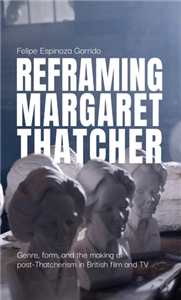
        Reframing Margaret Thatcher

        Genre, form, and the making of post-Thatcherism in British film and TV

        by Felipe Espinoza Garrido

        Against the backdrop of Britain's historically anti-Thatcherite films of the 1980s and 1990s, Reframing Margaret Thatcher outlines a decisive shift in the collective imagination of Thatcher. Drawing on genre, trauma, and queer studies, it demonstrates how post-Thatcherite films reflect upon their own entanglement in the polarization of the Thatcher years but also rewrite the clichéd Iron Lady. Chapters on The Iron Lady, This is England, Doomsday, 9 Dead Gay Guys, and the Sherlock TV series investigate various Thatcher imaginations, ranging from Thatcher as a lesbian mob boss, as prime minister in apocalyptic England, to Thatcher as an empty bust. This innovative study shows how the apparent depoliticization of British film makes visible new relations between genre, cinematic form, and imaginations of the past and offers fresh perspectives that both critique and reinterpret Thatcher's enduring impact.

      • Trusted Partner
        The Arts
        April 2011

        Postnationalist African Cinemas

        by Alexie Tcheuyap

        Postnationalist African cinemas convincingly interrogates the ways in which African narratives locate postcolonial identities and forms beyond essentially nationalist frameworks. It investigates how the emergence of new genres, discourses and representations, all unrelated to an overtly nationalist project, influences the formal choices made by contemporary directors. By foregrounding the narrative, generic, discursive, representational and aesthetic structures of films, this book shows how directors are beginning to regard film as a popular form of entertainment rather than political praxis. Tcheuyap investigates filmic genres such as comedy, dance, crime and epic alongside cultural aspects including witchcraft, sexuality, pornography and oracles. ;

      • Trusted Partner
      • Trusted Partner
        Humanities & Social Sciences
        May 2026

        Critical theory and the political

        by Anastasia Marinopoulou

        The book addresses what is political in critical theory and which aspects, arguments or notions of critical theory maintain political significance for the 20th and the 21st centuries. The collection of essays comprises itself of a series of clear and critical perspectives that analyze the extent to which critical theory relates political argument to modern societies and, thereby, exerts a critique of the multiple social and political phenomena of late modernity. The contributors focus on a multiplicity of universal phenomena such as globalization, multiple crises, late capitalism and the social role of the sciences, and posit some novel criticism of the contemporary social sphere, as it is situated within the wider system of global capitalism. They also present a plurivalent critique that links arguments in Marxism and Freud to all three generations of critical theory.

      • Trusted Partner
        Business, Economics & Law
        February 2025

        The political economy of Turkey’s integration to Europe

        Uneven development and hegemony

        by Elif Uzgören

        This book examines Turkey's integration with Europe within structural dynamics of globalisation from a critical political economy perspective. Critical approaches have been sidelined within European Studies. Turkish enlargement is not an exemption. The analyses are based on original data generated by 109 interviews conducted in 2010, 2017 and 2023 with five categories of actors: representatives of capital and labour, political parties, state officials, and struggles around ecology, patriarchy and migration. It argues that the pro-membership was hegemonic in the 2000s which was contested by two rival class strategies, Ha-vet and neo-mercantilism. In the 2010s, pro-membership is no longer hegemonic within rising critical tone of social forces supporting rival class strategies. Unevenness of Turkey's trajectory of integration to Europe is likely to be consolidated through market integration and management of migration through transactional approach.

      • Trusted Partner
        The Arts
        August 2022

        Robert Guédiguian

        by Joseph Mai

        Intervening at the crossroads of philosophy, politics, and cinema, this book argues that the career of Robert Guédiguian is the result of one of the most original and coherent projects in contemporary French cinema: to make a committed, historically-conscious cinema, in a local space, over a long period of time, but most especially with friends. The account starts with in-depth consideration of friendship and its relation to philosophy, politics, time, and space. The book chronologically traces this project as it begins in Guédiguian's hometown, the Communist-leaning Marseille. It further unfolds through the political transformations of the 1980s Left and the local activism and utopias of the 1990s, and spreads into Guédiguian's varied explorations of genre and register. Close analysis is accompanied with historical and social contextualization, but also with a consistent return to the underlying, radical and philosophically rich project.

      • Trusted Partner
        The Arts
        June 2025

        Toronto New Wave cinema and the anarchist-apocalypse

        by David Christopher

        The Toronto New Wave (TNW) comprises a group of avant-garde filmmakers working in Canada from the 1980s and into the new millennium whose innovative film works share significant affinities with anarchist themes and aesthetics. Several of the TNW filmmakers openly identify as anarchists and/or acknowledge a debt to anarchism in their production of highly apocalyptic narratives as part of their cinematic political projects. However, recognition of anarchism's progressive apocalyptic theoretical relevance has yet to be substantially taken up by scholarship in cinema analysis. This analysis introduces an anarchist-inflected analytical methodology to understand the apocalyptic-revelatory political work these films attempt to accomplish in the perceptual space between the filmic texts and both their auteurs and potential viewers, and to re-locate the TNW within cinema history as an ongoing phenomenon with new significance in an apocalyptic era of digital distribution.

      • Trusted Partner
        The Arts
        June 2021

        Lukácsian film theory and cinema

        A study of Georg Lukács' writing on film 1913–1971

        by Ian Aitken

        Lukácsian film theory and cinema explores Georg Lukács' writings on film. The Hungarian Marxist critic Georg Lukács is primarily known as a literary theorist, but he also wrote extensively on the cinema. These writings have remained little known in the English-speaking world because the great majority of them have never actually been translated into English - until now. Aitken has gathered together the most important essays and the translations appear here, often for the first time. This book thus makes a decisive contribution to understandings of Lukács within the field of film studies, and, in doing so, also challenges many existing preconceptions concerning his theoretical position. For example, whilst Lukács' literary theory is well known for its repudiation of naturalism, in his writings on film Lukács appears to advance a theory and practice of film that can best be described as naturalist. Lukácsian film theory and cinema is divided into two parts. In part one, Lukács' writings on film are explored, and placed within relevant historical and intellectual contexts, whilst part two consists of the essays themselves. This book will be of considerable interest to scholars and students working within the fields of film studies, literary studies, intellectual history, media and cultural studies. It is also intended to be the final volume in a trilogy of works on cinematic realism, which includes the author's earlier European film theory and cinema (2001), and Realist film theory and cinema (2006).

      • Trusted Partner
        The Arts
        June 2021

        Medieval film

        by Anke Bernau, Bettina Bildhauer

        Medieval film explores theoretical questions about the ideological, artistic, emotional and financial investments inhering in cinematic renditions of the medieval period. What does it mean to create and watch a 'medieval film'? What is a medieval film and why are they successful? This is the first work that attempts to answer these questions, drawing, for instance, on film theory, postcolonial theory, cultural studies and the growing body of work on medievalism. Contributors investigate British, German, Italian, Australian, French, Swedish and American film, exploring topics such translation, temporality, film noir, framing and period film - and find the medieval lurking in inexpected corners. In addition it provides in-depth studies of individual films from different countries including The Birth of a Nation to Nosferatu, and Robin Hood: Prince of Thieves. Medieval Film will be of interest to medievalists working in disciplines including literature, history, to scholars working on film and in cultural studies. It will also be of interest to undergraduates, postgraduates and to an informed enthusiast in film or/and medieval culture.

      • Trusted Partner
        The Arts
        January 2019

        Medieval film

        by Anke Bernau, Bettina Bildhauer

        Medieval film explores theoretical questions about the ideological, artistic, emotional and financial investments inhering in cinematic renditions of the medieval period. What does it mean to create and watch a 'medieval film'? What is a medieval film and why are they successful? This is the first work that attempts to answer these questions, drawing, for instance, on film theory, postcolonial theory, cultural studies and the growing body of work on medievalism. Contributors investigate British, German, Italian, Australian, French, Swedish and American film, exploring topics such translation, temporality, film noir, framing and period film - and find the medieval lurking in unexpected corners. In addition it provides in-depth studies of individual films from different countries including The Birth of a Nation to Nosferatu, and Robin Hood: Prince of Thieves. Medieval film will be of interest to medievalists working in disciplines including literature, history, art history, to scholars working on film and in cultural studies. It will also be of interest to undergraduates, postgraduates and to an informed enthusiast in film or/and medieval culture.

      • Trusted Partner
        The Arts
        January 2019

        Realist film theory and cinema

        The nineteenth-century Lukácsian and intuitionist realist traditions

        by Ian Aitken

        'Realist film theory and cinema' embraces studies of cinematic realism and 19th century tradition, the realist film theories of Lukács, Grierson, Bazin and Kracauer, and the relationship of realist film theory to the general field of film theory and philosophy. This is the first book to attempt a rigorous and systematic application of realist film theory to the analysis of particular films. The book suggests new ways forward for a new series of studies in cinematic realism, and for a new form of film theory based on realism. It stresses the importance of the question of realism both in film studies and in contemporary life. Aitken's work will be of interest to scholars and advanced students of film studies, literary studies, media studies, cultural studies and philosophy.

      Subscribe to our

      newsletter