Your Search Results

      • Trusted Partner
        The Arts
        September 2024

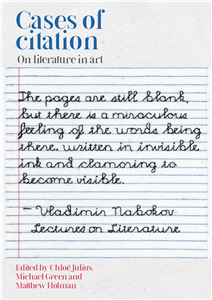
        Cases of citation

        On literature in art

        by Chloe Julius, Michael Green, Matthew Holman

        Cases of citation presents a history of artists who incorporated literary references into their work from the 1960s onwards. Through a series of object-focused chapters that each take up a singular 'case of citation', the collection considers how literary citation emerged as a viable and urgent strategy for artists during this period. It surveys eleven artworks by a diverse group of artists - including David Wojnarowicz, Lis Rhodes, Romare Bearden and Silvia Kolbowski - whose citations draw on works as varied as Karl Marx's Das Kapital and Mary Shelley's Frankenstein. The book also features an interview with pioneering feminist artist Elaine Reichek that discusses her career-long commitment to working with text. Together, the artworks and cited texts are approached from various critical angles, with each author questioning and complicating the ways in which we can 'read' textual citations in art.

      • Technology, Engineering & Agriculture
        March 1905

        The First Book of Farming

        by Charles L. Goodrich

        This book is a result of the author's search for these facts and truths as a student and farmer and his endeavor as a teacher to present them in a simple manner to others. The object in presenting the book to the general public is the hope that it may be of assistance to farmers, students and teachers, in their search for the fundamental truths and principles of farming.

      • Trusted Partner
        Literature & Literary Studies
        May 2023

        Creating character

        Theories of nature and nurture in Victorian sensation fiction

        by Helena Ifill

        This book explores the ways in which the two leading sensation authors of the 1860s, Mary Elizabeth Braddon and Wilkie Collins, engaged with nineteenth-century ideas about personality formation and the extent to which it can be influenced either by the subject or by others. Innovative readings of seven sensation novels explore how they employ and challenge Victorian theories of heredity, degeneration, inherent constitution, education, upbringing and social circumstance. Far from presenting a reductive depiction of 'nature' versus 'nurture', Braddon and Collins show the creation of character to be a complex interplay of internal and external factors. Drawing on material ranging from medical textbooks, to sociological treatises, to popular periodicals, Creating character shows how sensation authors situated themselves at the intersections of established and developing, conservative and radical, learned and sensationalist thought about how identity could be made and modified.

      • Trusted Partner
        November 2019

        Paul Klee

        by Daniel Kupper

      • Trusted Partner

        Character Strengths Intervention Cards

        50 cards with instruction booklet

        by Matthijs Steeneveld, Anouk van den Berg

        Would you like to teach your clients what their character strengths are and how they can use them more? This set of cards helps you do just that. Endorsed with a foreword by Ryan M. Niemiec, VIA Institute 50 full color cards Individual cards for the VIA 24 character strengths and 6 virtues 16 intervention cards 16-page booklet provides practice tips The VIA character strengths look at what positive character traits help us lead fulfilling and happy lives, rather than looking at what is wrong with us. Research has shown that knowing your strengths and using them more often leads to greater well-being, better performance, and more resilience. With these cards, you can help clients learn about their character strengths.   For: • psychotherapists• clinical psychologists• counselors

      • Trusted Partner
        Psychiatry

        Mindfulness and Character Strengths - A Practical Guide to Flourishing

        by Ryan M. Niemiec

        At the core of this hands-on resource for psychologists and other practitioners, including educators, coaches, and consultants, is Mindfulness-Based Strengths Practice (MBSP), the first structured program to combine mindfulness with the character strengths laid out in the VIA Institute's classification developed by Drs. Martin E. P. Seligman and Christopher Peterson. This 8-session program systematically boosts awareness and application of character strengths. The first section of the book consists of a detailed primer on mindfulness and character strengths while the second part goes into more detail about the integration of mindfulness and character strengths. The third section then leads readers step-by-step through each of the 8 MBSP sessions, including details of session structure and content, suggested homework, 30 practical handouts, as well as inspiring quotes and stories and useful practitioner tips. An additional chapter discusses the adaption of MBSP to different settings and populations (e.g., business, education, individuals, couples). The mindfulness and character strengths meditations on the accompanying CD support growth and development.   Target Group: Psychologists, consultants, therapists and counselors, and all those interested in mindfulness, positive psychology, and improving life.

      • Trusted Partner
        Humanities & Social Sciences
        April 2016

        University engagement and environmental sustainability

        by Michael Osborne, Patricia Inman, Diana Robinson

        Universities have a key role to play in contributing to environmental development and combating climate change. The chapters within this volume detail the challenges faced by higher education institutions in considering environmental sustainability, and provide both a broad view of university engagement and a detailed examination of various projects. As part of this series in association with the Place and Social Capital and Learning (PASCAL) International Observatory, the three key PASCAL themes of place management, lifelong learning and the development of social capital are considered throughout the book. While universities have historically generated knowledge outside of specific local contexts, this book argues that it is particularly important for them to engage with the local community and to consider diverse perspectives and assets when looking at issues within an ecological context. The chapters in this volume provide new perspectives and frames of reference for transforming universities by engaging in the development of resilient communities.

      • Trusted Partner
        Humanities & Social Sciences
        June 2026

        The Official Record

        by Peter Finn, Robert Ledger

      • Trusted Partner
      • Trusted Partner
        The Arts
        December 2024

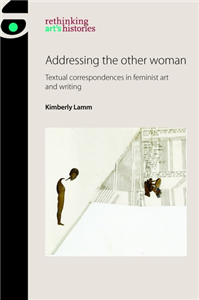
        Addressing the other woman

        Textual correspondences in feminist art and writing

        by Kimberly Lamm

        This book analyses how three artists - Adrian Piper, Nancy Spero and Mary Kelly - worked with the visual dimensions of language in the 1960s and 1970s. These artists used text and images of writing to challenge female stereotypes, addressing viewers and asking them to participate in the project of imagining women beyond familiar words and images of subordination. The book explores this dimension of their work through the concept of 'the other woman', a utopian wish to reach women and correspond with them across similarities and differences. To make the artwork's aspirations more concrete, it places the artists in correspondence with three writers - Angela Davis, Valerie Solanas, and Laura Mulvey - who also addressed the limited range of images through which women are allowed to become visible.

      • Trusted Partner
      • Trusted Partner
        February 1993

        Name und Notwendigkeit

        by Saul A. Kripke, Ursula Wolf

        Kripkes bahnbrechende Untersuchung Name und Notwendigkeit markiert einen Wendepunkt in der philosophischen Theorie der Eigennamen. In kritischer Auseinandersetzung mit der klassischen Theorie der Eigennamen entwickelt Kripke seine berühmte Alternative: die kausale Namentheorie. Sie besagt, daß der Bezug (die Referenz) eines Namens zunächst in einer Art Taufe festgelegt wird und dann in der Kommunikationsgemeinschaft tradiert wird. Dabei wird die Beschreibung, die bei der Festlegung der Referenz noch eine Rolle gespielt hat, irrelevant, so daß der Name selbst keinen semantischen Sinn hat. Namen sind, im Gegensatz zu Beschreibungen, sogenannte starre Bezeichnungsausdrücke (Designatoren), die, wenn einmal festgelegt, denselben Gegenstand in allen möglichen Welten bezeichnen. Daraus ergibt sich die Verbindung zum zweiten Thema der Untersuchung, der Notwendigkeit.

      • Trusted Partner
      • Trusted Partner
      • Trusted Partner
        The Arts
        August 2010

        Art, museums and touch

        by Fiona Candlin, Amelia Jones, Marsha Meskimmon

        Art, museums and touch examines conceptions and uses of touch within arts museums and art history. Candlin deftly weaves archival material and contemporary museology together with government policy and art practice to question the foundations of modern art history, museums as sites of visual learning, and the association of touch with female identity and sexuality. This remarkable study presents a challenging riposte to museology and art history that privileges visual experience. Candlin demonstrates that touch was, and still is, crucially important to museums and art history. At the same time she contests the recent characterisation of touch as an accessible and inclusive way of engaging with museum collections, and argues against prevalent ideas of touch as an unmediated and uncomplicated mode of learning. An original and wide-ranging enquiry, this book is essential reading for scholars and students of museum studies, art history, visual culture, disability, and for anyone interested in the cultural construction of the senses. ;

      • Trusted Partner
      • Trusted Partner
        February 2025

        Wo der Name wohnt

        Roman | Über das, was von einer Familie bleibt

        by Ricarda Messner

        »Lange dachte ich, Früher heißt das Land, aus dem sie kamen.« Hausnummer 36 und 37, hier in Berlin haben sie jahrelang in direkter Nachbarschaft gelebt. Als Kind spielte die Enkeltochter Tischtennis auf dem Glastisch im Wohnzimmer der Großeltern. Als Erwachsene löst sie deren Wohnung schließlich auf, bringt Besteck, Töpfe und Musikkassetten nach nebenan zu sich. Und sie will noch etwas bewahren: Levitanus, den Familiennamen. Der Wunsch, den Namen wieder anzunehmen, begleitet sie nicht nur im Alltag, sondern führt sie auch nach Riga. Sie folgt den Worten ihres Urgroßvaters Salomon und findet ein Fenster im ehemaligen Rigaer Ghetto, das eng mit ihrer Familiengeschichte verknüpft ist – und sie zeichnet die Bewegungen von vier Generationen nach, vom sowjetischen Lettland der siebziger Jahre bis nach Deutschland. Ricarda Messner erzählt in ihrem Debütroman vom Ort ihrer Erinnerungen, kehrt immer wieder zurück zum Leben in zwei Wohnungen, nähert sich Verlusten und Lücken, verbindet Heute und Gestern. Wo der Name wohnt lässt so zärtlich wie klar eine Familie aufleben und bewahrt ihre Geschichten.

      • Trusted Partner
        Literature & Literary Studies
        March 2026

        What's in a name?

        How historians know Shakespeare was Shakespeare

        by Susan Dwyer Amussen

        A compelling tour of Shakespeare's England that makes a powerful contribution to the 'authorship question'. How do we know Shakespeare was Shakespeare? Could a glover's son who left school at fifteen really be the author behind such masterpieces as Hamlet, King Lear and The Tempest? Yes! says historian Susan Amussen. She transports readers back to early modern England, to travel the path that carried William Shakespeare from humble origins in Stratford to literary greatness on the London stage. This was a society undergoing rapid change. Grammar schools made education in Latin and Greek available to commoners, while touring players brought the latest dramatic productions to the masses. And in London, a metropolis filled with European visitors, ordinary people had the opportunity to see courtly life up close. No serious historian doubts that Shakespeare was the author of the plays that bear his name. Susan Amussen shares what they know: that Shakespeare's England was a complex and cosmopolitan place, with everything a talented young playwright needed to develop his craft and furnish his imagination.

      Subscribe to our

      newsletter