
Your Search Results
-

-

Arab Scientific Publishers, Inc.
Arab Scientific Publishers (ASP) publishes award winning books that cater to all ages and interests. The subject matter is wide ranging from drawing and cooking books, to Mayo Clinic references, Microsoft Training Kits, and bestselling novels, targeting children, teenagers, students, adults, and professionals. A r a b S c i e n t i f i c P u b l i s h e r s (ASP) is a fully consolidated commercial Printing and Publishing powerhouse. The company is involved in all activities along the value chain from concept creation to distribution. The company’s proven track record in delivering first-rate publishing and printing services will serve as a catalyst to grow the company into a global digital enterprise. Our vision is that ASP will become a strategic holding structure with international subsidiaries all around the globe.
View Rights Portal
-
Promoted Content
-
Promoted Content
-
 Trusted Partner

 Humanities & Social SciencesJune 2026
A neoliberal revolution?
Thatcherism and the reform of British pensions
by Aled Davies, James Freeman, Hugh Pemberton
This book examines the Thatcher government's attempt to revolutionise Britain's pensions system in the 1980s and create a nation of risk-taking savers with an individual stake in capitalism. Drawing upon recently-released archival records, it shows how the ideas motivating these reforms journeyed from the writings of neoliberal intellectuals into government and became the centrepiece of a plan to abolish significant parts of the UK's welfare state and replace these with privatised personal pensions. Revealing a government that veered between political caution and radicalism, the book explains why this revolution failed and charts the malign legacy left by the evolutionary changes that ministers salvaged from the wreckage of their reforms. The book contributes to understanding of policy change, Thatcherism, and international neoliberalism by showing how major reforms to social security could reflect neoliberal thought and yet profoundly disappoint their architects.
-
Trusted Partner
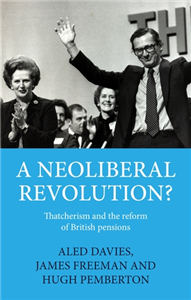 Humanities & Social SciencesJuly 2024
A neoliberal revolution?
Thatcherism and the reform of British pensions
by Hugh Pemberton, James Freeman, Aled Davies
This book examines the Thatcher government's attempt to revolutionise Britain's pensions system in the 1980s and create a nation of risk-taking savers with an individual stake in capitalism. Drawing upon recently-released archival records, it shows how the ideas motivating these reforms journeyed from the writings of neoliberal intellectuals into government and became the centrepiece of a plan to abolish significant parts of the UK's welfare state and replace these with privatised personal pensions. Revealing a government that veered between political caution and radicalism, the book explains why this revolution failed and charts the malign legacy left by the evolutionary changes that ministers salvaged from the wreckage of their reforms. The book contributes to understanding of policy change, Thatcherism, and international neoliberalism by showing how major reforms to social security could reflect neoliberal thought and yet profoundly disappoint their architects.
-
Trusted Partner
 Humanities & Social SciencesApril 1999
French society in revolution 1789–1799
by David Andress, Mark Greengrass
French society in revolution aims to retrieve the social history of the French Revolution from unjustified neglect. This study examines both the structural and cultural elements behind the breakdown of the eighteenth-century monarchic state and its aris. . . . ;
-
Trusted Partner
 Humanities & Social SciencesMarch 2019
Waiting for the revolution
The British far left from 1956
by Evan Smith, Matthew Worley, Jacquelyn Arnold, Daniel Finn, Michael Fitzpatrick, Diarmaid Kelliher, Jack Saunders, J Daniel Taylor, Jodi Burkett, Gavin Brown, Daisy Payling, Christopher Massey, Sheryl-Bernadett Buckley, Daryl Leeworthy, Rory Scothorne, Ewan Gibbs, Lyndon White (Lawrence Parker)
Waiting for the revolution is a volume of essays examining the diverse currents of British left-wing politics from 1956 to the present day. The book is designed to complement the previous volume, Against the grain: The far left in Britain from 1956, bringing together young and established academics and writers to discuss the realignments and fissures that maintain leftist politics into the twenty-first century. The two books endeavour to historicise the British left, detailing but also seeking to understand the diverse currents that comprise 'the far left'. Their objective is less to intervene in ongoing issues relevant to the left and politics more generally, than to uncover and explore the traditions and issues that have preoccupied leftist groups, activists and struggles. To this end, the book will appeal to scholars and anyone interested in British politics.
-
Trusted Partner
Humanities & Social SciencesJune 2004
The political marketing revolution
Transforming the government of the UK
by Jennifer Lees-Marshment
This book shows how British politics is being transformed from a leadership-run system to one dictated by public needs and demands. No longer confined to party politics, organisations including the monarchy, the BBC, universities, local councils, charities and the Scottish Parliament are adopting the tools of market intelligence to understand their market needs and demands. The political marketing revolution raises many questions, such as whether the student or patient really does know best and can decide their own education and health care. The book calls for a debate about the movement of the British political system towards a market-orientation and a re-negotiation of the relationship between leaders and the market. Whilst recognising the need for political leaders to listen, this debate places some responsibilities on the political consumer, looking to create a new relationship that might work more effectively for both sides.
-
Trusted Partner
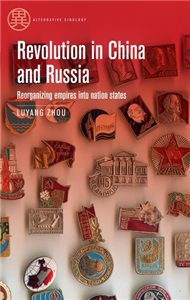 Humanities & Social SciencesJune 2025
Revolution in China and Russia
Reorganizing empires into nation states
by Luyang Zhou
Most scholars believe that China's nationality policy, like that of other socialist states, imitated the Soviet nationality model, a system which has been termed an "affirmative action empire." This book offers two contributions to the literature which run counter to this convention. First, it argues that the People's Republic of China (PRC) and the Soviet Union (USSR) were different; while the PRC was aimed to build an ideal-typical nation-state, the USSR was an open union of nation-states that was only temporarily confined to a physical territory. Second, while scholars who have noted this difference attribute it to contextual factors, such as ethnic structure, geopolitical status, and Russia's intervention into the Chinese Revolution, this book contends that context shaped the Sino-Soviet difference, yet it did not determine it. Rather, there was significant leeway between the implications of the contextual factors, and what the policy-designers ultimately established. This book probes who held agency, and how these individuals bridged this gap.
-
Trusted Partner
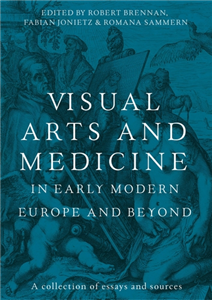 The ArtsFebruary 2026
Visual arts and medicine in early modern Europe and beyond
A collection of essays and sources
by Robert Brennan, Fabian Jonietz, Romana Sammern
This book opens up new perspectives on the relationship between art, medicine, and science in late-medieval and early modern Europe. Looking beyond the traditional nexus of art, anatomy, and optics, the volume sheds light on a broader array of connections between artists and physicians: collaborations between painters and doctors on colour charts, handwork skills common to sculptors and surgeons, the transmission of art theory through medical texts long before the emergence of art writing itself as an independent genre, and the kinship of medical diagnosis with early modes of connoisseurship. Reconfiguring the histories of art, medicine, and science, the book also traverses conventional boundaries between physical and mental health, religious and medical modes of healing, menial and exalted forms of knowledge and labour, as well as vernacular and scientific understandings of human difference, including gender, race, and neurodiversity.
-
Trusted Partner
 Humanities & Social SciencesOctober 2020
Feudalism, venality, and revolution
by Stephen Miller, William G. Naphy, Joseph Bergin
-
Trusted Partner
 Humanities & Social SciencesMarch 2026
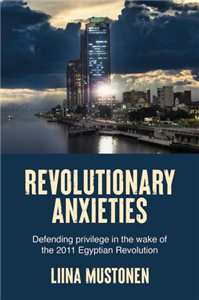
Revolutionary anxieties
Defending privilege in the wake of the 2011 Egyptian Revolution
by Liina Mustonen
Revolutionary anxieties sheds light on an unexplored dimension of the 2011 Egyptian revolution: the anxieties experienced by Cairo-based liberal elite, socialites, and cultural actors who opposed the rise of the new political actors, the Muslim Brotherhood. This book provides fresh insights into the failure of the Egyptian revolution by examining the perspectives of those who had a vested interest in maintaining the status-quo. It engages with post-colonial theory and examines the elite milieu in Cairo through the lenses of gender and race. Based on over two years of ethnographic research in various elite locations such as the Cairo Opera House, an Egyptian-European film festival, and an elite sporting club in Cairo, the book illustrates how members of Egyptian liberal upper class insisted on their privilege in a moment when the country's class hierarchies were challenged. By revealing the prevalence of counter-revolutionary sentiment among Cairo's liberal and affluent elite, the book tells an untold story of the Arab Spring.
-
Trusted Partner

 August 2020
Vernunft und Revolution
Hegel und die Entstehung der Gesellschaftstheorie
by Herbert Marcuse, Alfred Schmidt
Herbert Marcuses Vernunft und Revolution bietet eine durch ihre Klarheit und Werkkenntnis immer noch bestechende Einführung in das philosophische System Hegels und spürt zugleich dessen bahnbrechendem Einfluss auf die Entwicklung der Gesellschaftstheorie nach. Marcuse rekonstruiert das maßgeblich durch Hegel geprägte sozialphilosophische und sozialwissenschaftliche Denken des 19. und 20. Jahrhunderts und widerlegt dabei die immer wieder geäußerte These, Hegel sei ein Theoretiker der Restauration und ein Ideologe des Obrigkeitsstaats totalitärer Prägung gewesen. Für Marcuse ist er vielmehr ein Denker der Vernunft, des Fortschritts und der Freiheit. Ein Klassiker der Hegel-Literatur!
-
Trusted Partner
 April 1989
Die Russische Revolution. 1905–1921
by Manfred Hildermeier, Hans-Ulrich Wehler
Zu den Problemen, denen die vorliegende Darstellung besondere Aufmerksamkeit schenkt, gehören der wirtschaftliche und soziale Wandel des Zarenreichs im ausgehenden 19. Jahrhundert, die schwere Krise des alten Regimes 1905/07, der Zusammenhang von Krieg und Revolution, die Gründe für das Scheitern des einzigen demokratischen Regimes der russischen Geschichte sowie die Ursachen und inneren Folgen der Behauptung der Sowjetmacht im Bürgerkrieg.
-
Trusted Partner
 Humanities & Social SciencesApril 2018
Disability in the Industrial Revolution
Physical impairment in British coalmining, 1780–1880
by David M. Turner, Daniel Blackie, Julie Anderson
An electronic version of this book is also available under a Creative Commons (CC-BY-NC-ND) license, thanks to the support of the Wellcome Trust. The Industrial Revolution produced injury, illness and disablement on a large scale and nowhere was this more visible than in coalmining. Disability in the Industrial Revolution sheds new light on the human cost of industrialisation by examining the lives and experiences of those disabled in an industry that was vital to Britain's economic growth. Although it is commonly assumed that industrialisation led to increasing marginalisation of people with impairments from the workforce, disabled mineworkers were expected to return to work wherever possible, and new medical services developed to assist in this endeavour. This book explores the working lives of disabled miners and analyses the medical, welfare and community responses to disablement in the coalfields. It shows how disability affected industrial relations and shaped the class identity of mineworkers. The book will appeal to students and academics interested in disability, occupational health and social history.
-
Trusted Partner
Humanities & Social SciencesApril 2025
The Derby philosophers
Science and culture in British urban society, 1700–1850
by Paul A. Elliott
The Derby Philosophers focuses upon the activities of a group of Midland intellectuals that included the evolutionist and physician Erasmus Darwin, Rev. Thomas Gisborne the evangelical philosopher and poet, Robert Bage the novelist, Charles Sylvester the chemist and engineer, William George and his son Herbert Spencer, the internationally renowned evolutionist philosopher who coined the phrase 'survival of the fittest', and members of the Wedgwood and Strutt families. The book explores how, inspired by science and through educational activities, publications and institutions including the famous Derbyshire General Infirmary (1810) and Derby Arboretum (1840), the Derby philosophers strove to promote social, political and urban improvements with national and international consequences. Much more than a parochial history of one intellectual group or town, this book examines science, politics and culture during one of the most turbulent periods of British history.
-
Trusted Partner
 July 2025
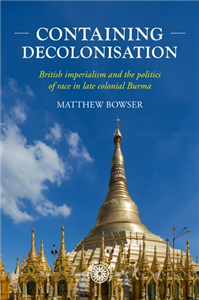
Containing decolonisation
British imperialism and the politics of race in late colonial Burma
by Matthew Bowser
This book examines British imperialism in late colonial Burma to study how imperialists attempted to protect their strategic and economic interests after decolonisation: they did so by supporting ethnonationalism. This process resembles the Cold War tactic of "containment," and the book makes a crucial contribution to the study of modern imperialism by demonstrating the continuity between "containment's" late- and "neo"-colonial manifestations. For Burma/Myanmar, it also explores the origin of the present-day military junta's racial regime: it emphasizes the protection of the ethnoreligious majority from ethnic minority insurgency. The Rohingya people are currently suffering a genocide because of this racial regime. As the country endures civil war against the junta, this book highlights how ethnonationalists in the late colonial period first promoted this racial regime to seize power and prevent revolution, a process supported by British imperialists for their own ends.
-
Trusted Partner
-
Trusted Partner
 Humanities & Social SciencesApril 2001
Making sense of the Industrial Revolution
English economy and society, 1700–1850
by Steve King, Geoff Timmins
Presents a new perspective on the Industrial Revolution providing far more than just an account of industrial change. Looks at the development of the economic structures and includes chapters on financing the revolution, technological change, markets and demand, transport and food. The final section looks at economic change and its impact and includes chapters on demography, the household, families, authority and regulation, and the built environment. Providing a complete summary of the various debates in the literature on this period, making a strong case for re-introducing a regional approach to the history of the age. ;
-
Trusted Partner
 Humanities & Social SciencesSeptember 2021
Revolution remembered
Seditious memories after the British civil wars
by Edward Legon, Jason Peacey
After the Restoration, parliamentarians continued to identify with the decisions to oppose and resist crown and established church. This was despite the fact that expressing such views between 1660 and 1688 was to open oneself to charges of sedition or treason. This book uses approaches from the field of memory studies to examine 'seditious memories' in seventeenth-century Britain, asking why people were prepared to take the risk of voicing them in public. It argues that such activities were more than a manifestation of discontent or radicalism - they also provided a way of countering experiences of defeat. Besides speech and writing, parliamentarian and republican views are shown to have manifested as misbehaviour during official commemorations of the civil wars and republic. The book also considers how such views were passed on from the generation of men and women who experienced civil war and revolution to their children and grandchildren.
-
Trusted Partner
 Humanities & Social SciencesApril 2020
Anarchism, 1914–18
Internationalism, anti-militarism and war
by Ruth Kinna, Matthew S. Adams
Anarchism 1914-18 is the first systematic analysis of anarchist responses to the First World War. It examines the interventionist debate between Peter Kropotkin and Errico Malatesta which split the anarchist movement in 1914 and provides a historical and conceptual analysis of debates conducted in European and American movements about class, nationalism, internationalism, militarism, pacifism and cultural resistance. Contributions discuss the justness of war, non-violence and pacifism, anti-colonialism, pro-feminist perspectives on war and the potency of myths about the war and revolution for the reframing of radical politics in the 1920s and beyond. Divisions about the war and the experience of being caught on the wrong side of the Bolshevik Revolution encouraged anarchists to reaffirm their deeply-held rejection of vanguard socialism and develop new strategies that drew on a plethora of anti-war activities.


