
Your Search Results


-
Promoted Content

 Geography & the EnvironmentJune 2025
Demystifying informal urban design and planning
Insights from Asia
by Mahyar Arefi
Touting informal settlements or informality in general as illegal, crime-ridden, unsafe, filthy, chaotic, and formal developments as legal, orderly or safe, and so forth has not solved anything and informality as a way of life or an economic reality lingers and grows. Demystifying informal urban design and planning delves deeper into this conundrum and seeks to debunk some common misguided perceptions about it. Borrowing popular philosophical and political analogies from Isaiah Berlin and Gregory Treverton and others, it encourages urban designers and planners to become multitaskers like foxes rather than hedgehogs who can do one thing right. The book ends with some general takeaways on assuming more proactive roles in informal urban design issues and avoiding two potential pitfalls while interacting with them.
-
Promoted Content
 Humanities & Social SciencesFebruary 2023
Globalized urban precarity in Berlin and Abidjan
Young men and the digital economy
by Hannah Schilling
Digital technologies promise efficiency and comfort, but the smoothness of platform services relies on the hidden social labour of those who keep the gig economy running. This book presents a comparative ethnography of young men making a living through digital technologies: selling mobile airtime in Abidjan, Côte d'Ivoire, and app-based delivery riders in Berlin, Germany. These case studies explore the significance of symbolic capital in urban youth's social existence and organisation of livelihood in the digital economy, and the technological mechanisms producing a new form of urban precarity. Globalized urban precarity in Berlin and Abidjan puts forward an original comparative approach to develop a global urban sociology for the digital era. It provides an innovative analytical toolbox that decentres discussions of precarity from the standard of a normal employment contract. With its focus on symbolic capital, the ethnography shows the consequences of the proliferating gig economy for status struggles among urban youth, and carefully embeds the densification of software and services into the socio-material relations on which these new urban infrastructures are built.
-
 Trusted Partner
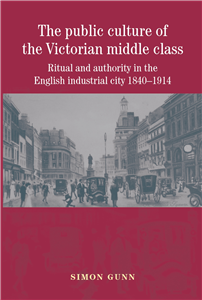 The ArtsAugust 2007
The public culture of the Victorian middle class
Ritual and authority in the English industrial city 1840–1914
by Simon Gunn
The public culture of the Victorian middle class looks at the creation of a distinctive 'high' culture in the industrial cities of Birmingham, Leeds and Manchester in the mid-nineteenth century and its incipient decline from the 1880s. The history of urban bourgeois culture has been relatively unexplored and under-theorised compared to popular culture. This volume therefore represents a significant contribution both to the study of middle-class cultural forms and to an understanding of the relationship between culture and power. In particular, it argues for the importance of ritualised modes of social behaviour in understanding the construction of authority in the nineteenth-century city. As well as many original arguments, the book provides a clear and useful overview of the public cultures of Victorian 'respectability'. The book will be of interest to scholars and students in the areas of social history, cultural history, urban history, cultural studies, urban studies and the sociology of culture. ;
-
Trusted Partner
 The ArtsJanuary 2026
David Simon's American City
by Mikkel Jensen
This book examines the television serials created by influential showrunner David Simon. The book argues that Simon's main theme is the state of the contemporary American city and that all of his serials (barring one about the Iraq War) explore different facets of the metropolis. Each series offers distinctly different visions of the American city, but taken together they represent a sustained and intricate exploration of urban problems in modern America. From deindustrialisation in The Wire and residential segregation in Show Me a Hero to post-Katrina New Orleans in Treme and the transformation of the urban core in The Deuce, David Simon's American city traces the urban through-line in Simon's body of work. Based on sustained analysis of these serials and their engagement with contemporary politics and culture, David Simon's American city offers a compelling examination of one of television's most arresting voices.
-
Trusted Partner
 Lifestyle, Sport & LeisureAugust 2016
Culture in Manchester
Institutions and urban change since 1850
by Janet Wolff, Mike Savage
This book brings together studies of cultural institutions in Manchester from 1850 to the present day, giving an unprecedented account of the city's cultural evolution. These bring to light the remarkable range of Manchester's contribution to modern cultural life, including the role of art education, popular theatre, religion, pleasure gardens, clubs and societies. The chapters show the resilience and creativity of Manchester's cultural institutions since 1850, challenging any simple narrative of urban decline following the erosion of Lancashire's industrial base, at the same time illustrating the range of activities across the social classes. This book will appeal to everyone interested in the cultural life of the city of Manchester, including cultural historians, sociologists and urban geographers, as well as general readers with interests in the city. It is written by leading international authorities, including Viv Gardner, Stephen Milner, Mike Savage, Bill Williams and Janet Wolff.
-
Trusted Partner
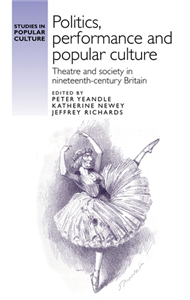 Humanities & Social SciencesFebruary 2023
Politics, performance and popular culture
Theatre and society in nineteenth-century Britain
by Peter Yeandle, Katherine Newey, Jeffrey Richards
This collection brings together studies of popular performance and politics across the nineteenth century, offering a fresh perspective from an archivally grounded research base. It works with the concept that politics is performative and performance is political. The book is organised into three parts in dialogue regarding specific approaches to popular performance and politics. Part I offers a series of conceptual studies using popular culture as an analytical category for social and political history. Part II explores the ways that performance represents and constructs contemporary ideologies of race, nation and empire. Part III investigates the performance techniques of specific politicians - including Robert Peel, Keir Hardie and Henry Hyndman - and analyses the performative elements of collective movements.
-
Trusted Partner
 Humanities & Social SciencesOctober 2025
Social democracy and the urban scene
Party responses to the diversifying centre-left
by Nik. Brandal, Øivind Bratberg
Social democratic parties struggle to appeal to a divided electorate. Particularly prescient is the clash between working-class voters thatare socially conservative and middle-class voters who are liberally inclined but economicallyleft. Are politics and policies that appeal to both even a possibility? Nowhere is thatdebate more acute than in European cities, yet in no other political space are answers more likely to be found.Where urban voters turn left, they are increasingly attracted by radical and green alternatives to social democracy.Social democracy and urban politicsdelves into the changing relationship between these three party families on the urban scene. Mapping electoral geography, governing strategies and the interface between parties and social movements on the left, the authors reflect upon the formation and dilemmas of a broader progressive alliance.
-
Trusted Partner
 Geography & the EnvironmentAugust 2020
Urban transformations and public health in the emergent city
by Michael Keith, Andreza Aruska de Souza Santos, Susan Parnell
The imperatives of public health shaped our understanding of the cities of the global north in the first industrial revolutions of the nineteenth and twentieth centuries. They are doing so again today, reflecting new geographies of the urban age of the twenty-first. Emergent cities in parts of the globe experiencing most profound urban growth face major problems of economic, ecological and social sustainability when making sense of new health challenges and designing policy frameworks for public health infrastructures. The rapid evolution of complex 'systems of systems' in today's cities continually reconfigure the urban commons, reshaping how we understand urban public health, defining new problems and drawing on new data tools for analysis that work from the historical legacies and geographical variations that structure public health systems.
-
Trusted Partner
Humanities & Social SciencesAugust 2024
The machinic city
Media, performance and participation
by Marcos P. Dias
As human and machine agency become increasingly intermingled and digital media is overlaid onto the urban landscape, The machinic city argues that performance art can help us to understand contemporary urban living. Dias analyses interventions from performance artists such as Blast Theory, Rafael Lozano-Hemmer and Rimini Protokoll, which draw from a rich history of avant-garde art movements to create spaces for deliberation and reflection on urban life, and speculation on its future. While cities are increasingly controlled by autonomous processes mediated by technical machines, Dias analyses the performative potential of the aesthetic machine, as it assembles with media, capitalist, human and urban machines. The aesthetic machine of performance art in urban space is examined through its different components - design, city and technology actants. This unveils the unpredictable nature and emerging potential of performance art as it unfolds in the machinic city.
-
Trusted Partner
Geography & the EnvironmentJune 2026
Living the urban periphery
by Paula Meth, Sarah Charlton, Tom Goodfellow, Alison Todes
-
Trusted Partner
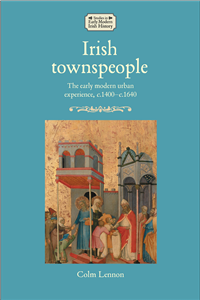 Humanities & Social SciencesMay 2026
Irish townspeople
The early modern urban experience, c.1400–c.1640
by Colm Lennon
Through a series of innovative perspectives, this book examines how early modern Irish townspeople experienced the urban world through a range of family and associational ties. Migrants inducted through town citizenship and marriage bonded more closely as sisters or brothers of confraternities and guilds, consolidating parish membership. Civic religion saw the integration of religion with town politics and councils, and monastic charity of the friars' hospitals preceded the era of modern municipal welfare. In circumstances of the alienation of the long-settled Catholic townspeople from the state's religious and political Reformation in the seventeenth century, they drew sustenance from the continuity of institutions such as colleges, fraternities and hospitals and forms of coexistence with Protestant fellow-citizens.
-
Trusted Partner
 The ArtsNovember 2006
Spanish visual culture
Cinema, television, internet
by Paul Julian Smith, Susan Williams
This book is the first to explore three visual media in contemporary Spain: cinema, television and the internet. It also examines cultural products in each of these media in terms of three vital themes: emotion, location and nostalgia. The first two chapters focus on emotion. They analyze the 'emotional imperative' in a recent Almodóvar feature film and in Spanish television's top-rated period drama, and investigate the politics of affect in TV drama in the last decade. The next pair of chapters deal with location. They use cultural geography to re-read contradictory accounts of the movida (the post-Franco cultural boom) and examine an attempt to anchor a US-derived genre (the youth movie) in the urban landscape of Madrid. The fifth and sixth chapters introduce the theme of location into nostalgia. They treat the unique cases of a successful Spanish heritage movie and a contemporary Spanish thriller remade in Hollywood. The peunultimate chapter investigates electronic artists and the virtual universe, and the book ends with a look at the implications of Hispano-Mexican co-productions and the interconnectedness of economic and aesthetic cultural forms. ;
-
Trusted Partner
-
Trusted Partner
 Humanities & Social SciencesOctober 2006
The experience of urban poverty, 1723–82
Parish, charity and credit
by Alannah Tomkins
This comparative study of urban poverty is the first to chart the irregular pulse of poverty's encounters with officialdom. It exploits an unusual methodology to secure new perspectives from familiar sources. The highly localised characteristics of the welfare economy generated a peculiarly urban environment for the poor. Separate chapters examine the parameters of workhouse life when the preconceptions of contemporaries have been stripped away; the reach of institutional charities such as almshouses, schools and infirmaries; and the surprisingly broad clientele of urban pawnbrokers. Detailed analysis of the poor is achieved via meticulous matching of individuals who fell within the purview of two or more authorities. The result is a unique insight into the survival economics of urban poverty, arising not from a tidy network of welfare but from a loose assembly of options, where the impoverished positioned themselves repeatedly to fit official, philanthropic, or casual templates of the 'deserving'. This book will be essential reading for historians of English poverty and welfare, and eighteenth-century social and economic life. ;
-
Trusted Partner
 Humanities & Social SciencesMarch 2021
African cities and collaborative futures
Urban platforms and metropolitan logistics
by Michael Keith, Andreza Aruska de Souza Santos, Susan Parnell
This groundbreaking volume brings together scholars from across the globe to discuss the infrastructure, energy, housing, safety and sustainability of African cities, as seen through local narratives of residents. Drawing on a variety of fields and extensive first-hand research, the contributions offer a fresh perspective on some of the most pressing issues confronting urban Africa in the twenty-first century. At a time when the future of the region as a whole will be determined in large part by its cities, the implications of these developments are profound. With case studies from cities in Ethiopia, Kenya, Malawi, Niger, Nigeria, South Africa and Tanzania, this volume explores how the rapid growth of African cities is reconfiguring the relationship between urban social life and its built forms. While the most visible transformations in cities today can be seen as infrastructural, these manifestations are cultural as well as material, reflecting the different ways in which the city is rationalised, economised and governed. How can we 'see like a city' in twenty-first-century Africa, understanding the urban present to shape its future? This is the central question posed throughout this volume, with a practical focus on how academics, local decision makers and international practitioners can collaborate to meet the challenge of rapid growth, environmental pressures and resource gaps.
-
Trusted Partner
 Geography & the EnvironmentMarch 2021
Sanctuary cities and urban struggles
by Jonathan Darling, Harald Bauder
-
Trusted Partner
 Literature & Literary StudiesJanuary 2013
The towns of Italy in the later Middle Ages
by Trevor Dean
The towns of Italy in the later middle ages presents over one hundred fascinating documents, carefully selected and coordinated from the richest, most innovative and most documented society of the European Middle Ages. No other English language sourcebook has the same geographical or chronological range. This collection is carefully structured around the crisis of the fourteenth century and arranged in contrasting groups of texts. By connecting documents in translation to recent scholarship and debates, it addresses five key areas of medieval urban history: the physical environment, civic religion, economy, society and politics. Offers students well-translated and effectively contextualised documents along with some guidance to the secondary work of Italian scholars which is largely inaccessible to undergraduate students.
-
Trusted Partner
Humanities & Social SciencesDecember 2024
British culture after empire
Race, decolonisation and migration since 1945
by Josh Doble, Liam Liburd, Emma Parker
British culture after Empire is the first collection of its kind to explore the intertwined social, cultural and political aftermath of empire in Britain from 1945 up to and beyond the Brexit referendum of 2016, combining approaches from the fields of history, English and cultural studies. Against those who would deny, downplay or attempt to forget Britain's imperial legacy, the various contributions expose and explore how the British Empire and the consequences of its end continue to shape Britain at the local, national and international level. As an important and urgent intervention in a field of increasing relevance within and beyond the academy, the book offers fresh perspectives on the colonial hangovers in post-colonial Britain from up-and-coming as well as established scholars.
-
Trusted Partner
 Humanities & Social SciencesJune 2026
Celebrating the city
Making festivals in early modern London and Paris
by Elaine Tierney
Celebrating the city goes behind the scenes of early modern celebrations. Moving from splendid coronations to courtyard bonfires, it offers the first comparative, interdisciplinary study of festivals in London and Paris. In a major departure from existing scholarship, it uses the widest range of textual, visual and material evidence to demonstrate the importance of designing, making and organising to how and why festivals were meaningful. Mining evidence of the active processes by which events were made, it argues that urban festival politics cannot be understood without incorporating its material world into our analysis. The book's unique methodology, combining the tools of design history and the concerns of political history, will shed new light on how political publics were formed in early modern European cities. In showing how cities made festivals - and festivals made cities - this wide-ranging study makes a significant contribution to histories of festivals, political culture and urban life.
-
Trusted Partner
 Literature & Literary StudiesJanuary 2014
Court and civic society in the Burgundian Low Countries c.1420–1530
by Andrew Brown, Graeme Small
This volume is the first ever attempt to unite and translate some of the key texts which informed Johan Huizinga's famous study of the Burgundian court, The Waning of the Middle Ages, a work which has never gone out of print. It combines these texts with sources that Huizinga did not consider, those that illuminate the wider civic world that the Burgundian court inhabited and the dynamic interaction between court and city. Through these sources, and an introduction offering new perspectives on recent historiography, the book tests whether Huizinga's controversial vision of the period still stands. Covering subjects including ceremonial events, such as the spectacles and gargantuan banquets that made the Burgundian dukes the talk of Europe, the workings of the court, and jousting, archery and rhetoric competitions, the book will appeal to students of late medieval and early modern Europe and to those with wider interests in court culture, ritual and ceremony.


