
Good values
Picture books on values and social issues. (Kidible imprint)
View Rights Portal


Die überwiegende Mehrzahl der hier vereinigten 56 Geschichten bilden die Zaubermärchen, die novellenartigen und die Schwankmärchen, nicht zu vergessen die in Bengalen beliebten Schwanjungfraumärchen.

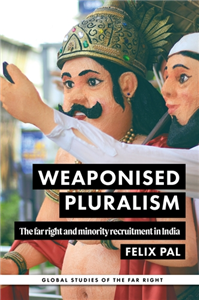
Weaponised pluralism takes a fine-grained lens to understand why far-right organisations recruit from the very minorities they oppose. Why do these organisations seek to appear like pluralists? Building on his time with the Muslim wing of the Hindu far-right in India, Felix Pal proposes that bigots can strategically use what he calls weaponised pluralism. This political strategy counterintuitively uses progressive political performances to bolster bigoted political agendas. Basing his analysis in an Indian context, Weaponised pluralism nonetheless reveals much about contexts as varied as Palestinian soldiers in the Israeli army, Indigenous Australians on far-right television, and Black congressional candidates in the American Republican Party. Drawing on rare access to the Hindu far-right and its Muslim wing, Pal paints an evocative picture of the complexities of how far-right organising extends far beyond the pointy end of traditional bigotry.
 Trusted Partner
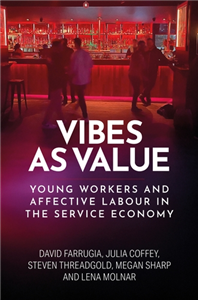
Vibes as value explores the relationship between subjectivity, labour and value in the hospitality industry, and thereby how youth, gender, sexuality, race and social class are embodied and made productive in the service economy. It shows that the key product of hospitality labour is 'vibes', or moments of enjoyment and relationality co-produced through exploitative relationships amongst workers and consumers. In the process, the book theorises hospitality as a form of affective labour organised through the normative and structural relations of precarious service work. It shows how identity construction produces value within the highly unequal social terrain of the service economy, and how hospitality labour enacts hierarchies of value extending far beyond the limits of the industry itself.
Trusted Partner
Trusted Partner
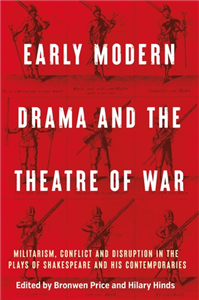
This volume explores the disruptive effects of militarism, war and social unrest in early modern drama. Engaging with Simon Barker's seminal work on dramatic representations of war and militarism, contributors highlight what often lies hidden beneath the surface of martial narratives, treating them as formative interventions in contemporary discourses, whether in justifying war, excluding dissident voices or shaping cultural identities. Discussions include new examinations of militarism, the figure of the soldier and early modern theories of war in Shakespearean tragedy, history and comedy, alongside antimasque and dramatic satire by lesser-known playwrights. The essays investigate how ideas of war underpin emerging concepts of gender, leadership, marriage and the family, as well as the continuing mobilisation of Shakespearean drama in the context of modern armed conflict. Together, they offer rich new contributions to the current lively critical debates on this topic.
Trusted Partner
The moral problem of authority is the challenge of reconciling legitimate authority (the right to rule) with the demands of freedom and rationality. In this book, I argue that authority can have legitimacy, but when it does it generates a moral dilemma, where the obligation to obey comes at some cost to freedom and reason. Hence, not only do I depart from the views of those who insist that authority can never have legitimacy, but also those who maintain that insofar as authority is legitimate it simply satisfies the demands of freedom or rationality. My focus here will be on both what it is that justifies authority (in particular focusing on membership, and the goods of membership) as well what type of reason an authoritative directive is, how it can come into conflict with others reasons, and how those conflicts are resolved.
Trusted Partner
 Trusted Partner
Trusted Partner
Trusted Partner
 Trusted Partner
Colonial war played a vital part in transforming the reputation of the military and placing it on a standing equal to that of the navy. The book is concerned with the interactive culture of colonial warfare, with the representation of the military in popular media at home, and how these images affected attitudes towards war itself and wider intellectual and institutional forces. It sets out to relate the changing image of the military to these fundamental facts. For the dominant people they were an atavistic form of war, shorn of guilt by Social Darwinian and racial ideas, and rendered less dangerous by the increasing technological gap between Europe and the world. Attempts to justify and understand war were naturally important to dominant people, for the extension of imperial power was seldom a peaceful process. The entertainment value of war in the British imperial experience does seem to have taken new and more intensive forms from roughly the middle of the nineteenth century. Themes such as the delusive seduction of martial music, the sketch of the music hall song, powerful mythic texts of popular imperialism, and heroic myths of empire are discussed extensively. The first important British war correspondent was William Howard Russell (1820-1907) of The Times, in the Crimea. The 1870s saw a dramatic change in the representation of the officer in British battle painting. Up to that point it was the officer's courage, tactical wisdom and social prestige that were put on display.
Trusted Partner
 Trusted Partner

Golden Mummies of Egypt presents new insights and a rich perspective on beliefs about the afterlife during an era when Egypt was part of the Greek and Roman worlds (c. 300 BCE-200 CE). This beautifully illustrated book, featuring photography by Julia Thorne, accompanies Manchester Museum's first-ever international touring exhibition. Golden Mummies of Egypt is a visually spectacular exhibition that offers visitors unparalleled access to the museum's outstanding collection of Egyptian and Sudanese objects - one of the largest in the UK.
Trusted Partner
Trusted Partner
Trusted Partner


Edzard Reuter is a European by conviction, and a fighter for an economy that is also geared to the well-being of employees, the environment and society. In his book, he looks back at the 90 years of his life as a politically and socially committed person. The expert in and observer of world politics and the world economy shows how the world has changed and what role the Middle East, Russia, the USA and China play in this. For Reuter, the path of the European Union is quite clear: it has to become an independent state structure. The war in Ukraine testifies to the urgency of a paradigm shift in Europe.
Trusted Partner

Maps take place in time as well as representing space. The Google map on your smartphone appears to fix the world, serving as a practical spatial tool, but in practice is deployed in ways that draw attention to memories, rhythm, synchronicity, sequence and duration. This interdisciplinary collection focuses on how these temporal aspects of mapping might be understood, at a time when mapping technologies have been profoundly changed by digital developments. It contrasts different aspects of this temporality, bringing together experts from critical cartography, media studies and science and technology studies. Together the chapters offer a unique interdisciplinary focus revealing the complex and social ways in which time in wrapped up with digital technologies and revealed in everyday mapping tasks: from navigating across cities, to serving as scientific groundings for news stories; from managing smart cities, to visual art practice. It brings time back into the map!
Trusted Partner

This edition of The Trial of Treasure will be a photographic facsimile of one of the five extant copies of this apparently anonymous play which was printed in 1567 by Thomas Purfoote. It will reproduce the copy at the Harry Ransome Library, Austin, Texas which has an anomaly in the printing not found in the other copies. In considering typographical characteristics of the text the Introduction discusses the place of this play in Purfoote's extensive output. It also addresses the relationship with William Wager's Enough is as Good as a Feast with which it shares some seventy lines, and considers the possibility of common authorship. The text is rich in stage directions and aspects of performance are discussed including the doubling scheme for five players and the role of the Vice which is exemplified here. ;
Trusted Partner
This book explores radical dissent from orthodox mainstream economics, and sets out a theoretically grounded vision for the emerging paradigm of social ecological economics. At the heart of this paradigmatic shift lies an acknowledgement of the inextricable embeddedness of economies in biophysical reality and social structure. The struggle for this transformative vision unfolds through a critical examination of mainstream environmental thought, followed by a nuanced evaluation of contributions from Marxists, socialists, critical institutionalists, feminists and Post-Keynesians grappling with the urgent environmental crisis. Synthesising insights from these diverse and heterodox schools, the book navigates the philosophical underpinnings of science, embracing a critical realist approach that challenges not only mainstream economic thought but also eclectic pluralism, relativism and strong constructionism. The question of what constitutes revolutionary science is explored in light of works by Kuhn, Schumpeter and Neurath, emphasising the pivotal role of values and ideology in works from Marx to Gramsci. Building on these radical and philosophical foundations, the book articulates a preanalytic vision of social ecological economics, dismantling entrenched notions of growth and efficiency in favour of a framework centered on social provisioning and needs embedded in ethics. In a thought-provoking conclusion, the book applies its analytical lens to the multiple crises of modernity within industrialised capital-accumulating economies. An agenda for social ecological transformation toward diverse alternative economies emerges, providing a compelling call to action in the face of contemporary challenges.
Trusted Partner
Since the mid-2000s, the harsh reality of call centre employment for a generation of young workers in Portugal has been impossible to ignore. With its endless rows of small cubicles, where human agents endure repetitive telephone conversations with abusive clients under invasive modes of technological surveillance, discipline and control, call centre work remains a striking symbol of labour precarity, a condition particularly associated with the neoliberal generational disenchantment that 'each generation does better than its predecessor'. This book describes the emergence of a regime of disciplined agency in the Portuguese call centre sector. Examining the ascendancy of call centres as icons of precarity in contemporary Portugal, this book argues that call centre labour constitutes a new form of commodification of the labouring subject. De Matos argues that call centres represent an advanced system of non-manual labour power exploitation, due to the underestimation of human creativity that lies at the centre of the regimented structures of call centre labour. Call centres can only guarantee profit maintenance, de Matos argues, through the commodification of the human agency arising from the operators' moral, relational and social embedded agentive linguistic interventions of creative improvisation, decision-making, problem-solving and ethical evaluation.
Trusted Partner



