Your Search Results

      • Bookline & Thinker

        Hookline Books is our fiction imprint - all authors have attended writing classes to post-graduate university level. All manuscripts are approved by book groups before being accepted for publication. Non-fiction publisher specialising in self-help, travel and social history.

        View Rights Portal
      • Woongjin Thinkbig Co., Ltd.

        Established in 1980, Woongjin Thinkbig is a multi-award winning top publishing and education company in South Korea. We provide tutoring at home sevices, various children's books and a digital library service with a variety of digital contents.

        View Rights Portal
      • Trusted Partner
        Humanities & Social Sciences
        June 2012

        Thinking towards humanity

        Themes from Norman Geras

        by David Aaronovitch, Stephen de Wijze, Ophelia Benson, Eve Gerrard, Gideon Calder

        How should we respond to the inhumanity that suffused the twentieth Century and continues in the present one? Has there been an adequate treatment of this issue by the political left? Questions such as these are treated in this, the first scholarly book to combine academic and blogging approaches to some of the major political issues of the day. It does this by focusing on the work of Norman Geras - Marxist, political philosopher and blogger - and developing the central themes of his work such as crimes against humanity, the Holocaust, Marxism, and the means/ends problem in politics. It contains contributions by famous political philosophers such as Michael Walzer, Hillel Steiner and David McLennan, and bloggers and journalists such as David Aaronovitch, Nick Cohen and Ophelia Benson. The book contains a unique response by Geras in which he draws together the various themes it covers. It will be of interest to all who are concerned with these pressing political issues of our time. The book will be particularly relevant for those with an academic or general interest in politics, philosophy, sociology, genocide studies, applied ethics, international relations and law. It will also be of interest to bloggers and all those who regard new technology as having significant implications for public debate on these issues. ;

      • Trusted Partner
        April 2013

        Flexible Arbeitskräfte

        Eine Situationsanalyse am Beispiel der Elektroindustrie im Perlflussdelta, China

        by Hartmann, Pamela

      • Trusted Partner
        October 2005

        Flexible Staatsbürgerschaften

        Die kulturelle Logik von Transnationalität

        by Aihwa Ong, Ilse Utz

        Aihwa Ong ist Professorin für Anthropologie an der Universität von Berkeley, Kalifornien.

      • Trusted Partner
        November 1990

        Zeitpioniere

        Flexible Arbeitszeit – neuer Lebensstil

        by Matthias Michailow, Karl H. Hörning, Anette Gerhard

        Mit den »Zeitpionieren« stellt dieses Buch Vertreter eines Lebensstils vor, die sich in besonders prägnanter Weise dem Problem der Zeit stellen und ein neues Zeitverständnis entwickeln. »Zeitpioniere« sind Arbeitnehmer, die am Arbeitsplatz und dem außerbetrieblichen Alltag ihre eigenen Zeitvorstellungen verwirklichen. Es gelingt ihnen, ihre persönliche Arbeitszeit im Betrieb zu reduzieren und zu flexibilisieren. Indem sie sich gegen die Verhaltenszumutungen des starren Normalarbeitstages wenden, handeln sie sich eine Reihe von Nachteilen ein – vor allem Einkommenseinbußen und Arbeitsverdichtung. Doch der Vorteil des erreichten Zeitwohlstands wiegt schwerer. Die gewonnene Zeit ist ihnen nicht bloße Freizeit, sie ist freie Zeit, mit der sie sorgfältig umgehen. Der Lebensstil der Zeitpioniere fördert Entwicklungstendenzen, die die bisherige Arbeitsgesellschaft maßgeblich verändern werden.

      • Trusted Partner
        2023

        Food Composition Table for the Practice

        The small Souci/Fachmann/Kraut

        by Founded by S.W. Souci, W. Fachmann and H. Kraut. Revised by Dr. Petra Steinhaus. Edited by the Leibniz Institute of Food Systems Biology at the Technical University of Munich.

        ■ How many omega-3 fatty acids does salmon contain? ■ Which dairy product contains the most calcium? ■ How iron-rich is spinach, really? Whether calories, vitamins or amino acids – whether in field beans, bananas, eggs, chicken, parmesan cheese or onion – it is all here. The compact edition of the time-tested „large SFK [Souci/Fachmann/Kraut]“ offers tested data on over 70 ingredients in more than 360 foods, systematically structured according to food groups. This edition with thousands of values has been completely revised and updated by the Leibniz Institute of Food Systems Biology at the Technical University of Munich. Extra: 32 summary tables cover more than 300 other, less common foods and allow for targeted, clear comparisons. 16 orientation tables provide information about foods with particularly high or low amounts of ingredients. Nutritional values, energy content, main components and ingredients displayed in uniform systematics and a practical format – just look it up!

      • Trusted Partner
      • Trusted Partner
        January 1980

        The Economics of Flexible Exchange Rates.

        Proceedings of a Conference at the Institute for Advanced Studies, Vienna, March 29 - 31, 1978.

        by Herausgegeben von Frisch, Helmut; Herausgegeben von Schwödiauer, Gerhard

      • Trusted Partner
      • Trusted Partner
        Humanities & Social Sciences
        April 2024

        Ideas of poverty in the Age of Enlightenment

        by Niall O’Flaherty, Robin Mills

        This collection of essays examines the ways in which poverty was conceptualised in the social, political, and religious discourses of eighteenth-century Europe. It brings together experts with a wide range of expertise to offer pathbreaking discussions of how eighteenth-century thinkers thought about the poor. Because the theme of poverty played important roles in many critical issues in European history, it was central to some of the key debates in Enlightenment political thought throughout the period, including the controversies about sovereignty and representation, public and private charity, as well as questions relating to crime and punishment. The book examines some of the most important contributions to these debates, while also ranging beyond the canonical Enlightenment thinkers, to investigate how poverty was conceptualised in the wider intellectual culture, as politicians, administrators and pamphlet writers grappled with the issue.

      • Trusted Partner
      • Trusted Partner
      • Trusted Partner
        Business, Economics & Law
        October 2004

        Qualities of food

        by Mark Harvey, Andrew McMeekin, Alan Warde

        In this book, the complexity and the significance of the foods we eat are analysed from a variety of perspectives, by sociologists, economists, geographers and anthropologists. Chapters address a number of intriguing questions: how do people make judgments about taste? How do such judgments come to be shared by groups of people?; what social and organisational processes result in foods being certified as of decent or proper quality? How has dissatisfaction with the food system been expressed? What alternatives are thought to be possible? The multi-disciplinary analysis of this book explores many different answers to such questions. The first part of the book focuses on theoretical and conceptual issues, the second part considers processes of formal and informal regulation, while the third part examines social and political responses to industrialised food production and mass consumption. Qualities of food will be of interest to researchers and students in all the social science disciplines that are concerned with food, whether marketing, sociology, cultural studies, anthropology, human nutrition or economics.

      • Trusted Partner
        Computing & IT
        May 2026

        Democratizing AI

        by Annette Zimmermann

        Democratizing AI offers a powerful rethinking of how artificial intelligence should be governed. Challenging the dominance of tech elites in shaping AI's future, Zimmermann argues that AI deployment is a political act-one that must be subject to democratic control. She proposes a practical "playbook" for reclaiming agenda-setting power through civic participation, public ownership, and institutional reform. Engaging with leading critics, Zimmermann defends a risk-sensitive proceduralist approach while acknowledging the deeper structural challenges posed by capitalism, inequality, and democratic fatigue. This book is a call to action: to resist learned helplessness, confront techno-authoritarianism, and shape AI's trajectory in line with democratic values. Thoughtful, urgent, and visionary, the book is essential reading for anyone concerned with the future of technology and democracy.

      • Trusted Partner
      • Trusted Partner
        The Arts
        May 2026

        Feminist substances

        Plastics in art of the 1960s and 1970s

        by Charlotte Matter

        Numerous women artists engaged with industrial materials such as plastics in the 1960s and 1970s, contrary to what the discourse of the time would have us believe. As Feminist substances shows, their works offered unique approaches to plastics in art, introducing new material meanings through a feminist lens. With a focus on Europe and Latin America, the book discusses the practices of Carla Accardi, Lea Lublin and Alina Szapocznikow, combining close readings of selected artworks with broader considerations of their social contexts. It explores their use of Sicofoil, plexiglass, plastic inflatables, polyester resin and polyurethane foam to address key concerns of feminist thought in relation to social reproduction, motherhood, memory, desire and illness. Beyond commonplaces of plastics as generic bad materials, Feminist substances considers more complex ways of engaging with synthetic matter, taking into account our messy relationships with these controversial materials.

      • Trusted Partner
        Humanities & Social Sciences
        July 2026

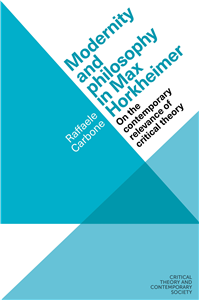
        Modernity and philosophy in Max Horkheimer

        On the contemporary relevance of critical theory

        by Raffaele Carbone

        This book shows that Max Horkheimer's program of critical theory and his research throughout his career as a university professor and thinker are rooted in the cogency of philosophical questions and an in-depth knowledge of the historical development of philosophical problems in their close correlation with the socio-economic framework which shaped the 'bourgeois society' and the Modern Era. Indeed, his analyses of modern philosophers allows us to understand how the bourgeoisie seeks legitimisation and consolidation of its position, partly through the voices of its thinkers. In this way, in his investigation of early modern philosophy problems, and through constant dialogue with his colleagues Adorno, Marcuse, Pollock and Fromm, Horkheimer expresses a profound awareness of the critical force inherent in thought which, admittedly, is ever vulnerable to crisis and weakening, but which can always be reactivated.

      • Trusted Partner
        July 1998

        New Approaches and Ways of Legal Thinking Revised.

        The Otto Brusiin Lectures 1982–1997. Brusiin-SONDERHEFT. Zeitschrift Rechtstheorie, 28. Band (1997), Heft 2 (S. 141–250).

        by Urheber (sonst.) Minkkinen, Panu; Herausgegeben von Aarnio, Aulis; Herausgegeben von Krawietz, Werner

      • Trusted Partner
        Business, Economics & Law
        August 2013

        Negotiation and Persuasion

        The Science and Art of Winning Cooperative Partners

        by Marco Behrmann

        This book is a clear and compact guide on how to succeed by means of goal-oriented negotiation and cooperative persuasion. Readers learn models to understand and describe what takes place during negotiations, while numerous figures, charts, and checklists clearly summarize effective strategies for analyzing context, processes, competencies, and the impact of our own behavior. Real-life case examples vividly illustrate the specific measures individuals and teams can take to systematically improve their powers of persuasion and bargaining strength. The book also describes a modern approach to raising negotiation competencies as part of personnel development, making it suitable for use in training courses as well as for anyone who wants to be a more persuasive and successful negotiator.   Target Group: For work and organizational psychologists, HR professionals, coaches, management trainers and trainees.

      Subscribe to our

      newsletter