
July 2023
Your Search Results
-
Promoted Content


-
Promoted Content
-
 Trusted Partner
-
Trusted Partner
-
Trusted Partner
-
Trusted Partner
-
Trusted Partner

 Humanities & Social SciencesJune 2004
Dress and globalisation
by Margaret Maynard, Christopher Breward, Bill Sherman
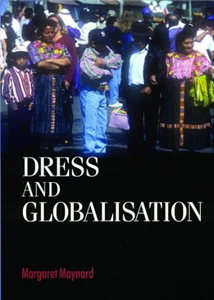
Dress and globalisation is the first work to survey dress around the world, drawing together issues of consumption, ethnicity, gender and the body, as well as anthropological accounts and studies of representation. It examines international western style dress, including jeans and business suits, headwear and hairdressing, ethnicity and so called 'ethnic chic', clothes for the tourist market, the politicisation of traditional dress, 'alternative' dressing, and T-shirts as temporary markers of identity. It also considers dress and environmental issues, touching on adventure gear, the 'green' consumer and the possible impact of 'smart' clothing. Dispelling the myth of universal 'world' attire, this book demonstrates that western-style clothing transcends geographical boundaries but along with other forms of dress, can form a montage of differing tastes, ethnic preferences and national and local imperatives. By discussing the nature of globalisation, this book shows that, if economics permit, all cultures are selective in their choice of what to wear. Dress and globalisation will be welcomed by students of dress history and cultural studies. ;
-
Trusted Partner
 Material cultureJanuary 2002
The study of dress history
by Lou Taylor
Over the past ten years the study of dress history has finally achieved academic respectability. This book shows how the fields of dress history and dress studies are now benefitting from the adoption of new multi-disciplinary approaches and outlines the full range of these approaches which draw on material culture, ethnography, and cultural studies. Raises a series of frank and fresh issues surrounding approaches to the history of dress, including analysis of the academic gender and subject divides that have riven it in the past. Comprehensive, engaging and trenchant, this will become the benchmark volume in the study of dress history.
-
Trusted Partner
 The ArtsNovember 2026
What the dresses know
A women's history of modernism told through clothes
by Sophie Oliver
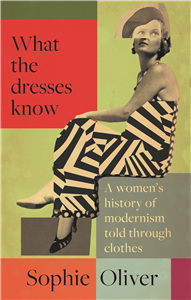
An exciting new history of modernism that re-examines the movement through some of its most brilliant female artists. Pioneering women were at the heart of the movement known as modernism. In What the dresses know, Sophie Oliver offers a new account of their radical experiments and extraordinary lives, told through the clothes they made and wore. From a dress Vanessa Bell rescued from the London Blitz to Frida Kahlo's huipiles and a waistcoat embroidered for Gertrude Stein by Alice B. Toklas, these special objects tell a story of artists seeking transformation. But getting dressed is rarely straightforward. Modernist women used clothes to think through the contradictions of the modern world: the inequalities of industrialisation, the terrible conformities demanded by fascism and racism and the call of feminists, socialists and avant-gardists to act differently and take up new forms of art. What the dresses know is an exhilarating account of women's bold attempts to make history during years of tumultuous change. A distinctive new voice in cultural criticism, Sophie Oliver uses clothes to explore the challenges modernist women faced - and to understand her own impulses in writing about them.
-
Trusted Partner

 November 2014
Jahrbuch für Liturgik und Hymnologie
by Herausgegeben von Deeg, Alexander; Herausgegeben von Kadelbach, Ada; Herausgegeben von Marti, Andreas; Herausgegeben von Meyer-Blanck, Michael; Herausgegeben von Neijenhuis, Jörg; Herausgegeben von Scheitler, Irmgard; Herausgegeben von Schneider, Matthias; Herausgegeben von Schwier, Helmut; Herausgegeben von Wissemann-Garbe, Daniela
-
Trusted Partner
-
Trusted Partner
 The ArtsNovember 2018
Art as worldmaking
Critical essays on realism and naturalism
by Malcolm Baker, Andrew Hemingway, Andrew Hemingway, Briony Fer, Joshua Shannon, Adrian Rifkin, Malcolm Baker, Martina Droth, Caroline Arscott, Anne Wagner, Martin Powers, Neil McWilliam, Celeste Brusati, T.J. Clark, Rebecca Zurier, Steve Edwards, Tamar Garb, Lisa Tickner, Alistair Rider, Thomas Crow, Gail Day
Art as worldmaking is a response to Alex Potts's provocative 2013 book Experiments in modern realism. Twenty essays by leading scholars test Potts's recasting of realism through examinations of art produced in different media and periods, ranging from eighth-century Chinese garden aesthetics to video work by the contemporary Russian collective Radek Community. While the book does not neglect avatars of pictorial realism such as Menzel and Eakins, or the question of nineteenth-century realism's historical antecedents, it is contemporary in orientation in that many contributors are particularly concerned with the questions that sculpture, photography and non-traditional media pose for realism as an aesthetic norm. It will be essential reading for students of art history concerned with art's truth value or more broadly with conceptual problems of representation and the intersections of art and politics.
-
Trusted Partner
-
Trusted Partner
-
Trusted Partner
-
Trusted Partner
 The ArtsJanuary 2025
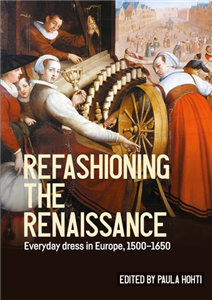
Refashioning the Renaissance
Everyday dress in Europe, 1500–1650
by Paula Hohti
How did ordinary men and women dress in early modern Europe? What fabrics and garments formed the essential elements of fashion for artisans and shopkeepers? Did they rely on affordable alternatives to the silks, jewellery, and decorations favoured by the wealthy elite? Or did those with modest means find innovative ways to express their fashion sense? This book provides new perspectives on early modern clothing and fashion history byinvestigating the consumption and meaning of fashionable clothing and accessories among the 'popular' classes. Through a close examination of the materials, craftsmanship and cultural significance of fashion items owned by and available to a broad group of consumers, it challenges conventional assumptions that the everyday dress of ordinary families was limited to a narrow selection of garments made of coarse textiles, often produced at home and resistant to change.
-
Trusted Partner
-
Trusted Partner
-
Trusted Partner
-
Trusted Partner

 September 2023
My Bank Washes Greener
Eco lies told by the finance sector
by Bernd Villhauer
— By the expert in ethical business — Once you have finished this, you will never fall for green financial lies again — Global Ethic Institute (Weltethos- Institut) network And suddenly every bank is sustainable. This truly necessary "debate book" explains in a wellfounded way what green-washing means in the financial sector, and why banks, insurance companies, asset managers, stockbrokers and other financial players clothe themselves in their allegedly so green-and-friendly cloak. It provides an easy-to-understand explanation of the various forms of greenwashing, how we can recognise the different "varieties" and – above all – how we can avoid them. This is also important because the entire financial and capital system is an important part of a sustainable future – and this can only succeed if it is honest, transparent and impact-orientated.



