
Your Search Results
-

-

ZNN Network Literary and Illustrator Agency
- International Copyright, Licensing, and Literary Agency - International Illustrator Agency and Management Services - Creative Content Development Services
View Rights Portal
-
Promoted Content
-
Promoted Content

 June 2018
Die allerbeste Prinzessin
by Poznanski, Ursula / Illustrated by Büchner, SaBine
An innovative & different princess story! • The three princesses love to quarrel • Original and incredibly witty • Written by Ursula Poznanski and stunning illustrations by Sabine Büchner • Translation Grant! Bianca, Violetta and Rosalind are three adorable princesses. But they share a tiny quirk: they love to argue! One day a visitor asks for entrance into the castle. Prince Waldomir doesn’t enjoy hunting dragons anymore and rather prefers to get married know. Of course each princess is convinced to be the best choice and the prince’s one and only. So a rat race is launched before they have even met the puny prince for the first time…
-
 Trusted Partner

 Humanities & Social SciencesOctober 2020
Representative democracy?
by Ron Johnston, Charles Pattie, David Rossiter
-
Trusted Partner

 2022
2022Talking to Customersin Pharmacies
A conversation guidefor newcomers and old hands
by Dr Kirsten Lennecke, Illustrated by Barbara Kohm
The basis for successful advice is having a sound knowledge of the effect and application of medicines, but also an instinct for the individual needs and characteristics of the person asking for your help. This skill can be trained! Entertaining explanations and numerous case examples taken from everyday pharmacy practice help with this. They show how pharmacy staff can react empathetically, avoid misunderstandings, and manage delicate situations with confidence. The 5th edition has become more colourful! This applies not only to the illustrations, but also to the team and customers of our model pharmacy. A personality model with distinctive colours representing the different characters promises exciting insights. Good communication creates satisfied customers who want to come back again and again!
-
Trusted Partner
 The ArtsJune 2026
The picture politics of Sir Francis Carruthers Gould
Britain's pioneering political cartoonist
by Colin Seymour-Ure, Mark Bryant
This is the first major study of Britain's pioneering graphic satirist, Sir Francis Carruthers Gould (1844-1925), the first staff political cartoonist on a daily newspaper in Britain, and the first of his kind to be knighted. Written by the distinguished media historian, Colin Seymour-Ure, it is essential reading for anyone interested in cartoons, caricature and illustration and will also be welcomed by students of history, politics and the media. It examines Gould's career in Fleet Street until his retirement after the First World War. It also discusses his illustrations for magazines and books and there is an analysis of his use of symbolism and literary allusion to lampoon such eminent politicians as Gladstone and Joseph Chamberlain. As Lord Baker says in his Foreword, this book is 'a major contribution to our knowledge of British cartooning.'
-
Trusted Partner
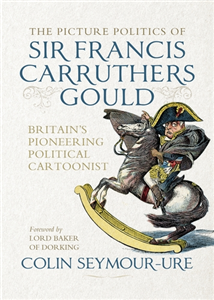 The ArtsDecember 2024
The picture politics of Sir Francis Carruthers Gould
Britain's pioneering political cartoonist
by Mark Bryant
This is the first major study of Britain's pioneering graphic satirist, Sir Francis Carruthers Gould (1844-1925), the first staff political cartoonist on a daily newspaper in Britain, and the first of his kind to be knighted. Written by the distinguished media historian, Colin Seymour-Ure, it is essential reading for anyone interested in cartoons, caricature and illustration and will also be welcomed by students of history, politics and the media. It examines Gould's career in Fleet Street until his retirement after the First World War. It also discusses his illustrations for magazines and books and there is an analysis of his use of symbolism and literary allusion to lampoon such eminent politicians as Gladstone and Joseph Chamberlain. As Lord Baker says in his Foreword, this book is 'a major contribution to our knowledge of British cartooning.'
-

 September 1904
Hamlet
by William Shakespeare
Hamlet is Shakespeare's longest play, and is considered among the most powerful and influential works of world literature, with a story capable of "seemingly endless retelling and adaptation by others". The play likely was one of Shakespeare's most popular works during his lifetime, and still ranks among his most performed, topping the performance list of the Royal Shakespeare Company and its predecessors in Stratford-upon-Avon since 1879. It has inspired many other writers—from Johann Wolfgang von Goethe and Charles Dickens to James Joyce and Iris Murdoch—and has been described as "the world's most filmed story after Cinderella"
-

 The ArtsJanuary 1905
The Elements of Drawing
by John Ruskin
Can drawing — sound, honest representation of the world as the eye sees it, not tricks with the pencil or a few "effects" — be learned from a book? One of the most gifted draftsmen, who is also one of the greatest art critics and theorists of all time, answers that question with a decided "Yes." He is John Ruskin, the author of this book, a classic in art education as well as a highly effective text for the student and amateur today. The work is in three parts, cast in the form of letters to a student, successively covering "First Practice," "Sketching from Nature," and "Colour and Composition." Starting with the bare fundamentals (what kind of drawing pen to buy; shading a square evenly), and using the extremely practical method of exercises which the student performs from the very first, Ruskin instructs, advises, guides, counsels, and anticipates problems with sensitivity. The exercises become more difficult, developing greater and greater skills until Ruskin feels his reader is ready for watercolors and finally composition, which he treats in detail as to the laws of principality, repetition, continuity, curvature, radiation, contrast, interchange, consistency, and harmony. All along the way, Ruskin explains, in plain, clear language, the artistic and craftsmanlike reasons behind his practical advice — underlying which, of course, is Ruskin's brilliant philosophy of honest, naturally observed art which has so much affected our aesthetic. Three full-page plates and 48 woodcuts and diagrams (the latter from drawings by the author) show the student what the text describes. An appendix devotes many pages to the art works which may be studied with profit.
-
 The ArtsMarch 1905
Concerning the Spiritual in Art
by Wassily Kandinsky
A pioneering work in the movement to free art from its traditional bonds to material reality, this book is one of the most important documents in the history of modern art. Written by the famous nonobjective painter Wassily Kandinsky (1866–1944), it explains Kandinsky's own theory of painting and crystallizes the ideas that were influencing many other modern artists of the period. Along with his own groundbreaking paintings, this book had a tremendous impact on the development of modern art. Kandinsky's ideas are presented in two parts. The first part, called "About General Aesthetic," issues a call for a spiritual revolution in painting that will let artists express their own inner lives in abstract, non-material terms. Just as musicians do not depend upon the material world for their music, so artists should not have to depend upon the material world for their art. In the second part, "About Painting," Kandinsky discusses the psychology of colors, the language of form and color, and the responsibilities of the artist. An Introduction by the translator, Michael T. H. Sadler, offers additional explanation of Kandinsky's art and theories, while a new Preface by Richard Stratton discusses Kandinsky's career as a whole and the impact of the book. Making the book even more valuable are nine woodcuts by Kandinsky himself that appear at the chapter headings. This English translation of Über das Geistige in der Kunst was a significant contribution to the understanding of nonobjectivism in art. It continues to be a stimulating and necessary reading experience for every artist, art student, and art patron concerned with the direction of 20th-century painting.
-

 Biography & True StoriesMarch 1905
Chopin: The Man and His Music
by James Huneker
Chopin: The Man and His Music reflects the intimate, thorough knowledge of Chopin's music that Huneker acquired while studying to be a concert pianist and his unusually keen insight into the character of the great Polish composer whose music he adored.
-

 Humanities & Social SciencesNovember 1904
Common Sense
Addressed to The Inhabitants of America
by Thomas Paine
Published anonymously in 1776, six months before the Declaration of Independence, Thomas Paine’s Common Sense was a radical and impassioned call for America to free itself from British rule and set up an independent republican government. Savagely attacking hereditary kingship and aristocratic institutions, Paine urged a new beginning for his adopted country in which personal freedom and social equality would be upheld and economic and cultural progress encouraged.
-

 Business, Economics & LawApril 1905
Creating Capital
Money-making as an aim in business
by Fredrick L. Lipman
The object of this paper is to discuss money-making; to examine its prevalence as an aim among people generally and the moral standards which obtain among those who consciously seek to make money.
-
 Business, Economics & LawApril 1905
The Acquisitive Society
by R.H. Tawney
This 1926 survey, written by a distinguished social and economic historian, examines the role of religion in the rise of capitalism. Arguing that material acquisitiveness is morally wrong and a corrupting social influence, the author draws upon his profound knowledge of labor and politics to show how concentrated wealth distorts economic policies. Colorful but credible, this study offers a timeless vision of alternative means toward a just economic, social, and intellectual order.
-

 Business, Economics & LawMarch 1905
The Path of the Law
by Oliver Wendell Holmes Jr.
In The Path of the Law, Holmes discusses his personal philosophy on legal practice. The Common Law is a series of lectures that established Holmes's reputation as a witty and articulate writer.
-

 Technology, Engineering & AgricultureMarch 1905
The First Book of Farming
by Charles L. Goodrich
This book is a result of the author's search for these facts and truths as a student and farmer and his endeavor as a teacher to present them in a simple manner to others. The object in presenting the book to the general public is the hope that it may be of assistance to farmers, students and teachers, in their search for the fundamental truths and principles of farming.
-

 Health & Personal DevelopmentMarch 1905
Ginseng and Other Medicinal Plants
by A. R. Harding
This book is made up largely from the experiences of hunters and trappers who have dug "seng" and "seal" and who know much of their peculiarities, and scores are now successful growers.In adidtion to Ginseng and Golden Seal nearly 50 other medicinal plants are described--habits, range, price, uses, etc.
-

 Lifestyle, Sport & LeisureMarch 1905
How to Cook Fish
by Myrtle Reed
This book is a collection of recipes for fish cooking.
-

 Children's & YAMarch 1905
The Crimson Sweater
by Ralph Henry Barbour
The story of a schoolboy who proves himself through rugged feats in football and hockey.
-

 Colonialism & imperialismMarch 1905
Heart of Darkness
by Joseph Conrad
Heart of Darkness (1899) is a novella by Polish-British novelist Joseph Conrad, about a voyage up the Congo River into the Congo Free State, in the heart of Africa, by the story's narrator Charles Marlow. Marlow tells his story to friends aboard a boat anchored on the River Thames, London, England. This setting provides the frame for Marlow's story of his obsession with the ivory trader Kurtz, which enables Conrad to create a parallel between London and Africa as places of darkness.



