Your Search Results
-

-

Reading Luxembourg
Reading Luxembourg is Luxembourg's export programme. Beyond the annual national stand at Frankfurt Book Fair, Reading Luxembourg is in charge of various missions, such as the presence at other fairs, festivals and literary events, a training offer for professionals of the book and publishing sector and strategic support to foreign rights sales. Reading Luxembourg is linking up publishers and authors from Luxembourg with stakeholders on an international level and providing information on available translation and publication grants.
View Rights Portal
-
Promoted Content
-
Promoted Content
-
 Trusted Partner

 Humanities & Social SciencesMarch 2017
Child, nation, race and empire
Child rescue discourse, England, Canada and Australia, 1850–1915
by Margot Hillel, Shurlee Swain, Andrew Thompson, John M. MacKenzie
Child, nation, race and empire is an innovative, inter-disciplinary, cross cultural study that contributes to understandings of both contemporary child welfare practices and the complex dynamics of empire. It analyses the construction and transmission of nineteenth-century British child rescue ideology. Locating the origins of contemporary practice in the publications of the prominent English Child rescuers, Dr Barnardo, Thomas Bowman Stephenson, Benjamin Waugh, Edward de Montjoie Rudolf and their colonial disciples and literature written for children, it shows how the vulnerable body of the child at risk came to be reconstituted as central to the survival of nation, race and empire. Yet, as the shocking testimony before the many official enquiries into the past treatment of children in out-of-home 'care' held in Britain, Ireland, Australia and Canada make clear, there was no guarantee that the rescued child would be protected from further harm.
-
Trusted Partner
 Humanities & Social SciencesMarch 2025
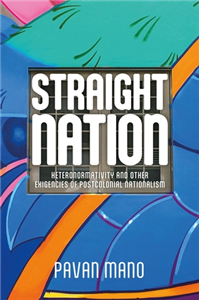
Straight nation
Heteronormativity and other exigencies of postcolonial nationalism
by Pavan Mano
In Straight Nation, Pavan Mano reveals the logic of straightness that sits at the heart of postcolonial nationalism in Singapore. Mano rejects the romantic notion of the nation as a haven of belonging, showing it to be a relentless force that is allied with heteronormativity to create a host of minoritized and xenologized figures. Through meticulous exploration and close reading of a swathe of texts, Mano unveils the instrumental role of sexuality in structuring the national imaginary. The book adroitly demonstrates how queerness is rendered foreign in postcolonial Singapore and functions alongside technologies of "race", gender, and class. A provocative critique of narrow contemporary identity politics and its concomitant stymying of a more ambitious political critique, Straight Nation sets out an argument that moves beyond the negativity of traditional critique into a space of (re)thinking, (re)building and (re)imagining.
-
Trusted Partner

 February 2007
Mister Moores Wortgestöber
Ein Wegweiser durch die Sprachen der Welt
by Moore, C.J / Deutsch Strüh, Christine
-
Trusted Partner
 The ArtsDecember 2022
D. W. Griffith's The Birth of a Nation
by Jenny Barrett, Douglas Field, Ian Scott
-
Trusted Partner
 Humanities & Social SciencesApril 2018
The Conservative Party and the nation
by Arthur Aughey, Richard Hayton
-
Trusted Partner
 TelevisionSeptember 2004
Terry Nation
by Jonathan Bignell, Andrew O'Day
This is the first in-depth study of the science fiction television devised and written by Terry Nation. Terry Nation was the inventor of the Daleks and wrote other serials for 'Doctor Who'; he also wrote the BBC's 1970s post-apocalyptic drama 'Survivors' and created the space adventure series 'Blake's 7'. Previously television science fiction in Britain has received little critical attention. This book fills that gap and places Nation's work in the context of its production. Using Terry Nation's science fiction work as a case study, the boundaries around the authorship and authority of the television writer are explored in detail. The authors make use of BBC's archival research and specially conducted interviews with television producers and other production staff, to discuss how the programmes that Terry Nation created and wrote were commissioned, produced and brought to the screen. The book makes an important contribution to the study of British television history and will be of interest to enthusiasts of Terry Nation's landmark drama series as well as students of Television Studies.
-
Trusted Partner
 January 2008
Love's Sacrifice
by A. T. Moore
A. T. Moore's thorough commentary on "Love's Sacrifice" is designed to be of use to all kinds of readers, from students of Early Modern drama to specialists in the field. The notes provide full explanations of obscure words and phrases, and offer analyzes of many aspects of staging and interpretation. The text for this edition is based on a fresh study of the quarto of 1633, the only authoritative early text. In his introduction to the play, Moore reappraises the evidence for the play's date of composition. He also looks at the circumstances of the play's genesis, presenting detailed discussions of both the theater where "Love's Sacrifice" was first performed and the acting company for which it was written. Arguing that Ford's adaptation of his source materials is the key to interpreting this remarkably allusive play, Moore provides a wealth of new information about Ford's sources.The introduction also includes a survey of critical responses, an overview of the play, stage history, and a bibliography of relevant secondary material. This new volume in the "Revels Plays" series is the most detailed and comprehensive edition of "Love's Sacrifice" ever published - and the first modern-spelling edition of Ford's tragedy in more than a century. The play's textual history is discussed in an appendix. A second appendix examines possible links between "Love's Sacrifice" and the real-life story of the murdered Italian prince and musician Carlo Gesualdo. ;
-
Trusted Partner
 Humanities & Social SciencesMay 2020
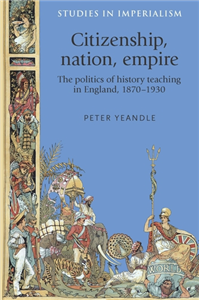
Citizenship, nation, empire
The politics of history teaching in England, 1870–1930
by Andrew Thompson, Peter Yeandle, John M. MacKenzie
Citizenship, nation, empire investigates the extent to which popular imperialism influenced the teaching of history between 1870 and 1930. It is the first book-length study to trace the substantial impact of educational psychology on the teaching of history, probing its impact on textbooks, literacy primers and teacher-training manuals. Educationists identified 'enlightened patriotism' to be the core objective of historical education. This was neither tub-thumping jingoism, nor state-prescribed national-identity teaching, but rather a carefully crafted curriculum for all children which fused civic as well as imperial ambitions. The book will be of interest to those studying or researching aspects of English domestic imperial culture, especially those concerned with questions of childhood and schooling, citizenship, educational publishing and anglo-British relations. Given that vitriolic debates about the politics of history teaching have endured into the twenty-first century, Citizenship, nation, empire is a timely study of the formative influences that shaped the history curriculum in English schools
-
Trusted Partner
-
Trusted Partner
-
Trusted Partner
-
Trusted Partner
 Humanities & Social SciencesJuly 2010
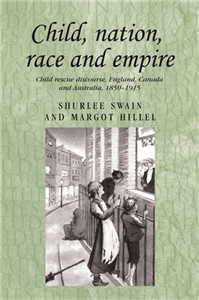
Child, nation, race and empire
Child rescue discourse, England, Canada and Australia, 1850–1915
by Margot Hillel, Shurlee Swain, Andrew Thompson, John Mackenzie
Child, nation, race and empire is an innovative, inter-disciplinary, cross cultural study that contributes to understandings of both contemporary child welfare practices and the complex dynamics of empire. It analyses the construction and transmission of nineteenth-century British child rescue ideology. Locating the origins of contemporary practice in the publications of the prominent English Child rescuers, Dr Barnardo, Thomas Bowman Stephenson, Benjamin Waugh, Edward de Montjoie Rudolf and their colonial disciples and literature written for children, it shows how the vulnerable body of the child at risk came to be reconstituted as central to the survival of nation, race and empire. Yet, as the shocking testimony before the many official enquiries into the past treatment of children in out-of-home 'care' held in Britain, Ireland, Australia and Canada make clear, there was no guarantee that the rescued child would be protected from further harm. ;
-
Trusted Partner
-
Trusted Partner
-
Trusted Partner
 Literature & Literary StudiesAugust 2013
Alan Moore and the Gothic tradition
by Matthew J. A. Green
-
Trusted Partner
-
Trusted Partner
-
Trusted Partner