Your Search Results

      • PIE International Inc. (PIE Books)

        Established in 1971, PIE International built their reputation for outstanding art direction and high-quality production over the years, starting with an extensive collection of Design & Art books, and later expanding to include Children's books, Comic & Manga Arts and Lifestyle books. “My First Earth Picture Book” is the latest title in the educational series by Akemi Tezuka. A total of 880,000 copies from this series have been printed in Asia. “Houses with a Story” by Seiji Yoshida is our latest bestselling Comic Art book, which has reprinted four times in four months. We are very excited to have this great opportunity to reach you all!

        View Rights Portal
      • Agriculture & International Development

        Textbooks, research and professional titles in Agriculture and International Development

        View Rights Portal
      • Trusted Partner
      • Trusted Partner
      • Trusted Partner
      • Trusted Partner
      • Trusted Partner
        Humanities & Social Sciences
        September 2023

        International law in Europe, 700–1200

        by Jenny Benham

        Was there international law in the Middle Ages? Using treaties as its main source, this book examines the extent to which such a system of rules was known and followed in the period 700 to 1200. It considers how consistently international legal rules were obeyed, whether there was a reliance on justification of action and whether the system had the capacity to resolve disputed questions of fact and law. The book further sheds light on issues such as compliance, enforcement, deterrence, authority and jurisdiction, challenging traditional ideas over their role and function in the history of international law. International law in Europe, 700-1200 will appeal to students and scholars of medieval Europe, international law and its history, as well as those with a more general interest in warfare, diplomacy and international relations.

      • Trusted Partner
        Humanities & Social Sciences
        October 2021

        Indo-Pacific Empire

        by Rory Medcalf

      • Trusted Partner
        Business, Economics & Law
        January 2026

        International organisations, non-State actors, and the formation of customary international law

        by Sufyan Droubi, Jean d'Aspremont

        This volume offers new practical and theoretical perspectives on one of the most complex questions regarding the formation of international law, namely that actors other than states contribute to the making of customary international law. Notwithstanding the International Law Commission's valuable contribution, the making of customary international law remains riddled with acute practical and theoretical controversies that continue to be intensively debated. Making extensive reference to the case-law of international law courts and tribunals, as well as the most recent scholarly work on customary international law, this volume provides a comprehensive study of the contribution of international organisations and non-state actors to the formation of customary international law. With innovative tools and guidance for law students, legal scholars, and researchers in law, as well as legal practitioners, advisers, judges, arbitrators, and counsels, this collection is essential reading for those wishing to understand and address contemporary questions of international law-making.

      • Trusted Partner
        Humanities & Social Sciences
        April 2020

        The British political elite and Europe, 1959-1984

        A higher loyalty

        by Bob Nicholls

        This book offers an original interpretation of Britain's relationship with Europe over a 25 year period: 1959-84 and advances the argument that the current problems over EU membership resulted from much earlier political machinations. This evidence based account of the seminal period analyses the applications for EEC membership, the 1975 referendum, and the role of the press. Was the British public misled over the true aims of the European project? How significant was the role of the press in changing public opinion from anti, to pro Common Market membership? Why, after over 40 years since Britain became a member of the European community, does the issue continue to deeply divide not only the political elite, but also the British public? These, and other pertinent questions are answered in this timely book on a subject that remains topical and highly controversial.

      • Trusted Partner
      • Trusted Partner
        Humanities & Social Sciences
        October 2023

        Towards a just Europe

        A theory of distributive justice for the European Union

        by João Labareda

        This highly original book constitutes one of the first attempts to examine the problem of distributive justice in the European Union in a systematic manner. João Labareda argues that the set of shared political institutions at EU level, including the European Parliament and the Court of Justice of the EU, generate democratic duties of redistribution among EU citizens. Furthermore, the economic structure of the EU, comprising a common market, a common currency and a free-movement area, triggers duties of reciprocity among member states. The responsibilities to fulfil these duties, Labareda argues, should be shared by the local, national and supranational levels of government. Not only should the EU act as a safety net to the national welfare systems, applying the principle of subsidiarity, but common market and Eurozone regulations should balance their efficiency targets with fair cooperation terms. The concrete policy proposals presented in this book include a threshold of basic goods for all EU citizens, an EU labour code, a minimum EU corporate tax rate and an EU fund for competitiveness. Labarada argues that his proposals match the political culture of the member states, are economically feasible, can be translated into functioning institutions and policies and are consistent with the limited degree of social solidarity in Europe. This book is a major contribution to the understanding of what a just Europe would look like and what it might take to get us there. This book is relevant to United Nations Sustainable Development Goal 10, Reduced inequalities

      • Trusted Partner
        Humanities & Social Sciences
        February 2025

        Empire and subject peoples

        Herbert Adolphus Miller and the political sociology of domination

        by Jan Balon, John Holmwood

        The book outlines the sociological arguments and political activities of the US pragmatist sociologist, Herbert Adolphus Miller (1875-1951). Miller was part of the milieu of Chicago sociology and involved in its studies of race and immigration. He took a distinctly more radical approach and developed a novel political sociology of domination in which he set out a critique of empires, the plight of subject minorities and the risks associated with the inevitable nationalist responses. Where others have identified with the 'internationalisation' of nationalism, Miller sought to make the nation 'international'. He was actively involved in movements for racial justice, Czechoslovakian independence, the formation of the Mid-European Union of subject peoples, as well as support for Korean and Indian independence. He was dismissed by Ohio State University for his activism in 1932.

      • Trusted Partner
        Humanities & Social Sciences
        November 2025

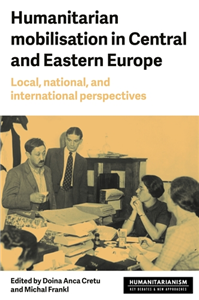
        Humanitarian mobilisation in Central and Eastern Europe

        Local, national, and international perspectives

        by Doina Anca Cretu, Michal Frankl

        By focusing on aid Central and Eastern Europe, the volume adds to the existent scholarly explorations of modern humanitarianism, its actors and practices. In the twentieth century, aid workers assisted victims of war and earthquakes, delivered food, supported health care, provided childcare, or sheltered refugees. The contributors not only reconstruct these diverse histories and their protagonists, but also bring international, national, and local actors together: from grassroots activists to private associations to state-driven "socialist humanitarians" to large Western aid organizations. In doing so, they challenge the often unidirectional, from West-to-East, and asymmetrical perspective on donor-recipient relationships in humanitarian processes.

      • Trusted Partner
        The Arts
        January 2019

        European Film Noir

        by Andrew Spicer

        European Film Noir is the first book to bring together specialist discussions of film noir in specific European national cinemas. Written by leading scholars, this groundbreaking study provides an authoritative understanding of an important aspect of European cinema and of film noir itself, for too long considered as a solely American form. The Introduction reviews the problems of defining film noir, its key characteristics and discusses its significance to the development of European film, the relationship of specific national films noirs to each other, to American noir and to historical and social change. Eight chapters then discuss film noir in France, Germany, Britain and Spain, analysing both earlier developments and the evolution of neo-noir through to the present. A further chapter explores film noir in Italian cinema where its presence is not so well defined. Each piece provides a critical overview of the most significant films in relation to their industrial and social contexts. European Film Noir is an important contribution to the study of European cinema that will have a broad appeal to undergraduates, cinéastes, film teachers and researchers.

      • Trusted Partner
      • Trusted Partner
      • Trusted Partner
      • Trusted Partner
      • Trusted Partner
        Humanities & Social Sciences
        April 2026

        Visions for Europe

        Debating the future of the European Union with great political thinkers

        by João Labareda

        This book offers a fresh look at some of the most challenging dilemmas of European integration and proposes innovative solutions to them by building on perspectives and insights from twelve classical authors in the history of political thought. The book simultaneously offers an original introduction to critical debates in EU studies and makes key political thinkers more accessible to contemporary readers by presenting present-day policy applications of their doctrines. While each chapter discusses a specific challenge for the EU, five key themes appear recurrently throughout the book: (i) the prospects for peace in Europe; (ii) the conditions for an inclusive EU democracy; (iii) socioeconomic inequalities in the EU; (iv) strategies to promote political change in Europe; and (v) the requisites for a fully-fledged EU citizenship. The authors discussed are Plato, Aristotle, Augustine, Machiavelli, Hobbes, Rousseau, Kant, Wollstonecraft, Marx, Arendt, Rawls and hooks.

      Subscribe to our

      newsletter