Your Search Results

      • Guangdong Science & Technology Press Co., Ltd.

        Guangdong Science and Technology Press, founded in May,1978, is one of the earliest regional press in China. Now it has developed into a comprehensive enterprise of technology press with a well-trained professional team and with an annual putout of 1000 books. We mainly publishes technology books in the fields of science, engineering, agriculture, medicine, economic management, daily science, etc.

        View Rights Portal
      • Guangxi Science & Technology Publishing House Co., Ltd.

        Guangxi Science & Technology Publishing House Co., Ltd.was founded in 1988 and have developed over 30 years. We were rated as "Copyright Importing and Exporting Excellent Company "in 2012. We keep selling books’copyrights of Chinese culture, medicine, agriculture, education, children's books with the publishers from U.S.A.,Canada,France,Germany,Japan, Korea, Malaysia, India, Vietnam, Indonesia.

        View Rights Portal
      • Trusted Partner
        Humanities & Social Sciences
        March 2017

        Science and society in southern Africa

        by Saul Dubow

        This collection, dealing with case studies drawn from South Africa, Zimbabwe, Mozambique and Mauritius, examines the relationship between scientific claims and practices, and the exercise of colonial power. It challenges conventional views that portray science as a detached mode of reasoning with the capacity to confer benefits in a more or less even-handed manner. That science has the potential to further the collective good is not fundamentally at issue, but science can also be seen as complicit in processes of colonial domination. Not only did science assist in bolstering aspects of colonial power and exploitation, it also possessed a significant ideological component: it offered a means of legitimating colonial authority by counter-poising Western rationality to native superstition and it served to enhance the self-image of colonial or settler elites in important respects. This innovative volume ranges broadly through topics such as statistics, medicine, eugenics, agriculture, entomology and botany.

      • Trusted Partner
        Humanities & Social Sciences
        January 2024

        Dog politics

        Species stories and the animal sciences

        by Mariam Motamedi Fraser

        Do dogs belong with humans? Scientific accounts of dogs' 'species story,' in which contemporary dog-human relations are naturalised with reference to dogs' evolutionary becoming, suggest that they do. Dog politics dissects this story. This book offers a rich empirical analysis and critique of the development and consolidation of dogs' species story in science, asking what evidence exists to support it, and what practical consequences, for dogs, follow from it. It explores how this story is woven into broader scientific shifts in understandings of species, animals, and animal behaviours, and how such shifts were informed by and informed transformative political events, including slavery and colonialism, the Second World War and its aftermath, and the emergence of anti-racist movements in the twentieth and twenty-first centuries. The book pays particular attention to how species-thinking bears on 'race,' racism, and individuals.

      • Trusted Partner
        Medicine
        November 2024

        Technology, health and the patient consumer in the twentieth century

        by Rachel Elder, Thomas Schlich

        Technology and consumerism are two characteristic phenomena in the history medicine and healthcare, yet the connections between them are rarely explored by scholars. In this edited volume, the authors address this disconnect, noting the ways in which a variety of technologies have shaped patients' roles as consumers since the early twentieth century. Chapters examine key issues, such as the changing nature of patient information and choice, patients' assessment of risk and reward, and matters of patient role and of patient demand as they relate to new and changing technologies. They simultaneously investigate how differences in access to care and in outcomes across various patient groups have been influenced by the advent of new technologies and consumer-based approaches to health. The volume spans the twentieth and twenty-first centuries, spotlights an array of medical technologies and health products, and draws on examples from across the United States and United Kingdom.

      • Trusted Partner
        Science & Mathematics
        September 2024

        The elephant and the dragon in contemporary life sciences

        A call for decolonising global governance

        by Joy Y. Zhang, Saheli Datta Burton

        This book provides a powerful diagnosis of why the global governance of science struggles in the face of emerging powers. Through unpacking critical events in China and India over the past twenty years, it demonstrates that the 'subversiveness' assumed in the two countries' rise in the life sciences reflects many of the regulatory challenges that are shared worldwide. It points to a decolonial imperative for science governance to be responsive and effective in a cosmopolitan world. By highlighting epistemic injustice within contemporary science, the book extends theories of decolonisation.

      • Trusted Partner
        Humanities & Social Sciences
        May 2009

        Consumerism and the Co-operative movement in modern British history

        Taking stock

        by Lawrence Black, Nicole Robertson

        Despite the abundance and quality of recent historical writing on consumerism, it cannot be said that the modern Co-operative movement (Co-op) has been well served. It has also been by-passed in studies that locate Britons' identity in their consumption. The reasons for this can be found in the widely perceived decline of the Co-op since the 1950s, but also in various historiographical agendas that have resulted in its relative invisibility in modern British history. This book, by demonstrating the variety of broader issues that can be addressed through the Co-op and the vibrancy of new historical research into consumption, seeks to remedy this. Taking stock, both of the Co-op in a broader context and of new approaches to the history of consumption, combines the work of leading authorities on the Co-op with recent scholarly research. It explores the Co-op's distinctive interface between everyday issues and grander idealistic concerns. The chapters intersect to examine a broad range of themes, notably: the politics of consumerism including consumer protection, ethical and fair trading and alternatives to corporate commerce; design and advertising; the Co-op's relations with other components of the labour movement; and its ideology, image and memory. The collection looks at the Co-operative movement locally (through specific case studies), nationally and also in comparison to the European movement. This collection will appeal to academics, researchers, teachers and students of the economic, cultural and political history of twentieth-century Britain. It will also be of interest to academics and students of business studies, and co-operative members themselves. ;

      • Trusted Partner
        Humanities & Social Sciences
        February 2017

        Conflict, Politics and Proselytism

        Methodist missionaries in colonial and postcolonial Burma, 1887–1966

        by Andrew Thompson, Michael D. Leigh, John M. MacKenzie

        This book is a study of the ambitions, activities and achievements of Methodist missionaries in northern Burma from 1887-1966 and the expulsion of the last missionaries by Ne Win. The story is told through painstaking original research in archives which contain thousands of hitherto unpublished documents and eyewitness accounts meticulously recorded by the Methodist missionaries. This accessible study constitutes a significant contribution to a very little-known area of missionary history. Leigh pulls together the themes of conflict, politics and proselytisation in to a fascinating study of great breadth. The historical nuances of the relationship between religion and governance in Burma are traced in an accessible style. This book will appeal to those teaching or studying colonial and postcolonial history, Burmese politics, and the history of missionary work.

      • Trusted Partner
        Humanities & Social Sciences
        June 2009

        Science and society in southern Africa

        by Andrew Thompson, Saul Dubow, John Mackenzie

        This collection, dealing with case studies drawn from South Africa, Zimbabwe, Mozambique and Mauritius, examines the relationship between scientific claims and practices, and the exercise of colonial power. It challenges conventional views that portray science as a detached mode of reasoning with the capacity to confer benefits in a more or less even-handed manner. That science has the potential to further the collective good is not fundamentally at issue, but science can also be seen as complicit in processes of colonial domination. Not only did science assist in bolstering aspects of colonial power and exploitation, it also possessed a significant ideological component: it offered a means of legitimating colonial authority by counter-poising Western rationality to native superstition and it served to enhance the self-image of colonial or settler elites in important respects. This innovative volume ranges broadly through topics such as statistics, medicine, eugenics, agriculture, entomology and botany. ;

      • Trusted Partner
        The Arts
        May 2026

        Ecology and feminism in performance

        Composting histories 1962–2020

        by Cara Berger

        This book provides a vital new history of feminist performance through an ecological lens. It argues that from the 1960s to the present, artists have used performance to challenge the linked oppression of women and nature. Proposing 'composting' as a new method for writing feminist history, the study moves beyond linear narratives to trace regenerative connections between generations of practitioners. It provides sustained analysis of genres from land art to postdramatic theatre, re-evaluating the work of canonical figures while examining how contemporary artists continue to address these urgent themes. By placing ecofeminism in dialogue with feminist new materialism, queer ecology, and transecological thought, this study demonstrates how performance has been a crucial site for imagining more just and sustainable futures in an age of environmental crisis.

      • Trusted Partner
        Humanities & Social Sciences
        February 2023

        Politics, performance and popular culture

        Theatre and society in nineteenth-century Britain

        by Peter Yeandle, Katherine Newey, Jeffrey Richards

        This collection brings together studies of popular performance and politics across the nineteenth century, offering a fresh perspective from an archivally grounded research base. It works with the concept that politics is performative and performance is political. The book is organised into three parts in dialogue regarding specific approaches to popular performance and politics. Part I offers a series of conceptual studies using popular culture as an analytical category for social and political history. Part II explores the ways that performance represents and constructs contemporary ideologies of race, nation and empire. Part III investigates the performance techniques of specific politicians - including Robert Peel, Keir Hardie and Henry Hyndman - and analyses the performative elements of collective movements.

      • Trusted Partner
        Humanities & Social Sciences
        August 1999

        British Politics in an Age of Reform

        by Michael J. Turner, Mark Greengrass

        This work is a detailed examination of principal themes in the political history of late 18th- and early 19th-century Britain. It evaluates much recent research, links the politics of the elite with the politics of the people and seeks to explain significant developments with reference to both their long- and short-term causes. Among the issues addressed are the relative powers of crown, cabinet and parliament between 1760 and 1832; the impact on domestic politics of revolution and war abroad; the growth of radicalism and popular political activity; agitation for reform and the responses of government; the rise of party; the connections between extra-parliamentary pressure and instability; at the centre of power. ;

      • Trusted Partner
        Humanities & Social Sciences
        February 2018

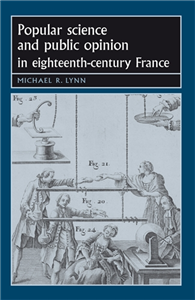
        Popular science and public opinion in eighteenth-century France

        by Michael Lynn, Joseph Bergin, Penny Roberts, Bill Naphy

        In this book, Michael R. Lynn analyses the popularisation of science in Enlightenment France. He examines the content of popular science, the methods of dissemination, the status of the popularisers and the audience, and the settings for dissemination and appropriation. Lynn introduces individuals like Jean-Antoine Nollet, who made a career out of applying electric shocks to people, and Perrin, who used his talented dog to lure customers to his physics show. He also examines scientifically oriented clubs like Jean-François Pilâtre de Rozier's Musée de Monsieur which provided locations for people interested in science. Phenomena such as divining rods, used to find water and ores as well as to solve crimes; and balloons, the most spectacular of all types of popular science, demonstrate how people made use of their new knowledge. Lynn's study provides a clearer understanding of the role played by science in the Republic of Letters and the participation of the general population in the formation of public opinion on scientific matters.

      • Trusted Partner
        European history
        October 2013

        Popular science and public opinion in eighteenth-century France

        by Michael R. Lynn

        Now available in paperback, Michael R. Lynn's book analyses the popularisation of science in Enlightenment France. He examines the content of popular science, the methods of dissemination, the status of the popularisers and the audience, and the settings for dissemination and appropriation. Lynn introduces individuals like Jean-Antoine Nollet, who made a career out of applying electric shocks to people, and Perrin, who used his talented dog to lure customers to his physics show. He also examines scientifically oriented clubs like Jean-François Pilâtre de Rozier's Musée de Monsieur which provided locations for people interested in science. Phenomena such as divining rods, used to find water and ores as well as to solve crimes; and balloons, the most spectacular of all types of popular science, demonstrate how people made use of their new knowledge. Lynn's study provides a clearer understanding of the role played by science in the Republic of Letters and the participation of the general population in the formation of public opinion on scientific matters.

      • Trusted Partner
        Political oppression & persecution
        July 2014

        Co-memory and melancholia

        Israelis memorialising the Palestinian Nakba

        by Ronit Lentin

        The 1948 war that led to the creation of the State of Israel also resulted in the destruction of Palestinian society when some 80 per cent of the Palestinians who lived in the major part of Palestine upon which Israel was established became refugees. Israelis call the 1948 war their 'War of Independence' and the Palestinians their 'Nakba', or catastrophe. After many years of Nakba denial, land appropriation, political discrimination against the Palestinians within Israel and the denial of rights to Palestinian refugees, in recent years the Nakba is beginning to penetrate Israeli public discourse. This book, available at last in paperback, explores the construction of collective memory in Israeli society, where the memory of the trauma of the Holocaust and of Israel's war dead competes with the memory claims of the dispossessed Palestinians. Against a background of the Israeli resistance movement, Lentin's central argument is that co-memorating the Nakba by Israeli Jews is motivated by an unresolved melancholia about the disappearance of Palestine and the dispossession of the Palestinians, a melancholia that shifts mourning from the lost object to the grieving subject. Lentin theorises Nakba co-memory as a politics of resistance, counterpoising co-memorative practices by internally displaced Israeli Palestinians with Israeli Jewish discourses of the Palestinian right of return, and questions whether return narratives by Israeli Jews, courageous as they may seem, are ultimately about Israeli Jewish self-healing rather than justice for Palestine.

      • Trusted Partner
        Biography & True Stories
        May 2025

        Mrs Dalloway

        Biography of a novel

        by Mark Hussey

        A compelling biography of one of the most celebrated novels in the English language. The fourth and best-known of Virginia Woolf's novels, Mrs Dalloway is a modernist masterpiece that has remained popular since its publication in 1925. Its dual narratives follow a day in the life of wealthy housewife Clarissa Dalloway and shell-shocked war veteran Septimus Warren Smith, capturing their inner worlds with a vividness that has rarely been equalled. Mrs Dalloway: Biography of a novel offers new readers a lively introduction to this enduring classic, while providing Woolf lovers with a wealth of information about the novel's writing, publication and reception. It follows Woolf's process from the first stirrings in her diary through her struggles to create what was quickly recognised as a major advance in prose fiction. It then traces the novel's remarkable legacy to the present day. Woolf wrote in her diary that she wanted her novel 'to give life & death, sanity & insanity. to criticise the social system, & to show it at work, at its most intense.' Mrs Dalloway: Biography of a novel reveals how she achieved this ambition, creating a book that will be read by generations to come.

      • Trusted Partner
        April 2017

        Science and Technology Studies

        Klassische Positionen und aktuelle Perspektiven

        by Susanne Bauer, Torsten Heinemann, Thomas Lemke

        In den vergangenen Jahrzehnten ist mit den Science and Technology Studies (STS) ein Forschungsfeld entstanden, das eine grundlegende Neubestimmung des Verhältnisses von Wissenschaft, Technik und Gesellschaft vornimmt. Der vorliegende Band versammelt erstmals zentrale Texte der STS in deutscher Sprache, u. a. von Bruno Latour, David Bloor, Michel Callon, Donna Harraway oder Karen Barad, und bietet zudem Überblicksdarstellungen aller wichtigen Forschungsgebiete und Theoriepositionen. Entstanden ist so eine grundlegende Einführung in diese innovative Forschungsrichtung, die darüber hinaus auch eine Zwischenbilanz der Entwicklung der STS zieht und aktuelle Herausforderungen und Debatten auslotet.

      • Trusted Partner
      • Trusted Partner
        Humanities & Social Sciences
        June 2025

        Local government and democracy in Britain

        by Neil Barnett, J. Chandler

        Local government in the UK is in crisis. It is now neither local in terms of the geography and populations of its principle units, nor does it truly govern in these areas. As this book reveals, over the previous 200 years local government has moved from a system in which local interests held governance over localities to one in which central government and national and multi-national agencies such as corporate businesses hold governance over local and community decision-making. These changes seriously undermine the important role that local government can play in liberal democracy in the UK. The book explains the nature of local government today and asks if there is any possibility of change.

      • Trusted Partner
        Humanities & Social Sciences
        January 2018

        Noble society

        Five lives from twelfth-century Germany

        by Jonathan R. Lyon

        This book provides scholars and students alike with a set of texts that can deepen their understanding of the culture and society of the twelfth-century German kingdom. The sources translated here bring to life the activities of five noblemen and noblewomen from Rome to the Baltic coast and from the Rhine River to the Alpine valleys of Austria. To read these five sources together is to appreciate how interconnected political, military, economic, religious and spiritual interests could be for some of the leading members of medieval German society-and for the authors who wrote about them. Whether fighting for the emperor in Italy, bringing Christianity to pagans in what is today northern Poland, or founding, reforming and governing monastic communities in the heartland of the German kingdom, the subjects of these texts call attention to some of the many ways that noble life shaped the world of central medieval Europe.

      Subscribe to our

      newsletter