
Wolters Kluwer Health
Wolters Kluwer Health is a leading global publisher of medical, nursing and allied health information resources in book, journal, newsletter, looseleaf and electronic media formats.
View Rights Portal
Wolters Kluwer Health is a leading global publisher of medical, nursing and allied health information resources in book, journal, newsletter, looseleaf and electronic media formats.
View Rights Portal



 Trusted Partner
Trusted Partner
Trusted Partner
Trusted Partner
Trusted Partner


This innovative critical volume brings the study of Margery Kempe into the twenty-first century. Structured around four categories of 'encounter' - textual, internal, external and performative - the volume offers a capacious exploration of The Book of Margery Kempe, characterised by multiple complementary and dissonant approaches. It employs a multiplicity of scholarly and critical lenses, including the intertextual history of medieval women's literary culture, medical humanities, history of science, digital humanities, literary criticism, oral history, the global Middle Ages, archival research and creative re-imagining. Revealing several new discoveries about Margery Kempe and her Book in its global contexts, and offering multiple ways of reading the Book in the modern world, it will be an essential companion for years to come.
Trusted Partner
This innovative critical volume brings the study of Margery Kempe into the twenty-first century. Structured around four categories of 'encounter' - textual, internal, external and performative - the volume offers a capacious exploration of The Book of Margery Kempe, characterised by multiple complementary and dissonant approaches. It employs a multiplicity of scholarly and critical lenses, including the intertextual history of medieval women's literary culture, medical humanities, history of science, digital humanities, literary criticism, oral history, the global Middle Ages, archival research and creative re-imagining. Revealing several new discoveries about Margery Kempe and her Book in its global contexts, and offering multiple ways of reading the Book in the modern world, it will be an essential companion for years to come.
Trusted Partner

The Island Book of Records brings the early years of this iconic record label to life. A fifteen-year labour of love, the volumes will fully document the analogue era of Island. Offering a comprehensive archive of album cover design and photography, together with the voices of the musicians, designers, photographers, producers, studio engineers and record company personnel that worked on each project, the volumes show in unique depth the workings of the label, covering every LP. Featuring material from recent interviews and from media interviews of the time, and each including a comprehensive discography of 45s, the books are lavishly illustrated with gig adverts (very many at venues which no longer exist), concert tickets, flyers, international LP variants, labels, LP and 45 adverts and other ephemera. These LP-sized editions are a collector's dream, offering a truly unparalleled resource for those interested in music history and a perfect gift for any music lover.


This book is a result of the author's search for these facts and truths as a student and farmer and his endeavor as a teacher to present them in a simple manner to others. The object in presenting the book to the general public is the hope that it may be of assistance to farmers, students and teachers, in their search for the fundamental truths and principles of farming.
Trusted Partner
Trusted Partner

The third in the acclaimed Island Book of Records series chronicles 1971-72, two years that saw the label secure a position at the forefront of contemporary music around the world. Major albums from Cat Stevens, Emerson, Lake & Palmer and Jethro Tull brought international success. Traffic released their era-defining The Low Spark of High Heeled Boys and Island returned to its roots with the soundtrack to the most important Jamaican film of all time, The Harder They Come. Nick Drake's masterpieces Bryter Layter and Pink Moon were yet to find their audience, but a new sensation emerged as Roxy Music released their first LP. Meanwhile, Bob Marley & The Wailers were beginning to record Catch A Fire - the album that will be the first to be detailed in IBoR IV. Featuring material from recent interviews and comment of the time, and including a comprehensive discography of 45s, The Island Book of Records Volume III is lavishly illustrated with album art, gig adverts, tickets, flyers, international LP variants, rare photos, LP and 45 adverts and exclusive ephemera.
Trusted Partner
Trusted Partner

Available in paperback for the first time, this important collection of essays illustrates the complexity, richness and diversity of the suffrage movement. Combining historical reappraisal with lively accounts of the culture of the women's suffrage movement, this volume offers a unique focus. It includes studies of the fascinating, but neglected groups that participated in the campaign: the Women's Franchise League; the Women's Freedom League; the Women's Tax Resistance League and the United Suffragists. This is accompanied by feminist research on the poetry, fiction and drama that emerged from women's struggle for the vote. In addition there are reappraisals of two leading figures in the Pankhursts' Women's Social and Political Union, an illuminating analysis of the relationship between suffrage and sexuality, and a discussion of what happened away from the metropolis, as well as of the little known campaign to extend the vote after 1918. ;
Trusted Partner
The second volume of this highly collectable series, covering the pivotal years of 1969-70. The Island Book of Records Volume II documents the years 1969-70, during which Island sought to build on its success with the Spencer Davis Group by seeking out new British rock talent. By the end of the period, Island was emerging as a major British label, one that could boast releases from Jethro Tull, Nick Drake, King Crimson, John and Beverley Martyn, Fairport Convention and Cat Stevens. Featuring material from recent interviews and from media interviews of the time, and including a comprehensive discography of 45s, The Island Book of Records Volume II is lavishly illustrated with gig adverts (very many at venues that no longer exist), concert tickets, flyers, international LP variants, labels, LP and 45 adverts and other ephemera collector's dream.
Trusted Partner

Universities have a key role to play in contributing to environmental development and combating climate change. The chapters within this volume detail the challenges faced by higher education institutions in considering environmental sustainability, and provide both a broad view of university engagement and a detailed examination of various projects. As part of this series in association with the Place and Social Capital and Learning (PASCAL) International Observatory, the three key PASCAL themes of place management, lifelong learning and the development of social capital are considered throughout the book. While universities have historically generated knowledge outside of specific local contexts, this book argues that it is particularly important for them to engage with the local community and to consider diverse perspectives and assets when looking at issues within an ecological context. The chapters in this volume provide new perspectives and frames of reference for transforming universities by engaging in the development of resilient communities.
Trusted Partner
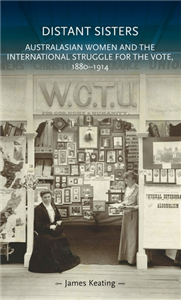
In the 1890s Australian and New Zealand women became the first in the world to win the vote. Buoyed by their victories, they promised to lead a global struggle for the expansion of women's electoral rights. Charting the common trajectory of the colonial suffrage campaigns, Distant Sisters uncovers the personal and material networks that transformed feminist organising. Considering intimate and institutional connections, well-connected elites and ordinary women, this book argues developments in Auckland, Sydney, and Adelaide-long considered the peripheries of the feminist world-cannot be separated from its glamourous metropoles. Focusing on Antipodean women, simultaneously insiders and outsiders in the emerging international women's movement, and documenting the failures of their expansive vision alongside its successes, this book reveals a more contingent history of international organising and challenges celebratory accounts of fin-de-siècle global connection.
Trusted Partner

The Love of Books examines the affective bond between people and books in the UK. In the context of the unprecedented abundance of media offering information, storytelling and entertainment, it investigates the attachment to print and digital books amongst readers from a range of backgrounds who read for pleasure, wish to be surrounded by print copies of books, and have trouble discarding books. Unlike existing research, which focuses on prestige, social status, and cultural capital, this study centres on meaning, materiality and emotion. Drawing on interviews and archive material, it shows how attachment emerges from the practical fusion of three elements that have so far been examined separately: the material, surface properties of books, the act of reading, and books' symbolic power.
Trusted Partner

Numerous women artists engaged with industrial materials such as plastics in the 1960s and 1970s, contrary to what the discourse of the time would have us believe. As Feminist substances shows, their works offered unique approaches to plastics in art, introducing new material meanings through a feminist lens. With a focus on Europe and Latin America, the book discusses the practices of Carla Accardi, Lea Lublin and Alina Szapocznikow, combining close readings of selected artworks with broader considerations of their social contexts. It explores their use of Sicofoil, plexiglass, plastic inflatables, polyester resin and polyurethane foam to address key concerns of feminist thought in relation to social reproduction, motherhood, memory, desire and illness. Beyond commonplaces of plastics as generic bad materials, Feminist substances considers more complex ways of engaging with synthetic matter, taking into account our messy relationships with these controversial materials.
Trusted Partner
Trusted Partner
 Trusted Partner

Written for everyone interested in women's and gender history, History matters reaffirms the importance to feminist theory and activism of long-term historical perspectives. Judith M. Bennett takes as her central problem the growing chasm between feminism and history which, although closely allied in the 1970s, have now moved away from one another. Seeking to narrow this gap, Bennett proposes that feminist historians turn their attention to the intellectual challenges posed by the persistence of patriarchy. She posits a 'patriarchal equilibrium' whereby, despite many changes in women's experiences over past centuries, women's status vis-à-vis men has remained remarkably unchanged. Bennett argues that the theoretical challenge posed by this 'patriarchal equilibrium' will be best met by long-term historical perspectives that reach back well before the modern era. A new manifesto, History matters engages forthrightly with the challenges faced by feminist historians today. It argues for the radical potential of a history that is focused on feminist issues, aware of the distant past, attentive to continuities over time, and alert to the workings of patriarchal power. ;



