
Your Search Results


-
Promoted Content

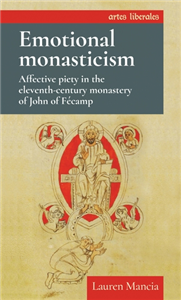 Humanities & Social SciencesJune 2021
Emotional monasticism
Affective piety in the eleventh-century monastery of John of Fécamp
by Lauren Mancia
Medievalists have long taught that highly emotional Christian devotion, often called 'affective piety', appeared in Europe after the twelfth century and was primarily practiced by communities of mendicants, lay people and women. Emotional monasticism challenges this view. The first study of affective piety in an eleventh-century monastic context, it traces the early history of affective devotion through the life and works of the earliest known writer of emotional prayers, John of Fécamp, abbot of the Norman monastery of Fécamp from 1028-78. Exposing the early medieval monastic roots of later medieval affective piety, the book casts a new light on the devotional life of monks in Europe before the twelfth century and redefines how medievalists should teach the history of Christianity.
-
Promoted Content
 Humanities & Social SciencesJune 2019
Emotional monasticism
by Lauren Mancia, T. J. H. McCarthy, Stephen Mossman, Carrie Beneš, Jochen Schenk
-
 Trusted Partner
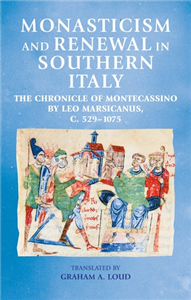 Humanities & Social SciencesFebruary 2026
Monasticism and renewal in southern Italy
The Chronicle of Montecassino by Leo Marsicanus, c. 529–1075
by Graham Loud
The chronicle of Leo Marsicanus recounts the history of the abbey of Montecassino from its foundation by St. Benedict in the sixth-century up to 1075. It presents a detailed and compelling story of tribulation and renewal, with the abbey twice destroyed and abandoned in the early Middle Ages and then rebuilt. It concludes with an informative account of the building and dedication of the new abbey church by Abbot Desiderius in 1066-71. The chronicle is also a key source for the more general history of southern Italy in the early Middle Ages, and of the conquest of the region by the Normans during the eleventh century. In addition, Montecassino was one of the great intellectual centres of western Christendom and a major contributor to the reform movement within the Church during the later eleventh century. Leo's chronicle is a crucial witness to that role.
-
Trusted Partner
 Humanities & Social SciencesApril 2024
Rethinking the Carolingian reforms
by Arthur Westwell, Ingrid Rembold, Carine van Rhijn
-
Trusted Partner
 Literary studies: classical, early & medievalJuly 2013
Monasticism in late medieval England, c.1300–1535
by Martin Heale
-
Trusted Partner
 Literature & Literary StudiesApril 2009
Monasticism in late medieval England, c.1300–1535
by Rosemary Horrox, Simon Maclean, Martin Heale, Rebecca Mortimer
-
Trusted Partner
Literature & Literary StudiesApril 2009
Monasticism in late medieval England, c.1300–1535
by Rosemary Horrox, Simon Maclean, Martin Heale
-
Trusted Partner
 Humanities & Social SciencesApril 2020
Monastic experience in twelfth-century Germany
by Alison I. Beach, Shannong Li, Samuel Sutherland
-
Trusted Partner
 Humanities & Social SciencesSeptember 2022
Monastic experience in twelfth-century Germany
by Alison I. Beach, Shannon M. T. Li, Samuel Sutherland
-
Trusted Partner
-
Trusted Partner
 Humanities & Social SciencesMay 2020
Confronting crisis in the Carolingian empire
by Mayke de Jong, Justin Lake, Simon Maclean


