
Your Search Results


-
Promoted Content

 June 2010
Kinder in Deutschland 2010
2. World Vision Kinderstudie
by Herausgegeben von World Vision Deutschland e.V., World
-
Promoted Content

 May 2021
On the Amazement of the World
(Im-)Possibilities of science
by Ernst Peter Fischer
The current debate on the corona virus shows that knowledge, and with that science, plays a central role in the struggle to preserve humanity. Knowledge provides opportunities to influence the world, for better or worse. In times when emotions and appeals to baser instincts often triumph over reason and humanity, Ernst Peter Fischer reminds us of the goal of science that has been pursued since the Enlightenment: “to facilitate the conditions of human existence”. In his new book, the bestselling author takes us on an instructive, varied and enjoyable journey through the history of knowledge and science.
-
 Trusted Partner

 June 1993
Die Ideologie des Ästhetischen
by Paul Man, Karl Heinz Bohrer, Christoph Menke, Jürgen Blasius, Christoph Menke
Als Paul de Man 1983 starb, war er der wohl bekannteste und einflußreichste Vertreter einer Richtung der Literaturkritik und ihrer Theore, die allgemein als »dekonstruktiv« bezeichnet wird. Kennzeichnend für diese Richtung ist eine erneute Konzentration auf die innere Verfaßtheit der literarischen Texte. Eine erste Auswahl dieser methodisch vorbildlich wie brillant geschriebenen Texte ist 1988 unter dem Titel »Allegorien des Lesens« in der edition suhrkamp erschienen. Die vorliegende Auswahl konzentriert sich auf die methodologischen und theoretischen Prämissen dieses Vorhabens, wie sie die Abhandlungen über die Zeitlichkeit der Literatur, über Shelley und über die Autobiographie deutlich machen. Sich auf die immanente Verfaßtheit und Bewegung von Texten einzulassen ist nach de Man kein selbstzweckhaftes, folgenloses Unternehmen. De Man beansprucht vielmehr für seine »Rückkehr zur Philologie« eine allgemeine Bedeutung; die Literaturkritik ist zugleich philosophische und politische Kritik. Damit ist der zweite Schwerpunkt dieser Auswahl bezeichnet. De Man erläutert diese These zum einen in kritischer Auseinandersetzung mit der Philosophie Jacques Derridas. Zum anderen zeigt er an zentralen Texten der ästhetischen Tradition, an Kant und Hegel, daß ihr falsches – »ideologisches« – Verständnis literarischer Texte unter der Kategorie des »Ästhetischen« ebenso weitreichende philosophische wie politische Konsequenzen hat.
-
Trusted Partner

 Humanities & Social SciencesSeptember 2025
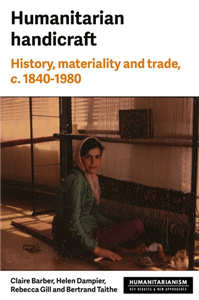
Humanitarian handicraft
History, materiality and trade, c. 1840–1980
by Rebecca Gill, Claire Barber, Helen Dampier, Bertrand Taithe
This book uncovers the overlooked history of artisanal textiles in projects aimed at social uplift and moral reform. The contributors ask what the implications of this form of gendered craft production are for our understanding of the humanitarian imagination, relations of humanitarian production and the generation of meaning and social and artistic value. It also opens a dialogue with contemporary socially-engaged textile artists to engender critical reflection on the socially-situated meaning of textile craft in past and present humanitarian contexts.
-
Trusted Partner

 2022
2022aporello: Human Parasites
by Christine Bender-Leitzig, Dr. Reiner Pospischil
Infestation with parasites usually causes revulsion in those affected and many infections are kept secret through shame. In recent times there has also been a rise in non-native parasites, which often remain undetected. This book gives an overview of the most significant human parasites as well as their - prevalence - symptoms - treatment possibilities. The text is accompanied by illustrations that help when giving everyday advice. Practical icons show at a glance when, for example, the authorities must be notified and what special things need to be considered. Highly concentrated knowledge in an instant? That’s aporello!
-
Trusted Partner
 Humanities & Social SciencesNovember 2025
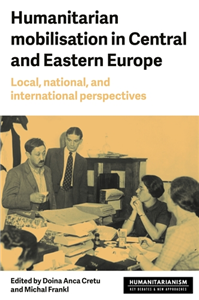
Humanitarian mobilisation in Central and Eastern Europe
Local, national, and international perspectives
by Doina Anca Cretu, Michal Frankl
By focusing on aid Central and Eastern Europe, the volume adds to the existent scholarly explorations of modern humanitarianism, its actors and practices. In the twentieth century, aid workers assisted victims of war and earthquakes, delivered food, supported health care, provided childcare, or sheltered refugees. The contributors not only reconstruct these diverse histories and their protagonists, but also bring international, national, and local actors together: from grassroots activists to private associations to state-driven "socialist humanitarians" to large Western aid organizations. In doing so, they challenge the often unidirectional, from West-to-East, and asymmetrical perspective on donor-recipient relationships in humanitarian processes.
-
Trusted Partner
 Business, Economics & LawMarch 2026
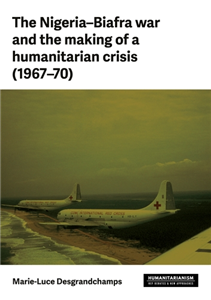
Humanitarianism in Civil War
The Biafra crisis, 1967-1970
by Marie-Luce Desgrandchamps
May 1967, in Nigeria, the Republic of Biafra declared its independence. Soon, civil war and famine ravaged the region and gradually entered the European and American media. Photographs of the conflict arouse considerable emotion in the West. The secessionist enclave and the areas taken over by the Nigerian army then became the scene of major relief operations, developed and financed by multiple organizations and governments. Part of a historiography of humanitarianism in full renewal, this book tells the story of the war, its metamorphosis into an international crisis and the responses that were provided. Based on a large body of sources from French, British, Swiss, Nigerian and American archives, it offers an insight into the world of humanitarian work at the end of the 1960s. It shows the reconfigurations taking place there. in the postcolonial era by proposing complementary scales of observation - international, national and local. The work also revisits some of the controversies which developed around the conflict regarding the instrumentalization of aid, its links with politics, the reception of relief operations on the ground or even the birth of borderlessness and testimony. It thus returns to the place occupied by the Biafran crisis in the history of humanitarian aid.
-
Trusted Partner
 Humanities & Social SciencesOctober 2024
Humanitarianism, empire and transnationalism, 1760-1995
Selective humanity in the Anglophone world
by Joy Damousi, Trevor Burnard, Alan Lester
This is the first book to examine the shifting relationship between humanitarianism and the expansion, consolidation and postcolonial transformation of the Anglophone world across three centuries, from the antislavery campaign of the late eighteenth century to the role of NGOs balancing humanitarianism and human rights in the late twentieth century. Contributors explore the trade-offs between humane concern and the altered context of colonial and postcolonial realpolitik. They also showcase an array of methodologies and sources with which to explore the relationship between humanitarianism and colonialism. These range from the biography of material objects to interviews as well as more conventional archival enquiry. They also include work with and for Indigenous people whose family histories have been defined in large part by 'humanitarian' interventions.
-
Trusted Partner
Humanities & Social SciencesNovember 2023
Critical theory and human rights
From compassion to coercion
by David McGrogan
This book describes how human rights have given rise to a vision of benevolent governance that, if fully realised, would be antithetical to individual freedom. It describes human rights' evolution into a grand but nebulous project, rooted in compassion, with the overarching aim of improving universal welfare by defining the conditions of human well-being and imposing obligations on the state and other actors to realise them. This gives rise to a form of managerialism, preoccupied with measuring and improving the 'human rights performance' of the state, businesses and so on. The ultimate result is the 'governmentalisation' of a pastoral form of global human rights governance, in which power is exercised for the general good, moulded by a complex regulatory sphere which shapes the field of action for the individual at every turn. This, unsurprisingly, does not appeal to rights-holders themselves.
-
Trusted Partner
-
Trusted Partner
-
Trusted Partner
 December 1987
Allegorien des Lesens
by Paul Man, Werner Hamacher, Peter Krumme, Werner Hamacher
Im Falle Paul de Mans ist die begriffliche Charakterisierung seines Vorgehens zusätzlich erschwert dadurch, daß die Theorie nie losgelöst von den Texten, an denen sie gewonnen wird, betrachtet werden kann.
-
Trusted Partner
 Business, Economics & LawMay 2025
Hierarchies and exclusion in humanitarianism
by Clara Egger, Andrea Schneiker
While humanitarians generally present themselves as 'do-gooders' and use this image to gather support and funding, this edited volume addresses hierarchies and exclusions in humanitarianism - an issue that has gained increased attention. Contributions analyse how hierarchies, power asymmetries and exclusion emerge, are maintained and can ultimately be challenged in humanitarian governance. Leading scholars on humanitarianism coming from a variety of disciplinary fields such as international relations, philosophy, organisational science and management, and sociology analyse exclusion dynamics at the individual, organisational and structural levels. Authors thereby combine data from a diverse range of methods, including ethnography, survey and statistical analysis. The volume informs current efforts to increase inclusiveness and equity in humanitarian practice.
-
Trusted Partner
 Humanities & Social SciencesOctober 2022
France, humanitarian intervention and the responsibility to protect
by Eglantine Staunton
-
Trusted Partner

 June 2017
Frauen der 1920er Jahre
Glamour, Stil und Avantgarde
by Thomas Bleitner, Man Ray, Edward Steichen, Claude Cahun, Dora Kallmus
In den 1920er Jahren war vieles wagemutiger, unkonventioneller und exzessiver als heute. Keine Zeit hat so viel Glamour, Stil und Avantgarde hervorgebracht, und eine nie gekannte Experimentierlust erobert Bühnen, Kunstateliers, den Sport und so manches Schlafzimmer. Frauen machen den Flug- und Führerschein, sie greifen zur Filmkamera, sie designen eine neue Mode, sie rauchen und trinken und tanzen fröhlich am Abgrund. Thomas Bleitner stellt in diesem opulent bebilderten Band legendäre und unvergleichliche Frauen aus Film, Fotografie, Sport, Mode und Kunst vor, die in den 1920er Jahren in Berlin, Paris und New York alte Rollenmuster auf den Kopf stellten und damit für Furore sorgten. »Als die Frauen begannen, ihre Röcke zu kürzen und ihre Haare zu stutzen, war dies der größte Umbruch in der Geschichte der Mode der letzten hundert Jahre.« New York Vogue vom 1. Juli 1928
-
Trusted Partner
 Humanities & Social SciencesJanuary 2013
Christian Dualist Heresies in the Byzantine World, c. 650-c. 1450
by Janet Hamilton, Bernard Hamilton
Christian dualism originated in the reign of Constans II (641-68). It was a popular religion, which shared with orthodoxy an acceptance of scriptual authority and apostolic tradition and held a sacramental doctrine of salvation, but understood all these in a radically different way to the Orthodox Church. One of the differences was the strong part demonology played in the belief system. This text traces, through original sources, the origins of dualist Christianity throughout the Byzantine Empire, focusing on the Paulician movement in Armenia and Bogomilism in Bulgaria. It presents not only the theological texts, but puts the movements into their social and political context.
-
Trusted Partner
 Humanities & Social SciencesNovember 2013
Renaissance humanism and ethnicity before race
The Irish and the English in the seventeenth century
by Ian Campbell
The modern ideology of race, so important in twentieth-century Europe, incorporates both a theory of human societies and a theory of human bodies. Ian Campbell's new study examines how the elite in early modern Ireland spoke about human societies and human bodies, and demonstrates that this elite discourse was grounded in a commitment to the languages and sciences of Renaissance Humanism. Emphasising the education of all of early modern Ireland's antagonistic ethnic groups in common European university and grammar school traditions, Campbell explains both the workings of the learned English critique of Irish society, and the no less learned Irish response. Then he turns to Irish debates on nobility, medicine and theology in order to illuminate the problem of human heredity. He concludes by demonstrating how the Enlightenment swept away these humanist theories of body and society, prior to the development of modern racial ideology in the late eighteenth century. ;
-
Trusted Partner
 May 1992
Beschreibung einer Form
Versuch über Kafka
by Martin Walser, Walter Höllerer
Der Versuch über Kafka Beschreibung einer Form ist Martin Walsers Dissertation, sie erschien erstmals 1961 und ist eine bemerkenswerte Einführung in das Werk Franz Kafkas, das eine so tiefe und nicht nachlassende Wirkung ausübt.
-
Trusted Partner

 April 2003
Crazy New York
Die Frauen von Harlem und Greenwich Village
by Barnet, Andrea / Illustriert von Abbott, Berenice; Illustriert von Ray, Man; Deutsch Stromberg, Kyra
-
Trusted Partner
 November 2007
Kinder in Deutschland 2007
1. World Vision Kinderstudie
by Herausgegeben von World Vision Deutschland e.V.



