Your Search Results

      • moses. Verlag GmbH

        Over the years, an unusual mix of books, useful book accessories, gift items and games has remained an important characteristic of a steadily growing product range. Inventive non-fiction and activity books with a focus on playing, experimenting and learning are complemented by an extensive selection of little objects you see at your bookshop which somehow belong together with books. Our game portfolio ranges from children’s games, family games, card games to games involving patience, communication games, word games, puzzles, and games involving mental exercises. Thinking outside the box, discovering and realising new ideas - this is the concept of our publishing house. Our motto is: moses., one idea more.

        View Rights Portal
      • Trusted Partner
        2024

        Where is Russia Heading?

        by Jens Siegert

        Vladimir Putin has been ruling Russia for 25 years. There is no end in sight to his dictatorship. He relies on repression at home and is waging a war of destruction against a neighbouring country. The conflict with the West has long become a systemic conflict between an illiberal-autocratic ideology and liberal-democratic principles. Nothing will change as long as Putin remains in power. Nevertheless, as far as can be ascertained under unfree conditions, the majority of the population seems to be supporting Putin. Does this mean that too many people in Russia do not want democracy or peace? Will everything remain the same after Putin? Or is there a chance that Russia will eventually take a different, more democratic path? Whatever the outcome of the war in Ukraine, Russia is not going to disappear. We will still have to deal with our big neighbour in the east. This makes it all the more important to focus on longer-term developments. As a recognised expert on Russian history and society, the author outlines what the post-Putin era might look like. His in-depth analysis makes it clear that Russia is partly Putin, but Putin is not everything about Russia.

      • Trusted Partner
        Humanities & Social Sciences
        February 2026

        AIDS in Soviet Russia

        A story of deception, despair and hope

        by Rustam Alexander

        The first book to tell the shocking story of the AIDS crisis in Soviet Russia. Throughout the 1980s, as the world was grappling with the escalating crisis of AIDS, Soviet Russia continued to deny there was a problem. Arguing that the disease was limited to foreigners and 'immoral' groups, the government failed to take meaningful action, long past the point other countries had begun to recognise the full scale of the threat. In this ground-breaking book, Rustam Alexander tells the story of AIDS in Soviet Russia. Fixated on disinformation, censorship and the persecution of marginalised communities, the Soviet authorities wasted precious time, allowing the epidemic to strike at the very heart of the nation: its children. Yet, despite the government's failure, a number of brave journalists, doctors and nascent gay groups decided to take matters into their own hands and engage in full-fledged AIDS activism. Tracing the political and social response to AIDS in the final years of the Soviet era, Alexander sheds light on the devastating consequences of government inaction. He draws on personal stories, media reports and archival materials to provide a riveting account of the Russian people's fight against AIDS amid the tumultuous transformations of Gorbachev's perestroika.

      • Trusted Partner
        Humanities & Social Sciences
        June 2025

        Revolution in China and Russia

        Reorganizing empires into nation states

        by Luyang Zhou

        Most scholars believe that China's nationality policy, like that of other socialist states, imitated the Soviet nationality model, a system which has been termed an "affirmative action empire." This book offers two contributions to the literature which run counter to this convention. First, it argues that the People's Republic of China (PRC) and the Soviet Union (USSR) were different; while the PRC was aimed to build an ideal-typical nation-state, the USSR was an open union of nation-states that was only temporarily confined to a physical territory. Second, while scholars who have noted this difference attribute it to contextual factors, such as ethnic structure, geopolitical status, and Russia's intervention into the Chinese Revolution, this book contends that context shaped the Sino-Soviet difference, yet it did not determine it. Rather, there was significant leeway between the implications of the contextual factors, and what the policy-designers ultimately established. This book probes who held agency, and how these individuals bridged this gap.

      • Trusted Partner
        Humanities & Social Sciences
        April 2024

        The new politics of Russia

        by Andrew Monaghan

      • Trusted Partner
        March 2020

        The German Channel

        A Mythology from the FRG

        by Frank Uekötter

        A historic big infrastructure project in the nexus of federal government policy planning From Berlin Airport to Stuttgart 21 – public building projects seem to get out of hand with growing frequency. Frank Uekötter follows the example of the Elbe Lateral Canal, which was opened in 1976, to show that institutional failure is not a new phenomenon. The virtually forgotten story of the Elbe Lateral Canal represents an inglorious episode of German federal policy planning. The benefit of the 115 km long waterway, which connects the Mittelland Canal with the River Elbe, was completely out of proportion to the level of investment. Despite this, the project was soon unstoppable in the nexus of corporate interests, political aims and the policy for growth. A dam ruptured at Lüneburg only weeks after its opening. Uekötter argues for a social rethink based on the clear chronology of these “organized irresponsibilities”.

      • Trusted Partner
        July 2017

        Drei sind keiner zu viel

        by Eulàlia Canal, Rocio Bonilla, Ursula Bachhausen

        "Drei sind keiner zu viel" von Eulàlia Canal ist eine charmante und lehrreiche Geschichte, die auf humorvolle Weise die Themen Eifersucht, Akzeptanz und die Freude am Teilen behandelt. Im Mittelpunkt der Erzählung stehen der Bär und das Murmeltier, die beste Freunde sind und ihre Zeit mit gemeinsamen Spielen und Abenteuern verbringen. Als der Bär jedoch die Ente einlädt, sich ihnen anzuschließen, ist das Murmeltier alles andere als begeistert und versucht, die Ente mit einer kleinen Notlüge fernzuhalten. Doch als ein kleines Gespenst vor der Tür steht, lernt das Murmeltier, dass Lügen kurze Beine haben und dass das Zusammensein mit mehr Freunden noch mehr Spaß und Freude bringen kann. Die Geschichte zeigt auf liebenswerte Weise, wie wichtig es ist, offen für neue Freundschaften zu sein und dass drei Freunde keiner zu viel sind. Eine herzerwärmende Geschichte über Freundschaft, Eifersucht und das Teilen, perfekt für Kinder im Kindergartenalter ab 4 Jahren. Humorvoll und einfühlsam erzählt, ideal zum Vorlesen und gemeinsamen Lachen. Beleuchtet auf spielerische Weise die Bedeutung von Akzeptanz und Zusammenhalt. Liebevolle und ausdrucksstarke Illustrationen von Rocio Bonilla, die die Geschichte zum Leben erwecken. Kurze, prägnante Texte, die auch jüngere Kinder fesseln und zum Mitdenken anregen. Fördert wichtige soziale Kompetenzen wie Empathie und die Fähigkeit, Freundschaften zu pflegen und zu erweitern. Ein Buch, das in keiner Familienbuchsammlung fehlen sollte und das Kinder immer wieder gerne zur Hand nehmen.

      • Trusted Partner
        Humanities & Social Sciences
        June 2021

        Germany's Russia problem

        by John Lough, Andrew Monaghan

      • Trusted Partner
        History of art & design styles: c 1800 to c 1900
        June 2011

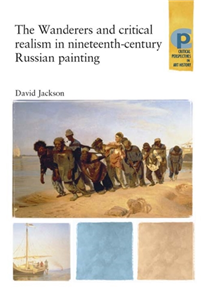
        The Wanderers and Critical Realism in Nineteenth Century Russian Painting

        Critical realism in nineteenth-century Russia

        by David Jackson

        The rise of critical realism in nineteenth-century Russia culminated in 1870 with the formation of the Wanderers, Russia's first independent artistic society. Through depictions of the harsh lives of the peasantry, the fate of political activists, Russian history, landscapes, and portraits of the nation's cultural elite, such as Tolstoy and Dostoevsky, the society became synonymous with dissident sentiments. Yet its members were far from being purveyors of anti-Tsarist propaganda and their canvases reflect also a warm humanity and a fierce pride for such nationalistic themes as Russian myth and legend. Through close readings of single canvases, investigations of major themes and a multi-disciplinary integration of the Wanderers within Russian society, this book gives the first comprehensive analysis of the crucial cultural role played by one of the most successful and genuinely popular schools of art, the legacy of which comprises a fascinating panorama of life and thought in pre-revolutionary Russia.

      • Trusted Partner
        Humanities & Social Sciences
        October 2006

        Securitising Russia

        The domestic politics of Vladimir Putin

        by Bettina Renz, Edwin Bacon, Julian Cooper

        Securitising Russia shows the impact of twenty-first-century security concerns on the way Russia is ruled. It demonstrates how President Putin has wrestled with terrorism, immigration, media freedom, religious pluralism, and economic globalism, and argues that fears of a return to old-style authoritarianism oversimplify the complex context of contemporary Russia. The book focuses on the internal security issues common to many states in the early twenty-first-century, and places them in the particular context of Russia. Detailed analysis of the place of security in Russia's political discourse and policy-making reveals nuances often missing from overarching assessments of Russia today. To characterise the Putin regime as the 'KGB-resurgent' is to miss vital continuities, contexts, and on-going political conflicts which make up the contemporary Russian scene. Securitising Russia draws together current debates about whether Russia is a 'normal' country developing its own democratic and market structures, or a nascent authoritarian regime returning to the past. ;

      • Trusted Partner
        Humanities & Social Sciences
        October 2009

        Regional politics in Russia

        by Cameron Ross

        This innovative, multi-contributed book, now available in paperback, argues convincingly that Russia will never be able to create a viable democracy as long as authoritarian regimes are able to flourish in the regions. The main themes covered are democratisation at the regional level, and the problems faced by the federal states in forging viable democratic institutions in what is now a highly assymetrical Federation. A major strength of the book lies in its combination of thematic chapters with case studies of particular regions and republics. Very little has been published to date on the actual processes of democratisation in particular republics and regions. The book takes into account the literature available on the 'new institutionalism' and outlines the importance of institutions in developing and maintaining democracy. It looks at the importance of sovereignty, federalism and democratic order, and considers the distinct problems of party-building in Russia's regions. Electoral politics are also considered fully, before the book goes on to consider the whole issue of regional politics and democratisation in five particular areas of Russia - Novgorod, the Komi Republic, Russia's Far East, Tatarstan and Bashkortostan. The authors, the majority of whom are internationally recognised experts in their field, have been drawn from Britain, the USA, Russia and Germany, giving the book a truly global perspective. ;

      • Trusted Partner
        Humanities & Social Sciences
        July 2005

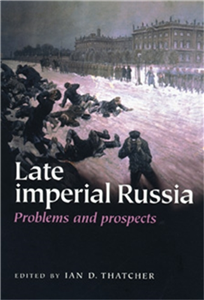
        Late Imperial Russia

        Problems and prospects

        by Ian Thatcher

        This volume offers a detailed examination of the stability of the late imperial regime in Russia. Students and scholars will appreciate the lively summaries of the latest scholarship in political, economic, social, cultural, and international history. Accessible yet insightful, contributions cover the historiography of complex topics such as peasants, workers, revolutionaries, foreign relations, and Nicholas II. In addition, there are original studies of some of the leading intellectuals of the time. The late imperial economy is examined through the writings of Tugan-Baranovsky. There is an account of M. N. Pokrovskii's radical interpretation of late imperial Russia's historical path of development. The state of the Russian theatre is studied through the lives of theatrical impresarios. Each chapter also highlights a unique interpretation, suggesting new lines of inquiry and research. This book will be compulsory reading for students of Russian and European history of the late nineteenth and early twentieth centuries seeking to better understand why Tsarism collapsed in 1917. ;

      • Trusted Partner
      • Trusted Partner
      • Trusted Partner
        December 2018

        Whiteout

        by Canal, Anne von

      • Trusted Partner
        Humanities & Social Sciences
        October 2020

        The European Union and its eastern neighbourhood

        Europeanisation and its twenty-first-century contradictions

        by Mike Mannin, Paul Flenley

        This volume is timely in that it explores key issues which are currently at the forefront of the EU's relations with its eastern neighbours. It considers the impact of a more assertive Russia, the significance of Turkey, the limitations of the Eastern Partnership with Belarus and Moldova, the position of a Ukraine in crisis and pulled between Russia and the EU, security and democracy in the South Caucasus. It looks at the contested nature of European identity in areas such as the Balkans. In addition it looks at ways in which the EU's interests and values can be tested in sectors such as trade and migration. The interplay between values, identity and interests and their effect on the interpretation of europeanisation between the EU and its neighbours is a core theme of the volume.

      • Trusted Partner
        Humanities & Social Sciences
        February 2023

        Globalized urban precarity in Berlin and Abidjan

        Young men and the digital economy

        by Hannah Schilling

        Digital technologies promise efficiency and comfort, but the smoothness of platform services relies on the hidden social labour of those who keep the gig economy running. This book presents a comparative ethnography of young men making a living through digital technologies: selling mobile airtime in Abidjan, Côte d'Ivoire, and app-based delivery riders in Berlin, Germany. These case studies explore the significance of symbolic capital in urban youth's social existence and organisation of livelihood in the digital economy, and the technological mechanisms producing a new form of urban precarity. Globalized urban precarity in Berlin and Abidjan puts forward an original comparative approach to develop a global urban sociology for the digital era. It provides an innovative analytical toolbox that decentres discussions of precarity from the standard of a normal employment contract. With its focus on symbolic capital, the ethnography shows the consequences of the proliferating gig economy for status struggles among urban youth, and carefully embeds the densification of software and services into the socio-material relations on which these new urban infrastructures are built.

      • Trusted Partner
        Humanities & Social Sciences
        March 2005

        Russian politics today

        by Michael Waller, Bill Jones

        This introductory text, written by an established authority on communist and post-communist politics, describes how Vladimir Putin has turned to those with backgrounds in the military and security structures to provide stability in today's Russian Federation, following the democratising reforms of Gorbachev and the ensuing instability of the Yeltsin presidency. Against the background of an increasing authoritarianism, which has restored features of the Soviet political system, it examines the attempts by social and economic groups to assert themselves against the state using embryonic democratic forms that fall far short of pluralism. The book's fourteen chapters offer an exceptionally broad coverage. It will appeal to first- and second-year students in higher education, but its deliberately accessible style will also make it attractive to sixth-form students and the general reader. ;

      • Trusted Partner
        Humanities & Social Sciences
        June 2023

        The sea in Russian strategy

        by Andrew Monaghan, Richard Connolly

      Subscribe to our

      newsletter