
Your Search Results


-
Promoted Content

 Humanities & Social SciencesFebruary 2017
Servants of the empire
The Irish in Punjab 1881–1921
by Patrick O'Leary, Andrew Thompson, John M. MacKenzie
Punjab, 'the pride of British India', attracted the cream of the Indian Civil Service, many of the most influential of whom were Irish. Some of these men, along with Irish viceroys, were inspired by their Irish backgrounds to ensure security of tenure for the Punjabi peasant, besides developing vast irrigation schemes which resulted in the province becoming India's most affluent. But similar inspiration contributed to the severity of measures taken against Indian nationalist dissent, culminating in the Amritsar massacre which so catastrophically transformed politics on the sub-continent. Setting the experiences of Irish public servants in Punjab in the context of the Irish diaspora and of linked agrarian problems in Ireland and India, this book descrides the beneficial effects the Irish had on the prosperity of India's most volatile province. Alongside the baleful contribution of some towards a growing Indian antipathy towards British rule. Links are established between policies pursued by Irishmen of the Victorian era and current happenings on the Pakistan-Afghan border and in Punjab.
-
Promoted Content
 Humanities & Social SciencesJanuary 2017
The West must wait
County Galway and the Irish Free State, 1922–32
by Una Newell
The West must wait presents a new perspective on the development of the Irish Free State. It extends the regional historical debate beyond the Irish revolution and raises a series of challenging questions about post-civil war society in Ireland. Through a detailed examination of key local themes - land, poverty, politics, emigration, the status of the Irish language, the influence of radical republicans and the authority of the Catholic Church - it offers a probing analysis of the socio-political realities of life in the new state. This book opens up a new dimension by providing a rural contrast to the Dublin-centred views of Irish politics. Significantly, it reveals the level of deprivation in local Free State society with which the government had to confront in the west. Rigorously researched, it explores the disconnect between the perceptions of what independence would deliver and what was achieved by the incumbent Cumann na nGaedheal administration.
-
 Trusted Partner
 Biography & True StoriesMarch 2026
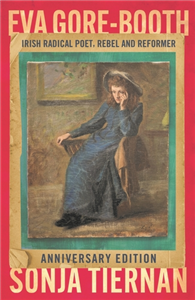
Eva Gore-Booth: Irish radical poet, rebel and reformer
Anniversary edition
by Sonja Tiernan
An acclaimed biography of poet, pacifist and political firebrand Eva Gore-Booth. The Irish poet and activist Eva Gore-Booth (1870-1926) led a life defiantly at odds with her aristocratic origins. Choosing to live and work among the poor of Manchester, she campaigned on behalf of barmaids, circus performers, flower sellers and pit-brow lasses, her partner, Esther Roper, at her side. Gore-Booth was tireless in her pursuit of justice. She was a militant pacifist during the First World War, a champion of Irish independence and a pioneering thinker on gender and sexuality. She was also a prolific author, publishing nineteen volumes of poetry and prose that reflect the full force of her radical convictions. Featuring a new preface that situates Gore-Booth's life and work in the context of our current political climate, this biography reclaims her place as a significant figure of Anglo-Irish letters and an unsung hero of LGBT+ history.
-
Trusted Partner
 Literature & Literary StudiesFebruary 2023
Imagining the Irish child
Discourses of childhood in Irish Anglican writing of the seventeenth and eighteenth centuries
by Jarlath Killeen
This book examines the ways in which ideas about children, childhood and Ireland changed together in Irish Protestant writing of the seventeenth and eighteenth centuries. It focuses on different varieties of the child found in the work of a range of Irish Protestant writers, theologians, philosophers, educationalists, politicians and parents from the early seventeenth century up to the outbreak of the 1798 Rebellion. The book is structured around a detailed examination of six 'versions' of the child: the evil child, the vulnerable/innocent child, the political child, the believing child, the enlightened child, and the freakish child. It traces these versions across a wide range of genres (fiction, sermons, political pamphlets, letters, educational treatises, histories, catechisms and children's bibles), showing how concepts of childhood related to debates about Irish nationality, politics and history across these two centuries.
-
Trusted Partner
 Humanities & Social SciencesMay 2026
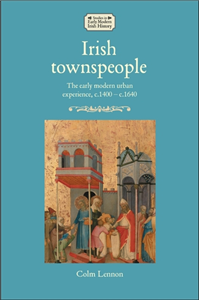
Irish townspeople
The early modern urban experience, c.1400–c.1640
by Colm Lennon
Through a series of innovative perspectives, this book examines how early modern Irish townspeople experienced the urban world through a range of family and associational ties. Migrants inducted through town citizenship and marriage bonded more closely as sisters or brothers of confraternities and guilds, consolidating parish membership. Civic religion saw the integration of religion with town politics and councils, and monastic charity of the friars' hospitals preceded the era of modern municipal welfare. In circumstances of the alienation of the long-settled Catholic townspeople from the state's religious and political Reformation in the seventeenth century, they drew sustenance from the continuity of institutions such as colleges, fraternities and hospitals and forms of coexistence with Protestant fellow-citizens.
-
Trusted Partner
 Business, Economics & LawFebruary 2017
Judges, politics and the Irish Constitution
by Edited by Laura Cahillane, James Gallen, Tom Hickey
This volume brings together academics and judges to consider ideas and arguments flowing from the often complex relationships between law and politics, adjudication and policy-making, and the judicial and political branches of government. Contributors explore numerous themes, including the nature and extent of judicial power, the European Court of Human Rights decision in O'Keeffe v Ireland, the process of appointing judges and judicial representation, judicial power and political processes. Contrasting judicial and academic perspectives are provided on the role of the European Court of Human Rights and the nature of exhausting domestic remedies, including a contribution from the late Mr. Justice Adrian Hardiman. The role of specific judges, social and political disputes and case law are examined and socio-economic rights, the rule of law and electoral processes are all addressed.
-
Trusted Partner
 Literature & Literary StudiesMarch 2009
Irish Literature Since 1990
by Michael Parker, Scott Brewster
-
Trusted Partner
 Humanities & Social SciencesApril 2021
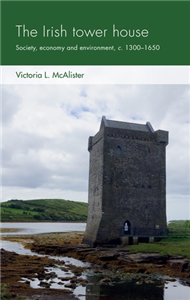
The Irish tower house
Society, economy and environment, c. 1300–1650
by Victoria L. McAlister
The Irish tower house examines the social role of castles in late-medieval and early modern Ireland. It uses a multidisciplinary methodology to uncover the lived experience of this historic culture, demonstrating the interconnectedness of society, economics and the environment. Of particular interest is the revelation of how concerned pre-modern people were with participation in the economy and the exploitation of the natural environment for economic gain. Material culture can shed light on how individuals shaped spaces around themselves, and tower houses, thanks to their pervasiveness in medieval and modern landscapes, represent a unique resource. Castles are the definitive building of the European Middle Ages, meaning that this book will be of great interest to scholars of both history and archaeology.
-
Trusted Partner
 Humanities & Social SciencesAugust 1998
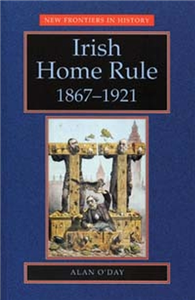
Irish Home Rule
by Alan O'Day, Mark Greengrass
Irish Home Rule considers the pre-eminent issue in British politics during the late nineteenth and early twentieth-centuries. It is the first account to explain the various self-government plans, to place these in context and examine the motives for putting the schemes forward. The book distinguishes between moral and material home rulers, making the point that the first appealed especially to outsiders, some Protestants and the intelligentsia, who saw in self-government a means to reconcile Ireland's antagonistic traditions. In contrast, material home rulers viewed a Dublin Parliament as a forum of Catholic interests. This account appraises the home rule movement from a fresh angle, distinguishing it from the usual division drawn between physical force and constitutional nationalists It maintains that an ideological continuity runs from Young Ireland, the Fenians, the early home rulers including Isaac Butt and Charles Stewart Parnell, to the Gaelic Revivalists to the Men of 1916. These nationalists are distinguishable from material home rulers not on the basis of methods or strategy but by a fundamental ideological cleavage. ;
-
Trusted Partner
 Humanities & Social SciencesJanuary 2024
Dog politics
Species stories and the animal sciences
by Mariam Motamedi Fraser
Do dogs belong with humans? Scientific accounts of dogs' 'species story,' in which contemporary dog-human relations are naturalised with reference to dogs' evolutionary becoming, suggest that they do. Dog politics dissects this story. This book offers a rich empirical analysis and critique of the development and consolidation of dogs' species story in science, asking what evidence exists to support it, and what practical consequences, for dogs, follow from it. It explores how this story is woven into broader scientific shifts in understandings of species, animals, and animal behaviours, and how such shifts were informed by and informed transformative political events, including slavery and colonialism, the Second World War and its aftermath, and the emergence of anti-racist movements in the twentieth and twenty-first centuries. The book pays particular attention to how species-thinking bears on 'race,' racism, and individuals.
-
Trusted Partner
 Humanities & Social SciencesMarch 2014
The domestic, moral and political economies of post-Celtic Tiger Ireland
What rough beast?
by Kieran Keohane, Rob Kitchin, Carmen Kuhling
This book provides an analysis of neo-liberal political economics implemented in Ireland and the deleterious consequences of that model in terms of polarised social inequalities, impoverished public services and fiscal vulnerability as they appear in central social policy domains - health, housing and education in particular. Tracing the argument into the domains where the institutions are sustained and reproduced, this book examines the movement of modern economics away from its original concern with the household and anthropologically universal deep human needs to care for the vulnerable - the sick, children and the elderly - and to maintain inter-generational solidarity. The authors argue that the financialisation of social relations undermines the foundations of civilisation and opens up a marketised barbarism. Civic catastrophes of violent conflict and authoritarian liberalism are here illustrated as aspects of the 'rough beast' that slouches in when things are falling apart and people become prey to new forms of domination. ;
-
Trusted Partner
 Humanities & Social SciencesApril 2026
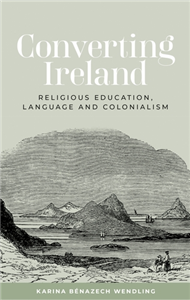
Converting Ireland
Religious education, language and colonialism
by Karina Bénazech Wendling
Karina Bénazech Wendling offers a re-assessment of 'souperism'-the long-debated claim that food was used to convert Irish Catholics to Protestantism during the Great Famine. Focusing on the Irish Society for Promoting the Education of the Native Irish through their Own Language, the first group labeled 'soupers' in 1841, she uncovers a more complex picture. Rather than a mere tool of British cultural imperialism, the Society had a deep engagement with the Irish language and Bible translation, while also encouraging religious conversions in the West. The book explores the Society's role in Ireland's religious and political landscape, the rise of Catholic counter-missions, and nationalist resistance. Offering fresh insights into Ireland's religious history and global missionary movements, this book is essential for scholars of Irish studies, interdenominational relations, and education in Ireland.
-
Trusted Partner
 Political science & theoryJuly 2015
The political theory of the Irish Constitution
Republicanism and the basic law
by Eoin Daly, Tom Hickey
The political theory of the Irish Constitution considers Irish constitutional law and the Irish constitutional tradition from the perspective of Republican theory. It analyses the central devices and doctrines of the Irish Constitution - popular sovereignty, constitutional rights and judicial review - in light of Republican concepts of citizenship and civic virtue. The Constitution, it will argue, can be understood as a framework for promoting popular participation in government as much as a mechanism for protecting individual liberties. It will be of interest to students and researchers in Irish politics, political theory and constitutional law, and to all those interested in political reform and public philosophy in Ireland.
-
Trusted Partner
 Humanities & Social SciencesFebruary 2017
Scottishness and Irishness in New Zealand since 1840
by Angela McCarthy, Andrew Thompson, John M. MacKenzie
This book examines the distinctive aspects that insiders and outsiders perceived as characteristic of Irish and Scottish ethnic identities in New Zealand. When, how, and why did Irish and Scots identify themselves and others in ethnic terms? What characteristics did the Irish and the Scots attribute to themselves and what traits did others assign to them? Did these traits change over time and if so how? Contemporary interest surrounding issues of ethnic identities is vibrant. In countries such as New Zealand, descendants of European settlers are seeking their ethnic origins, spurred on in part by factors such as an ongoing interest in indigenous genealogies, the burgeoning appeal of family history societies, and the booming financial benefits of marketing ethnicities abroad. This fascinating book will appeal to scholars and students of the history of empire and the construction of identity in settler communities, as well as those interested in the history of New Zealand.
-
Trusted Partner
 Humanities & Social SciencesOctober 2021
Ireland and the European Union
Economic, political and social crises
by Michael Holmes, Kathryn Simpson, Dimitris Papadimitriou, Kathryn Simpson, Paul Tobin
This book examines how Ireland's relationship with the EU was affected by a succession of crises in both the Republic of Ireland and Northern Ireland. The financial crisis, the Brexit crisis and the migration crisis were not of equal significance on the island of Ireland. The financial crisis was a huge issue for the Republic but not Northern Ireland, Brexit had a major impact in both polities, the migration and populism issues were less controversial, while foreign policy challenges had a minimal impact. The book provides a summary of the main features of each of the crises to be considered, from both the EU and the Irish perspective. Ireland and the European Union is the first volume of its kind to provide a comprehensive analysis on British-Irish relations in the context of Brexit. It assesses the Withdrawal Agreement and Protocol on Ireland/Northern Ireland, the devolution settlement and the 1998 Agreement, as well as the European dimension to Northern Ireland's peace process. The contributors explore a number of policy areas that are central to the understanding of each of the crises and the impact of each for Ireland. Chapters examine issues such as security, migration and taxation as well as protest politics, political parties, the media, public opinion and the economic impact of each of these crises on Ireland's relationship with the EU.
-
Trusted Partner
 Humanities & Social SciencesFebruary 1999
The Irish and the Spanish Civil War, 1936–1939
by Robert Stradling
The outbreak of the Spanish Civil War threw Irish politics, north and south of the border, into turmoil. Tragic events in Spain aroused emotive responses across the spectrum of Irish society. In contrast to most other communities of the British Isles, citizens of the Irish Free State were mainly pro-Franco. But many on the left felt a strong identification with the plight of the Republic. Ireland sent large organized bodies of men to fight on opposite sides in the Spanish Civil War. The International Brigade volunteers were led by the IRA warrior, Frank Ryan. Their rivals, who became a battalion of Franco's Foreign Legion were mostly members of the semi-facist Blueshirts, and were commanded by the ex-leader of that movement, General Eoin O'Duffy. In late 1936, two enemy crusades - Communist and Catholic - left Ireland to fight it out in Spain. This book, illuminated by personal histories, tells the story of what happened to those two sides. Starting with their eventful journey to Spain, it follows their footsteps across the battlefields of Spain. ;
-
Trusted Partner
 Humanities & Social SciencesAugust 2022
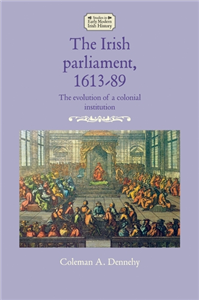
The Irish parliament, 1613–89
The evolution of a colonial institution
by Coleman A. Dennehy
The Irish parliament was both the scene of frequent political battles and an important administrative and legal element of the state machinery of early modern Ireland. This institutional study looks at how parliament dispatched its business on a day-to-day basis. It takes in major areas of responsibility such as creating law, delivering justice, conversing with the executive and administering parliamentary privilege. Its ultimate aim is to present the Irish parliament as one of many such representative assemblies emerging from the feudal state and into the modern world, with a changing set of responsibilities that would inevitably transform the institution and how it saw both itself and the other political assemblies of the day.
-
Trusted Partner
 Humanities & Social SciencesJanuary 2011
Irish Environmental Politics After the Communicative Turn
by Patrick O'Mahony
This book applies social and political theory to the field of environmental politics in Ireland. It offers both a substantive contribution to understanding environmental politics in this country and a test case of the application of theory within the field of environmental scholarship more generally. The essays are integrated by a concern for analysing the relationship between culture, discourse and action in this political field, hence the emphasis on the communicative turn. The book is innovative in offering a sustained application of social and political theory within environmental scholarship as well as in combining theoretical and empirical approaches to advancing environmental scholarship in a particular case. This synergy of theory and substantive analysis is a key feature of the book and offers an important contribution to the environmental literature in the social sciences. The authors apply key developments in the modern social sciences and offer compelling evidence of their value for clarifying the cultural foundations of political action and for its evaluation and critique. Academics in the social sciences and in philosophy, postgraduate and advanced undergraduate, both in Ireland and beyond, will find this book highly rewarding for its multi-faceted application of social and political theories and associated methodologies to the environmental field. ;
-
Trusted Partner
 Humanities & Social SciencesDecember 2019
Northern Ireland and the politics of boredom
by George Legg
-
Trusted Partner
Literature & Literary StudiesJune 2026
The politics of Middle English parables
Fiction, theology, and social practice
by Mary Raschko
The politics of Middle English parables examines the dynamic intersection of fiction, theology and social practice in late-medieval England. Parables occupy a prominent place in Middle English literature, appearing in dream visions and story collections as well as in lives of Christ and devotional treatises. While most scholarship approaches the translated stories as stable vehicles of Christian teaching, this book highlights the many variations and points of conflict across Middle English renditions of the same story. In parables related to labour, social inequality, charity and penance, the book locates a creative theological discourse through which writers attempted to re-construct Christian belief and practice. Analysis of these diverse retellings reveals not what a given parable meant in a definitive sense but rather how Middle English parables inscribe the ideologies, power structures and cultural debates of late-medieval Christianity.

