
Your Search Results
-

-

Penerbit Republika
Republika Penerbit is a Jakarta-based publishing company. We publish books with genres ranging from religious (Islamic books), nonfiction, biography, historical fiction, contemporary fiction, fantasy, picture books, to comics. Some of our fiction has been adapted into films and there will be more to be filmed.
View Rights Portal
-
Promoted Content

 Humanities & Social SciencesJanuary 2026
Surviving repression
The Egyptian Muslim Brotherhood after the 2013 coup
by Lucia Ardovini
Surviving repression tells the story of the Muslim Brotherhood following the 2013 coup d'état in Egypt. The Brotherhood gained legal recognition and quickly rose to power after the 2011 Arab uprisings, but its subsequent removal from office marked the beginning of the harshest repression of its troubled history. Forced into exile, the Brotherhood and its members are now faced with a monumental task as they rebuild this fragmented organisation. Drawing on extensive fieldwork and interviews with current and former members of the Brotherhood, the book explores this new era in the movement's history, emphasising first-hand experiences, perspectives and emotions to better understand how individual responses to repression are affecting the movement as a whole. Surviving repression offers a unique insight into the main strategic, ideological and organizational debates dividing the Brotherhood.
-
Promoted Content
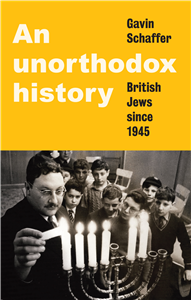 Humanities & Social SciencesFebruary 2025
An unorthodox history
British Jews since 1945
by Gavin Schaffer
A bold, new history of British Jewish life since the Second World War. Historian Gavin Schaffer wrestles Jewish history away from the question of what others have thought about Jews, focusing instead on the experiences of Jewish people themselves. Exploring the complexities of inclusion and exclusion, he shines a light on groups that have been marginalised within Jewish history and culture, such as queer Jews, Jews married to non-Jews, Israel-critical Jews and even Messianic Jews, while offering a fresh look at Jewish activism, Jewish religiosity and Zionism. Weaving these stories together, Schaffer argues that there are good reasons to consider Jewish Britons as a unitary whole, even as debates rage about who is entitled to call themselves a Jew. Challenging the idea that British Jewish life is in terminal decline. An unorthodox history demonstrates that Jewish Britain is thriving and that Jewishness is deeply embedded in the country's history and culture.
-
 Trusted Partner
-
Trusted Partner
 Humanities & Social SciencesJuly 2023
Now that's what I call a history of the 1980s
by Lucy Robinson
-
Trusted Partner
-
Trusted Partner
-
Trusted Partner
-
Trusted Partner

 May 1971
Repressive Kriminalpsychiatrie
Vom Elend einer Wissenschaft
by Tilmann Moser
Die Kriminalpsychiatrie ist eine Disziplin im Zwielicht. Sie ist angesiedelt zwischen zwei Wissenschaften unterschiedlicher Ausrichtung: der Medizin und dem Strafrecht. Obwohl von Ärzten betrieben, steht die forensische Psychiatrie im Dienste der Strafrechtsordnung, und zwar mit Sicherheit nicht einer liberalen und progressiven. Im Gegenteil: dieses Buch zeigt auf, daß die Kriminalpsychiatrie durch ihr Beharren auf einem somatisch-biologistisch orientierten Krankheitsbegriff ein repressives Strafrecht stützt und legitimiert. Was Menschen durch Menschen erleiden, und zwar in Kindheit und Jugend, und was ihre Charakterstruktur früh deformiert, gilt der Kriminalpsychiatrie nicht als entlastend, sondern wird auf das Konto der individuell meßbaren Schuld gebucht. Exkulpiert wird nur die Gesellschaft.
-
Trusted Partner
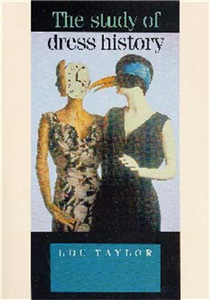 Material cultureJanuary 2002
The study of dress history
by Lou Taylor
Over the past ten years the study of dress history has finally achieved academic respectability. This book shows how the fields of dress history and dress studies are now benefitting from the adoption of new multi-disciplinary approaches and outlines the full range of these approaches which draw on material culture, ethnography, and cultural studies. Raises a series of frank and fresh issues surrounding approaches to the history of dress, including analysis of the academic gender and subject divides that have riven it in the past. Comprehensive, engaging and trenchant, this will become the benchmark volume in the study of dress history.
-
Trusted Partner
 Humanities & Social SciencesMay 2021
Doing digital history
by Jonathan Blaney, Jane Winters, Sarah Milligan, Martin Steer
-
Trusted Partner

 July 2021
My Life with Viruses
A researcher’s history of the fascinating world of pathogens
by Ernst-Ludwig Winnacker in association with Jeanne Rubner
In times of the coronavirus pandemic many people have certainly condemned them, but Professor Ernst-Ludwig Winnacker has dedicated his life to researching them and is intrigued by viruses – even if sometimes he is keenly aware of their fatal effects. To mark his 80th birthday the biochemist describes the co-evolution and co-existence as well as the eternal ‘battle’ between humans and viruses. Winnacker takes up the cause of these ‘biological elements between animate and inanimate nature’ because they play an important role in fundamental research and genetic technology, and without them human beings would not be what they are.
-
Trusted Partner
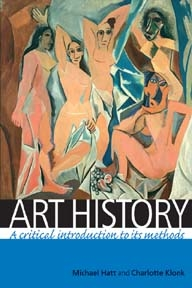 The ArtsMarch 2006
Art history
A critical introduction to its methods
by Michael Hatt, Charlotte Klonk
Art History: A critical introduction to its methods provides a lively and stimulating introduction to methodological debates within art history. Offering a lucid account of approaches from Hegel to post-colonialism, the book provides a sense of art history's own history as a discipline from its emergence in the late-eighteenth century to contemporary debates. By explaining the underlying philosophical and political assumptions behind each method, along with clear examples of how these are brought to bear on visual and historical analysis, the authors show that an adherence to a certain method is, in effect, a commitment to a set of beliefs and values. The book makes a strong case for the vitality of the discipline and its methodological centrality to new fields such as visual culture. This book will be of enormous value to undergraduate and graduate students, and also makes its own contributions to ongoing scholarly debates about theory and method. ;
-
Trusted Partner
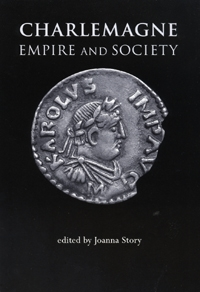 Humanities & Social SciencesMarch 2005
Charlemagne
Empire and society
by Edited by Joanna Story
The age of Charlemagne was a crucible for change in the history of Europe, bridging the divide between the medieval and the classical worlds and setting the political and cultural tone for centuries to come. This book focuses directly on the reign of Charlemagne, bringing together a wide range of approaches and sources from the diverse voices of fifteen of the top scholars of early medieval Europe. The contributors have taken a number of original aproaches to the subject, from the fields of archaeology and numismatics to thoroughly-researched essays on key historical texts. The essays are embedded in the scholarship of recent decades but also offer insights into new areas and new approaches for research. A full bibliography of works in English as well as key reading in European languages is provided, making the volume essential reading for experienced scholars as well as students new to the history of the early middle ages. ;
-
Trusted Partner
-
Trusted Partner
 Business, Economics & LawOctober 2026
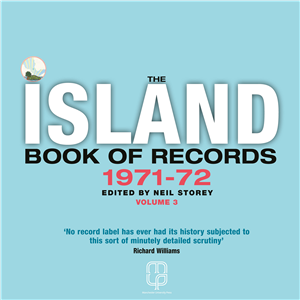
The Island Book of Records Volume III
1971-72
by Neil Storey
The third in the acclaimed Island Book of Records series chronicles 1971-72, two years that saw the label secure a position at the forefront of contemporary music around the world. Major albums from Cat Stevens, Emerson, Lake & Palmer and Jethro Tull brought international success. Traffic released their era-defining The Low Spark of High Heeled Boys and Island returned to its roots with the soundtrack to the most important Jamaican film of all time, The Harder They Come. Nick Drake's masterpieces Bryter Layter and Pink Moon were yet to find their audience, but a new sensation emerged as Roxy Music released their first LP. Meanwhile, Bob Marley & The Wailers were beginning to record Catch A Fire - the album that will be the first to be detailed in IBoR IV. Featuring material from recent interviews and comment of the time, and including a comprehensive discography of 45s, The Island Book of Records Volume III is lavishly illustrated with album art, gig adverts, tickets, flyers, international LP variants, rare photos, LP and 45 adverts and exclusive ephemera.
-
Trusted Partner
 Humanities & Social SciencesApril 2010
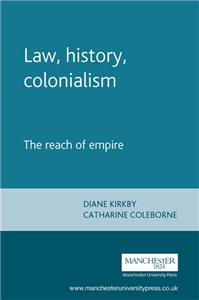
Law, history, colonialism
The reach of empire
by Diane Kirkby, Andrew Thompson, Catharine Coleborne, John Mackenzie
Drawing on the latest contemporary research from an internationally acclaimed group of scholars, Law, history, colonialism brings together the disciplines of law, history and post-colonial studies in a singular exploration of imperialism. In fresh, innovative essays from a range of disciplinary backgrounds, this collection offers exciting new perspectives on the length and breadth of empire. As issues of native title, truth and reconciliation commissions, and access to land and natural resources are contested in courtrooms and legislation of former colonies, the disciplines of law and history afford new ways of seeing, hearing and creating knowledge. Issues explored include the judicial construction of racial categories, the gendered definitions of nation-states, the historical construction of citizenship, sovereignty and land rights, the limits to legality and the charting of empire, constructions of madness among colonised peoples, reforming property rights of married women, questions of legal and historical evidence, and the rule of law. This collection will be an indispensable reference work to scholars, students and teachers. ;
-
Trusted Partner
Humanities & Social SciencesMarch 2017
Law, history, colonialism
The reach of empire
by Diane Kirkby, Andrew Thompson, Catharine Coleborne, John M. MacKenzie
Drawing on the latest contemporary research from an internationally acclaimed group of scholars, Law, history, colonialism bring together the disciplines of law, history and postcoloinial studies in a singular exploration of imperialism. In fresh, innovative essays from a range of disciplinary backgrounds, this collection offers exciting new perspectives on the length and breadth of empire. As issues of native title, truth and reconciliation commission, and access to land and natural resources are contested in courtrooms and legislation of former colonies, the disciplines of law and history afford new ways of seeing, hearing and creating knowledge. Issues explored include the judicial construction of racial categories, the gendered definitions of nation-states, the historical construction of citizenship, sovereignty and land rights, the limits to legality and the charting of empire, constructions of madness among colonised peoples, reforming property rights of married women, questions of legal and historical evidence, and the rule of law. This collection will be an indispensable reference work to scholars, students and teachers.
-
Trusted Partner
Business, Economics & LawNovember 2024
The Island Book of Records Volume II
1969-70
by Neil Storey
The second volume of this highly collectable series, covering the pivotal years of 1969-70. The Island Book of Records Volume II documents the years 1969-70, during which Island sought to build on its success with the Spencer Davis Group by seeking out new British rock talent. By the end of the period, Island was emerging as a major British label, one that could boast releases from Jethro Tull, Nick Drake, King Crimson, John and Beverley Martyn, Fairport Convention and Cat Stevens. Featuring material from recent interviews and from media interviews of the time, and including a comprehensive discography of 45s, The Island Book of Records Volume II is lavishly illustrated with gig adverts (very many at venues that no longer exist), concert tickets, flyers, international LP variants, labels, LP and 45 adverts and other ephemera collector's dream.
-
Trusted Partner
 2019
2019When a Virus Defeated Napoleon
How nature makes history
by Sebastian Jutzi
Humans write history, but nature and coincidence often play a significant part in making history. The weather, volcanoes, celestial bodies, pathogens: all of them can influence historical events. In 413 BC, a lunar eclipse contributed to the defeat of the Athenians by Syracuse. In 1802, Napoleon’s soldiers on Saint-Domingue, the Haiti of today, were carried off in their thousands by yellow fever; the slave revolt that the troops had been sent to suppress succeeded, and the island declared itself independent in 1804. Nature not only makes history, it can also contribute to the understanding of history. For example, the route that the Carthaginians took over the Alps was only revealed recently by the discovery of ancient manure – not too surprising since Hannibal was accompanied by an estimated 10,000 horses. Sebastian Jutzi relates these and many other (hi)stories in a knowledgeable, entertaining and informative way – a treasure trove for anyone who wants to get to know history from an “unusual” perspective.
-
Trusted Partner
 2020
2020History of the German Language
A textbook for German studies; Part 1: Introduction, prehistory and history; Part 2: Old High German, Middle High German and Early New High German
by Wilhelm Schmidt, Edited by Dr. Elisabeth Berner and Prof. Dr. Dr. h.c. Dr. h.c. Norbert Richard Wolf
The 12th revised and updated version of the History of the German language – long regarded as an indispensable standard work for German Studies, has just been published. From now on, this comprehensive textbook on the history of the language is divided into two volumes. In addition to introducing questions about historical linguistics, the first volume provides a detailed account of the prehistory and history of German right up to the present day. Based on extensive source analyses, the focus is on aspects of culture and social history; only the chapters on the Indo-Germanic and Germanic language include key information about structural history. The second part contains concise, but readily understandable accounts of Old, Middle and Early New High German in terms of phonology, graphemics, morphology and syntax. Not only are synchronous descriptions given of the particular language period, but also the development of German language construction at all structural levels is explained. The association of grammatical synchrony and structural diachrony is a particular characteristic of this second part of Schmidt’s work on the history of language.



