
NIPA
NIPA is a 4.5-decade-old, Scopus Indexed publishing company with a strong legacy in academic and professional publishing.
View Rights Portal
NIPA is a 4.5-decade-old, Scopus Indexed publishing company with a strong legacy in academic and professional publishing.
View Rights Portal
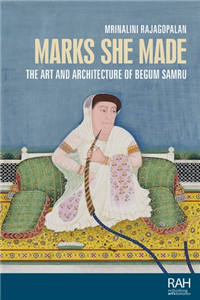
Begum Samru (b. circa 1750-d. 1836) was a north Indian woman ruler who used art and architecture to facilitate her social, political, and financial station in early modern India. Rising from the ranks of courtesans in Mughal Delhi to become the commander of her own mercenary army, she later became the ruler of an independent territory of Sardhana (60 km northwest of Delhi). The begum (Urdu/ Hindustani title for noblewoman) was a trusted ally to the Mughal emperor and the English East India Company, two of the dominant political powers in north India at the time. As a sovereign ruler, she corresponded with two popes and King Louis Philippe of France, exchanging portraits, architectural drawings, and letters with these powerful men in addition to her Mughal counterparts in India. Art and architecture played a key role in establishing Begum Samru as a powerful but non-threatening ruler; as an upholder and patron of the Catholic faith in India; as a political ally to several European and Indian factions that were vying for power; and as ruling matriarch of a cosmopolitan household, court, and army. In narrating the story of a single woman in nineteenth-century India, this book offers a path to think of the creative ways in which women participated in public and political spheres. It also illustrates how women without pedigree, women who did not bear biological children or produce male heirs, and women who lived in contravention of gendered norms found alternative methods of recognition, dignity, power, and sometimes, as in the case of Begum Samru, global visibility.
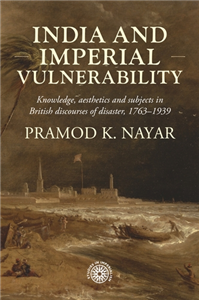
This study of famines, earthquakes and cyclones in British India, 1770-1934, moves from the aesthetics of representation through the knowledge cultures that sprang up around the disasters and finally the construction of the helpless native and the labouring Englishman. It studies the creation of imperial networks of knowledge acquisition, codification and training, as well as the employment of certain aesthetic modes when speaking of the land's disasters. It pays attention to the categorization of the disaster victims and the work of the Englishman in understanding and helping the native. The study shows how the disasters were shaped and were shaped by imperial discourses of knowledge and learning, aesthetics of fright and horror and the labouring English.
 Trusted Partner


— An extraordinary story of migration — Contemporary history of the 70s and backgrounds to India, Afghanistan, Iran, Turkey, Bulgaria, the former Yugoslavia, the GDR and the Federal Republic of Germany He was the son of the Sikh priest, a successful 400-meter runner and, eventually, a migrant. In 1979, Bagicha Singh turned his back on his homeland and set off with a head full of dreams on the long, turbulent overland journey from India to Germany. It was the year the Soviet Union invaded Afghanistan and the Islamic Revolution raged in Iran. A year whose aftermath continues to shape the world to this day. More than 40 years later, his daughter tells the story of Bagicha's adventurous journey. The result is a touching document on origin, contemporary history, and the meaning of migration.
Trusted Partner

Any reader who has ever visited Asia knows that the great bulk of Western-language fiction about Asian cultures turns on stereotypes. This book, a collection of essays, explores the problem of entering Asian societies through Western fiction, since this is the major port of entry for most school children, university students and most adults. In the thirteenth century, serious attempts were made to understand Asian literature for its own sake. Hau Kioou Choaan, a typical Chinese novel, was quite different from the wild and magical pseudo-Oriental tales. European perceptions of the Muslim world are centuries old, originating in medieval Christendom's encounter with Islam in the age of the Crusades. There is explicit and sustained criticism of medieval mores and values in Scott's novels set in the Middle Ages, and this is to be true of much English-language historical fiction of the nineteenth and early twentieth centuries. Even mediocre novels take on momentary importance because of the pervasive power of India. The awesome, remote and inaccessible Himalayas inevitably became for Western writers an idealised setting for novels of magic, romance and high adventure, and for travellers' tales that read like fiction. Chinese fictions flourish in many guises. Most contemporary Hong Kong fiction reinforced corrupt mandarins, barbaric punishments and heathens. Of the novels about Japan published after 1945, two may serve to frame a discussion of Japanese behaviour as it could be observed (or imagined) by prisoners of war: Black Fountains and Three Bamboos.
Trusted Partner
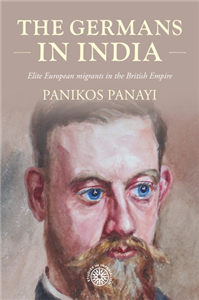
Based on years of research in libraries and archives in England, Germany, India and Switzerland, this book offers a new interpretation of global migration from the early nineteenth until the early twentieth century. Rather than focusing upon the mass transatlantic migration or the movement of Britons towards British colonies, it examines the elite German migrants who progressed to India, especially missionaries, scholars and scientists, businessmen and travellers. The story told here questions, for the first time, the concept of Europeans in India. Previous scholarship has ignored any national variations in the presence of white people in India, viewing them either as part of a ruling elite or, more recently, white subalterns. The German elites undermine these conceptions. They developed into distinct groups before 1914, especially in the missionary compound, but faced marginalisation and expulsion during the First World War.
Trusted Partner
Trusted Partner

This book, newly available in paperback, looks at India in the context of a globalized world. It starts by looking at the history of Indian civilization, exploring the roots of Indian identity and highlighting processes such as foreign invasions, foreign trade, cultural imperialism, colonial rule and the growth of Indian nationalism. The book examines the gradual democratization of Indian politics. Cultural and ethnic divisions in Indian society are examined in depth, as are the problems that have prevented economic development and stood in the way of economic liberalization. The history of India's integration into the global economy is considered, and the opportunities available to the country in the early years of the twenty-first century are detailed. The final chapters consider the Indian government's perception of the Indian diaspora, as well as the changing priorities reflected in India's foreign policy since 1947.
Trusted Partner
Trusted Partner
This book provides a powerful diagnosis of why the global governance of science struggles in the face of emerging powers. Through unpacking critical events in China and India over the past twenty years, it demonstrates that the 'subversiveness' assumed in the two countries' rise in the life sciences reflects many of the regulatory challenges that are shared worldwide. It points to a decolonial imperative for science governance to be responsive and effective in a cosmopolitan world. By highlighting epistemic injustice within contemporary science, the book extends theories of decolonisation.
Trusted Partner
Trusted Partner
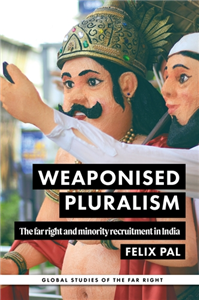
Weaponised pluralism takes a fine-grained lens to understand why far-right organisations recruit from the very minorities they oppose. Why do these organisations seek to appear like pluralists? Building on his time with the Muslim wing of the Hindu far-right in India, Felix Pal proposes that bigots can strategically use what he calls weaponised pluralism. This political strategy counterintuitively uses progressive political performances to bolster bigoted political agendas. Basing his analysis in an Indian context, Weaponised pluralism nonetheless reveals much about contexts as varied as Palestinian soldiers in the Israeli army, Indigenous Australians on far-right television, and Black congressional candidates in the American Republican Party. Drawing on rare access to the Hindu far-right and its Muslim wing, Pal paints an evocative picture of the complexities of how far-right organising extends far beyond the pointy end of traditional bigotry.
Trusted Partner
Both India and South Africa have shared the infamy of being labelled the world's 'rape capitals', with high levels of everyday gender-based and sexual violence. At the same time, both boast long histories of resisting such violence and its location in wider cultures of patriarchy, settler colonialism and class and caste privilege. Through the lens of the #MeToo moment, the book tracks histories of feminist organising in both countries, while also revealing how newer strategies extended or limited these struggles. Intimacy and injury is a timely mapping of a shifting political field around gender-based violence in the global south. In proposing comparative, interdisciplinary, ethnographically rich and analytically astute reflections on #MeToo, it provides new and potentially transformative directions to scholarly debates this book builds transnational feminist knowledge and solidarity in and across the global south.
Trusted Partner
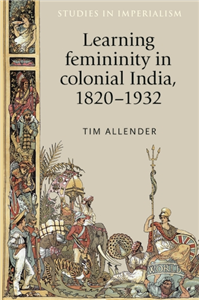
Learning femininity in colonial India explores the colonial mentalities that shaped and were shaped by women living in colonial India between 1820 and 1932. Using a broad framework the book examines the many life experiences of these women and how their position changed, both personally and professionally, over this long period of study. Drawing on a rich documentary record from archives in the United Kingdom, India, Pakistan, North America, Ireland and Australia this book builds a clear picture of the colonial-configured changes that influenced women interacting with the colonial state. This book will appeal to students and academics working on the history of empire and imperialism, gender studies, postcolonial studies and the history of education.
Trusted Partner

This book looks at India in the context of a globalized world. It starts by looking at the history of Indian civilization, exploring the roots of Indian identity and highlighting processes such as foreign invasions, foreign trade, cultural imperialism, colonial rule and the growth of Indian nationalism. The book examines the gradual democratization of Indian politics. Cultural and ethnic divisions in Indian society are examined in depth, as are the problems that have prevented economic development and stood in the way of economic liberalization. The history of India's integration into the global economy is considered, and the opportunities available to the country in the early years of the 21st century are detailed. The final chapters consider the Indian government's perception of the Indian diaspora, as well as the changing priorities reflected in India's foreign policy since 1947.
Trusted Partner
 Trusted Partner
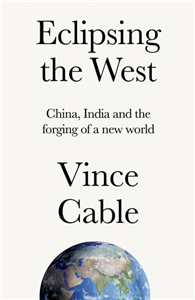
As the international order begins to crumble, this incisive book asks what the rise of the Asian superstates means for the future. The Western-dominated world we have known for the past three hundred years is coming to an end. As America withdraws from its role as enforcer of the international order, other countries are moving in to fill the void. Among them are two rising Asian 'superstates'. Accounting for almost half of the world's population, China and India have the potential to wield enormous economic and political power. China is already vying with the US for the top spot in the global economy, and on some measures has surpassed it. By the middle of the century India may be number two. How will these countries navigate their growing roles on the world stage? What are the implications for commerce, international law and the fight against climate change? Vince Cable has followed China and India for decades, first as a professional economist and later as a senior government minister. In Eclipsing the West he draws on the latest data and a lifetime of political and economic experience to offer a compelling account of what the rise of the Asian superstates means for the future.
Trusted Partner

This book examines the empire cinema made in Hollywood and Britain during the turbulent 1930s and 1940s.. It shows how the empire cinema constructed the colonial world, its rationale for doing so, and the manner in which such constructions were received by the colonized people.. Unique approach to the subject cinema and Empire from the perspective of the colonised rather than the coloniser.. Vast amount of original research conducted in India contributing to a fresh perspective.. Multifocal attitude which stretches through media and cultural studies, gender, film, imperial history, nationalism and postcolonialism. ;
Trusted Partner
Imperialist discourse interacted with regional and class discourses. Imperialism's incorporation of Welsh, Scots and Irish identities, was both necessary to its own success and one of its most powerful functions in terms of the control of British society. Most cultures have a place for the concept of heroism, and for the heroic figure in narrative fiction; stage heroes are part of the drama's definition of self, the exploration and understanding of personal identity. Theatrical and quasi-theatrical presentations, whether in music hall, clubroom, Shakespeare Memorial Theatre or the streets and ceremonial spaces of the capital, contributed to that much-discussed national mood. This book examines the theatre as the locus for nineteenth century discourses of power and the use of stereotype in productions of the Shakespearean history canon. It discusses the development of the working class and naval hero myth of Jack Tar, the portrayal of Ireland and the Irish, and the portrayal of British India on the spectacular exhibition stage. The racial implications of the ubiquitous black-face minstrelsy are focused upon. The ideology cluster which made up the imperial mindset had the capacity to re-arrange and re-interpret history and to influence the portrayal of the tragic or comic potential of personal dilemmas. Though the British may have prided themselves on having preceded America in the abolition of slavery and thus outpacing Brother Jonathan in humanitarian philanthropy, abnegation of hierarchisation and the acceptance of equality of status between black and white ethnic groups was not part of that achievement.
Trusted Partner
Law across imperial borders offers new perspectives on the complex legal connections between Britain's presence in Western China in the western frontier regions of Yunnan and Xinjiang, and the British colonies of Burma and India. Bringing together a transnational methodology with a social-legal focus, it demonstrates how inter-Asian mobility across frontiers shaped British authority in contested frontier regions of China. It examines the role of a range of actors who helped create, constitute and contest legal practice on the frontier-including consuls, indigenous elites and cultural mediators. The book will be of interest to historians of China, the British Empire in Asia and legal history.
Trusted Partner
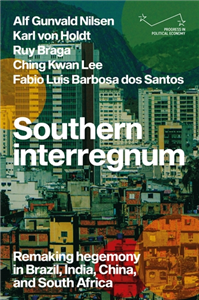
How do governing elites in the global South attempt to remake hegemony in a conjuncture of durable crisis? This is the question at the core of Southern interregnum, a comparative conjunctural analysis of hegemonic projects in Brazil, India, China, and South Africa. Working with a Gramscian notion of crisis, centred on the interregnum as an enduring period of instability and uncertainty, in which hegemonic authority erodes and competing projects for crisis resolution emerge, the book proposes a novel critical reading of the convulsions that are currently reshaping the political economy of the global South and the world-system. Mapping the variegated trajectories of elite projects to reconcile accumulation and legitimation - and probing the limits of these projects - the book breaks new ground in the study of the contemporary global South.



